Motorized Bicycle Laws in Louisiana depend on whether your ride is a true electric-assisted bicycle, a pedal-equipped motorized bicycle, or a motor-driven cycle such as a small scooter. Louisiana now has a real three-class e-bike statute, but the older motorized-bicycle rules still matter for gas-helper or pedal-moped style builds.
Note: This Louisiana guide is based on current Louisiana statutes and Louisiana OMV policy material. It is informational only and not legal advice.
Last reviewed / source-checked: 2026-03-15
Local rule note: Parish, municipal, and state agencies can still regulate trail and path access, especially for class 3 e-bikes and natural-surface nonmotorized trails.
Louisiana treats compliant e-bikes, pedal mopeds, and small scooters differently, so the first step is identifying the vehicle category correctly.
Motorized Bicycle Laws in Louisiana: quick answer
Electric-assisted bicycle: Louisiana defines this as a bicycle with fully operable pedals, a motor under 750 watts, and class 1, 2, or 3 performance.
E-bike access: Louisiana generally lets electric-assisted bicycles ride where bicycles are allowed, including streets, highways, roadways, bicycle facilities, bicycle lanes, shared-use trails, bicycle paths, and trails, subject to local restrictions and the natural-surface trail exception.
Class 3 rule: No rider under 12 may operate a class 3 e-bike, all operators and passengers on a class 3 e-bike must wear an approved bicycle helmet, and class 3 bikes must have a speedometer.
Motorized bicycle: Louisiana defines this as a pedal bicycle with a helper motor rated at no more than 1.5 horsepower, no more than 50cc, an automatic transmission, and a maximum design speed of no more than 25 mph on a flat surface, excluding electric-assisted bicycles.
Motorized bicycle rider rule: A Louisiana motorized bicycle may only be operated on the roadway by a person age 15 or older who has a valid Louisiana driver's license.
Where you cannot ride a motorized bicycle: Louisiana bars motorized bicycles from sidewalks and interstate highways.
Helmet rule for motorized bicycles: Louisiana requires a motorcycle-style safety helmet for anyone operating or riding on a motorized bicycle, motorcycle, or motor-driven cycle.
Paperwork caveat: Louisiana OMV publishes a dedicated policy section for “Mopeds or Motorized Bicycles,” but because the linked policy document did not yield clean machine-readable text during this review, this draft avoids a hard title, plate, or insurance checklist and recommends verifying paperwork directly with OMV before street use.
How Louisiana splits e-bikes, motorized bicycles, and small scooters
Louisiana is easier to follow once you stop treating every powered bike as the same thing.
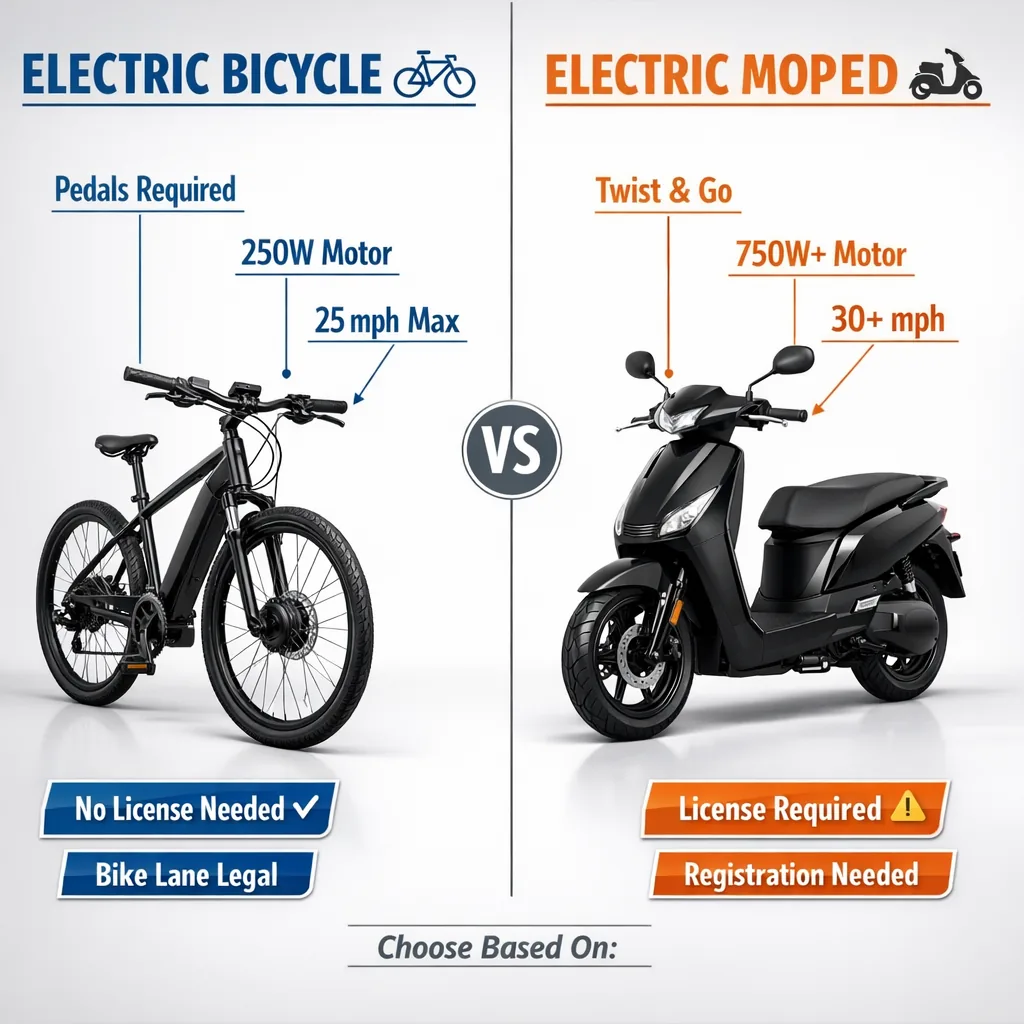
Electric-assisted bicycle: bicycle-style vehicle with pedals, under-750W motor, and class 1, 2, or 3 setup.
Motorized bicycle: pedal bicycle with a helper motor up to 1.5 horsepower, up to 50cc, automatic transmission, and a 25 mph design-speed ceiling.
Motor-driven cycle: motorcycle category that includes a motor scooter with a motor not over 5 horsepower.
That is the core of Motorized Bicycle Laws in Louisiana: if your machine still fits the modern e-bike definition, the rules are much closer to bicycle law. If it falls into the older motorized-bicycle lane, or further into the motor-driven-cycle lane, the licensing and roadway rules get stricter.
Louisiana does not put e-bikes and pedal mopeds in the same legal bucket, even when both look small and neighborhood-friendly.
Motorized Bicycle Laws in Louisiana for electric-assisted bicycles
Louisiana added a real three-class e-bike system in 2020. That changed the older “just treat it like a moped” assumption that still appears on a lot of outdated pages.
Louisiana uses a true class 1, 2, and 3 framework
Class 1: pedal-assist only, with assistance stopping at 20 mph.
Class 2: throttle-capable, with assistance stopping at 20 mph.
Class 3: pedal-assist only, with assistance stopping at 28 mph.
Louisiana also requires a permanent label showing the classification number, top-assisted speed, and motor wattage.
Louisiana gives e-bikes bicycle-style rights by default
Under La. R.S. 32:204, an electric-assisted bicycle and its operator get the same general rights and duties as a bicycle and bicycle rider. The statute also says an electric-assisted bicycle may be ridden where bicycles are allowed, including streets, highways, roadways, bicycle facilities, bicycle lanes, shared-use trails, bicycle paths, and trails.
Local authorities can still tighten access rules
Louisiana does not make every trail permanently open. Local municipal authorities, parish authorities, and state agencies with jurisdiction can restrict class 1 and class 2 e-bikes on shared-use trails or bicycle paths after notice and public hearing when safety or legal compliance requires it. Those same authorities may prohibit class 3 e-bikes on those paths or trails.
Natural-surface nonmotorized trails are a special case
If a trail is specifically designated as nonmotorized and has a natural surface tread made by clearing and grading native soil with no added surface material, Louisiana's broad default-access rule does not control that trail. The authority in charge may regulate e-bike use there separately.
Class 3 e-bikes get extra age, helmet, and equipment rules
Louisiana sets three important class 3 rules:
Minimum operator age: no rider under 12 may operate a class 3 e-bike.
Helmet rule: all operators and passengers on a class 3 e-bike must wear an approved bicycle helmet.
Speedometer: every class 3 e-bike must be equipped with a speedometer that displays speed in miles per hour.
Motorized Bicycle Laws in Louisiana for pedal mopeds
Louisiana still keeps a distinct motorized-bicycle lane for pedal-equipped helper-motor machines. This category is not the same as the e-bike category.
Louisiana's motorized-bicycle definition is narrow
A Louisiana motorized bicycle must be a pedal bicycle that may be propelled by human power, helper motor, or both, with these limits:
no more than 1.5 horsepower,
no more than 50cc,
automatic transmission,
maximum design speed of no more than 25 mph on a flat surface.
If your build exceeds those limits, drops the pedals, or stops qualifying under the motorized-bicycle definition, do not assume Louisiana will still treat it as a simple pedal moped.
Louisiana requires both age and a valid driver's license
La. R.S. 32:198 says a motorized bicycle may only be operated on the roadway of Louisiana highways by a person who is 15 years of age or older and who has a valid Louisiana driver's license.
Motorized bicycles stay off sidewalks and interstate highways
The same statute bars Louisiana motorized bicycles from sidewalks and interstate highways. That is one of the cleanest practical takeaways for everyday riding.
Helmet use is mandatory on motorized bicycles
Louisiana's helmet statute applies to anyone operating or riding on a motorcycle, motor-driven cycle, or motorized bicycle. If you are on the motorized-bicycle side of the line instead of the e-bike side, plan on a motorcycle-style safety helmet every time.
Louisiana paperwork needs an OMV double-check
Louisiana OMV publicly maintains a vehicle-registration policy section titled “Mopeds or Motorized Bicycles”. However, because the linked policy document did not yield clean machine-readable text during this review, this draft does not make a hard claim about title, plate, or insurance steps beyond noting that riders should verify those items directly with OMV before relying on a seller summary.
Louisiana is more trail-friendly for compliant e-bikes than for motorized bicycles, but local agencies still control a lot of the final access answer.
What Louisiana gets right and what confuses riders
Louisiana now has a modern three-class e-bike statute instead of forcing every powered bicycle into an older moped definition.
Louisiana keeps a separate pedal-motorized-bicycle category capped at 1.5 horsepower, 50cc, automatic transmission, and 25 mph.
Louisiana's motorized-bicycle statute is unusually clear that riders must be 15+ and have a valid Louisiana driver's license.
Louisiana requires helmets for all motorized-bicycle riders and passengers, while its e-bike helmet rule is targeted specifically at class 3 operators and passengers.
Louisiana lets local trail authorities make more specific access calls, especially for class 3 e-bikes and natural-surface nonmotorized trails.
Louisiana separately defines motor-driven cycles up to 5 horsepower, which is why some small scooters do not belong in the simple motorized-bicycle lane.
Common rider situations under Motorized Bicycle Laws in Louisiana
If you ride a class 1 or class 2 e-bike around town
You are usually in Louisiana's electric-assisted-bicycle lane, not its older motorized-bicycle lane. That means the bicycle-style rights and duties rule is your starting point, along with any local trail or path restrictions.
If you want a faster class 3 commuter e-bike
Louisiana allows class 3 e-bikes, but the rider must be at least 12, everyone on the bike must wear an approved bicycle helmet, the bike needs a speedometer, and the local authority in charge of a shared-use trail or bicycle path may prohibit class 3 use there.
If your bike has pedals and a small gas helper motor
If it stays under 1.5 horsepower, 50cc, automatic transmission, and 25 mph, Louisiana may treat it as a motorized bicycle. In that case, the rider must be 15 or older, have a valid Louisiana driver's license, stay on the roadway, and stay off sidewalks and interstates.
If your scooter has no pedals or pushes above the motorized-bicycle limits
Do not assume it is still a motorized bicycle. Louisiana separately defines motor-driven cycles and motorcycles, and that different classification can change the licensing, equipment, and road-use answer.
Official Louisiana sources
La. R.S. 32:1 — definitions for bicycle and electric-assisted bicycle
To provide the best experiences, we use technologies like cookies to store and/or access device information. Consenting to these technologies will allow us to process data such as browsing behavior or unique IDs on this site. Not consenting or withdrawing consent, may adversely affect certain features and functions.
Functional
Always active
The technical storage or access is strictly necessary for the legitimate purpose of enabling the use of a specific service explicitly requested by the subscriber or user, or for the sole purpose of carrying out the transmission of a communication over an electronic communications network.
Preferences
The technical storage or access is necessary for the legitimate purpose of storing preferences that are not requested by the subscriber or user.
Statistics
The technical storage or access that is used exclusively for statistical purposes.The technical storage or access that is used exclusively for anonymous statistical purposes. Without a subpoena, voluntary compliance on the part of your Internet Service Provider, or additional records from a third party, information stored or retrieved for this purpose alone cannot usually be used to identify you.
Marketing
The technical storage or access is required to create user profiles to send advertising, or to track the user on a website or across several websites for similar marketing purposes.