Motorized Bicycle Laws in Oklahoma make the most sense when you split the state into three different lanes: electric-assisted bicycles, motorized bicycles / mopeds, and the separate motor-driven cycle or motorcycle lane. Oklahoma uses one set of rules for class 1, class 2, and class 3 e-bikes, and another for combustion-engine motorized bicycles that can reach up to 35 mph.
Note: This Oklahoma guide is based on current Oklahoma statutes and current Service Oklahoma pages linked below. It is informational only and not legal advice.
Last reviewed / source-checked: 2026-03-16
Local caveat: Cities, campuses, parks, trails, and private property can impose narrower operating rules than the statewide baseline.
In Oklahoma, the first legal question is which category your motorized bike actually fits.
Motorized Bicycle Laws in Oklahoma: quick answer
Motorized bicycle definition: Oklahoma defines a motorized bicycle as a bicycle with fully operative pedals, a direct or automatic power drive system, a combustion engine of 80 cc or less, and a maximum design speed of 35 mph or less on level ground.
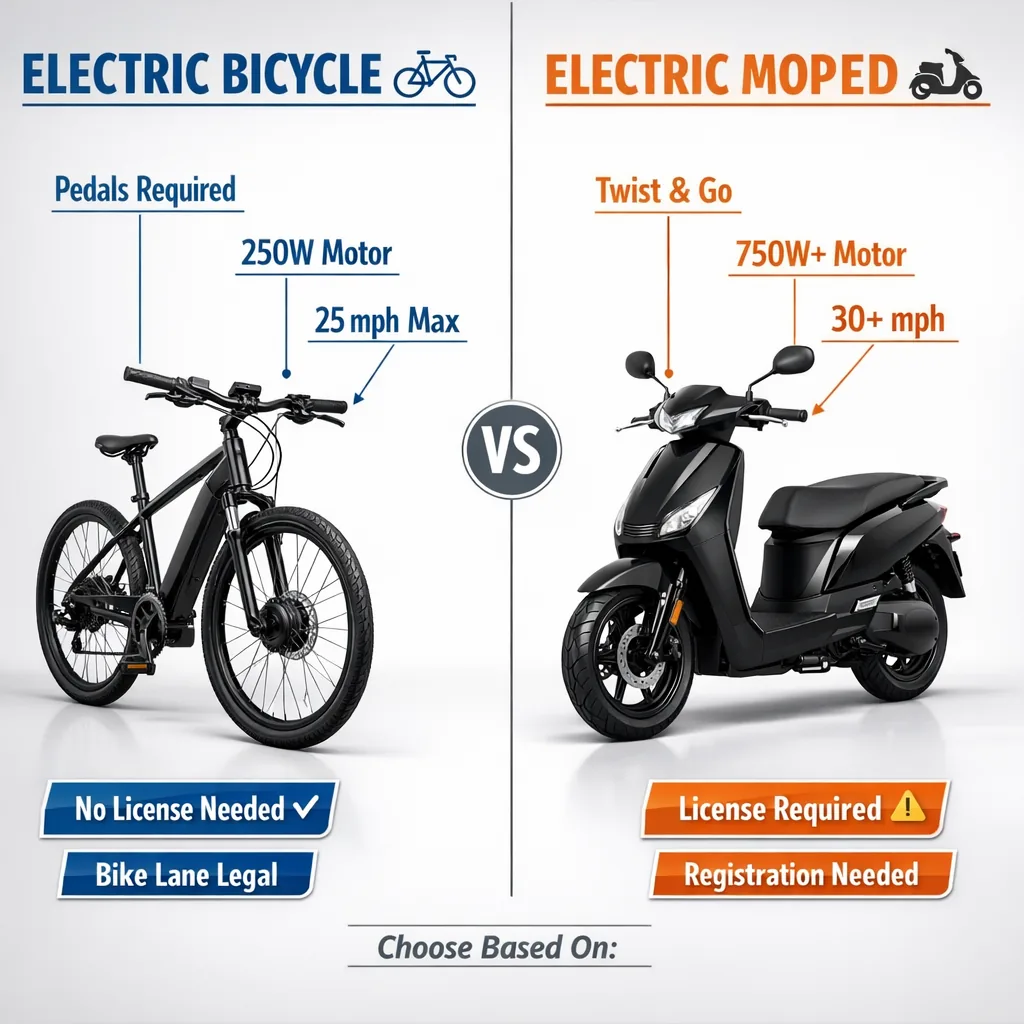
Electric-assisted bicycle definition: Oklahoma separately defines class 1, class 2, and class 3 electric-assisted bicycles with a motor of no more than 750 watts.
Moped title / registration: Service Oklahoma lists mopeds as requiring both title and registration.
Motor-driven cycle trigger: Oklahoma separately defines a motor-driven cycle as a vehicle above the motorized-bicycle engine range or, if electric, under 1,000 watts with a seat or saddle and up to three wheels.
License caution: Oklahoma's official motorcycle pages clearly cover motorcycle and motor-driven-cycle permits and endorsements. Before riding a moped-style build on public roads, verify the current licensing requirement with Service Oklahoma.
Why Oklahoma is different: Oklahoma's motorized-bicycle definition uses 80 cc and 35 mph, which is broader than many riders expect.
Motorized Bicycle Laws in Oklahoma: the split that matters first
Oklahoma does not lump every powered two-wheeler into one bucket. The state uses a real legal split between electric-assisted bicycles, motorized bicycles, and motor-driven cycles. That distinction matters because the right answer changes fast once a build falls out of one definition and into another.
Electric-assisted bicycle: pedal-capable bike, 750-watt max motor, and one of Oklahoma's class 1, class 2, or class 3 definitions.
Motorized bicycle: pedal-capable bicycle, automatic or direct drive system, combustion engine of 80 cc or less, and a max design speed of 35 mph or less.
Motor-driven cycle: a separate motor-vehicle lane for combustion engines above 35 cc but below 150 cc, or certain electric vehicles below 1,000 watts with a seat or saddle and up to three wheels.
That is the center of Motorized Bicycle Laws in Oklahoma. If you skip the classification step, almost every later answer can go sideways.
Motorized Bicycle Laws in Oklahoma for electric-assisted bicycles
Oklahoma gives electric-assisted bicycles a modern three-class structure instead of treating every e-bike as a disguised moped.
Class 1: assistance only while pedaling, with assistance ending at 20 mph.
Class 2: the motor can propel the bicycle without pedaling, but assistance cannot continue once the bicycle reaches 20 mph.
Class 3: pedal-assist only, with assistance ending at 28 mph.
The same statute caps the motor at 750 watts and requires fully operative pedals. That means a bike that drifts above the wattage ceiling or loses the pedal-capable structure should not automatically be treated as an Oklahoma e-bike just because it still looks bicycle-shaped.
Once you confirm that your bike fits Oklahoma's electric-assisted bicycle definition, still check the local rule set for trails, sidewalks, campuses, greenways, and park property.
Oklahoma separates electric-assisted bicycles from combustion-engine motorized bicycles, and that split matters more than the generic word “moped.”
Motorized Bicycle Laws in Oklahoma for mopeds and motorized bicycles
Oklahoma defines a motorized bicycle more broadly than many riders expect. The controlling rule in the statute is not 50 cc and 30 mph. It is the definition below.
Pedals: fully operative pedals are required.
Drive system: the power drive must function directly or automatically without clutching or shifting by the operator after engagement.
Engine size: up to 80 cc.
Top design speed: not more than 35 mph on level ground.
That means a gas bike with fully operative pedals, automatic or direct drive, no more than 80 cc, and no more than 35 mph on level ground can still fit Oklahoma's motorized-bicycle lane.
Service Oklahoma's vehicle pages also matter here. The agency's Motorcycles, Trailers, & More page lists mopeds as requiring both title and registration. That is the clearest official administrative signal in the reviewed sources for the moped lane.
When a bike stops being a motorized bicycle in Oklahoma
Oklahoma also uses a separate motor-driven cycle definition. That category catches vehicles that are no longer in the motorized-bicycle lane, but still are not being described as full-size motorcycles.
Combustion example: more than 35 cc but less than 150 cc moves into the motor-driven-cycle definition.
Electric example: a seated electric vehicle under 1,000 watts can fall into this separate lane even if it is not a compliant 750-watt electric-assisted bicycle.
That distinction matters because Oklahoma's official motorcycle permit and endorsement resources apply to the motorcycle and motor-driven-cycle lane. If your build sits near the line between categories, treat it as a Service Oklahoma verification issue before riding on public roads.
Once an Oklahoma build leaves the e-bike or motorized-bicycle definition and enters the motorcycle or motor-driven-cycle lane, separate permit, endorsement, and safety resources matter.
What is different in Oklahoma?
Oklahoma's motorized-bicycle statute uses an 80 cc / 35 mph definition.
Oklahoma gives electric-assisted bicycles their own class 1 / 2 / 3 framework instead of forcing every e-bike into the moped lane.
Oklahoma separately defines a motor-driven cycle, so there is an extra legal threshold between bicycle-style machines and the broader motorcycle lane.
Service Oklahoma explicitly lists mopeds as title-and-registration vehicles.
Local access rules can still tighten what is allowed on trails, campuses, sidewalks, and park property.
Common rider situations under Motorized Bicycle Laws in Oklahoma
Scenario 1: You bought a 750-watt pedal bike with class labels from the manufacturer
That usually points toward Oklahoma's electric-assisted bicycle lane, not the combustion-engine motorized-bicycle lane. Your first job is to confirm the bike really fits the 750-watt and class 1, 2, or 3 definition, then check local access rules for where you plan to ride.
Scenario 2: You built a gas bike with pedals and an automatic or direct drive under 80 cc
Now you are in the Oklahoma motorized bicycle conversation. Service Oklahoma still treats mopeds as title-and-registration vehicles, so this is not just a casual bicycle question.
Scenario 3: Your combustion build is above 35 cc and starts approaching motorcycle-style hardware
That should trigger a closer look at Oklahoma's motor-driven cycle definition. Once you leave the lighter motorized-bicycle lane, it is safer to verify endorsement and operating requirements directly with Service Oklahoma.
Scenario 4: Your electric build is stronger than a normal e-bike but does not feel like a full motorcycle
Do not assume Oklahoma will still treat it as an electric-assisted bicycle. The statute caps the e-bike lane at 750 watts, while the separate motor-driven-cycle definition reaches certain electric vehicles under 1,000 watts. That is exactly the kind of edge case where riders should verify the category before riding on public roads.
This page is for general informational purposes only and is not legal advice. Oklahoma statutes, Service Oklahoma procedures, and local rules can change. Verify the current classification and operating requirements before riding on public roads, trails, campuses, sidewalks, or other public spaces.
Warranty Protection
Have a problem? Bike repairs and replacement parts are covered through our manufacturer warranty for up to two years after purchase.
Verified Secure Checkout
Your information is kept 100% protected and private. Payments are handled through trusted third-party providers and never stored on our servers.
To provide the best experiences, we use technologies like cookies to store and/or access device information. Consenting to these technologies will allow us to process data such as browsing behavior or unique IDs on this site. Not consenting or withdrawing consent, may adversely affect certain features and functions.
Functional
Always active
The technical storage or access is strictly necessary for the legitimate purpose of enabling the use of a specific service explicitly requested by the subscriber or user, or for the sole purpose of carrying out the transmission of a communication over an electronic communications network.
Preferences
The technical storage or access is necessary for the legitimate purpose of storing preferences that are not requested by the subscriber or user.
Statistics
The technical storage or access that is used exclusively for statistical purposes.The technical storage or access that is used exclusively for anonymous statistical purposes. Without a subpoena, voluntary compliance on the part of your Internet Service Provider, or additional records from a third party, information stored or retrieved for this purpose alone cannot usually be used to identify you.
Marketing
The technical storage or access is required to create user profiles to send advertising, or to track the user on a website or across several websites for similar marketing purposes.