Motorized Bicycle Laws in South Dakota are easiest to understand when you split the state into two lanes: electric bicycles and mopeds. South Dakota now has a real class 1, class 2, and class 3 e-bike statute, while true mopeds stay in a separate lane with their own license, under-18 helmet, eye-protection, passenger, and equipment rules.
Note: This South Dakota guide is based on current South Dakota Codified Laws and current South Dakota Department of Revenue guidance linked below. It is informational only and not legal advice.
Last reviewed / source-checked: 2026-03-16
South Dakota caution: Older summaries often blur mopeds, motorcycles, and e-bikes together. Current South Dakota law does not. The state expressly excludes electric bicycles from the moped definition, and class 3 e-bikes have their own age, helmet, path, and speedometer rules.
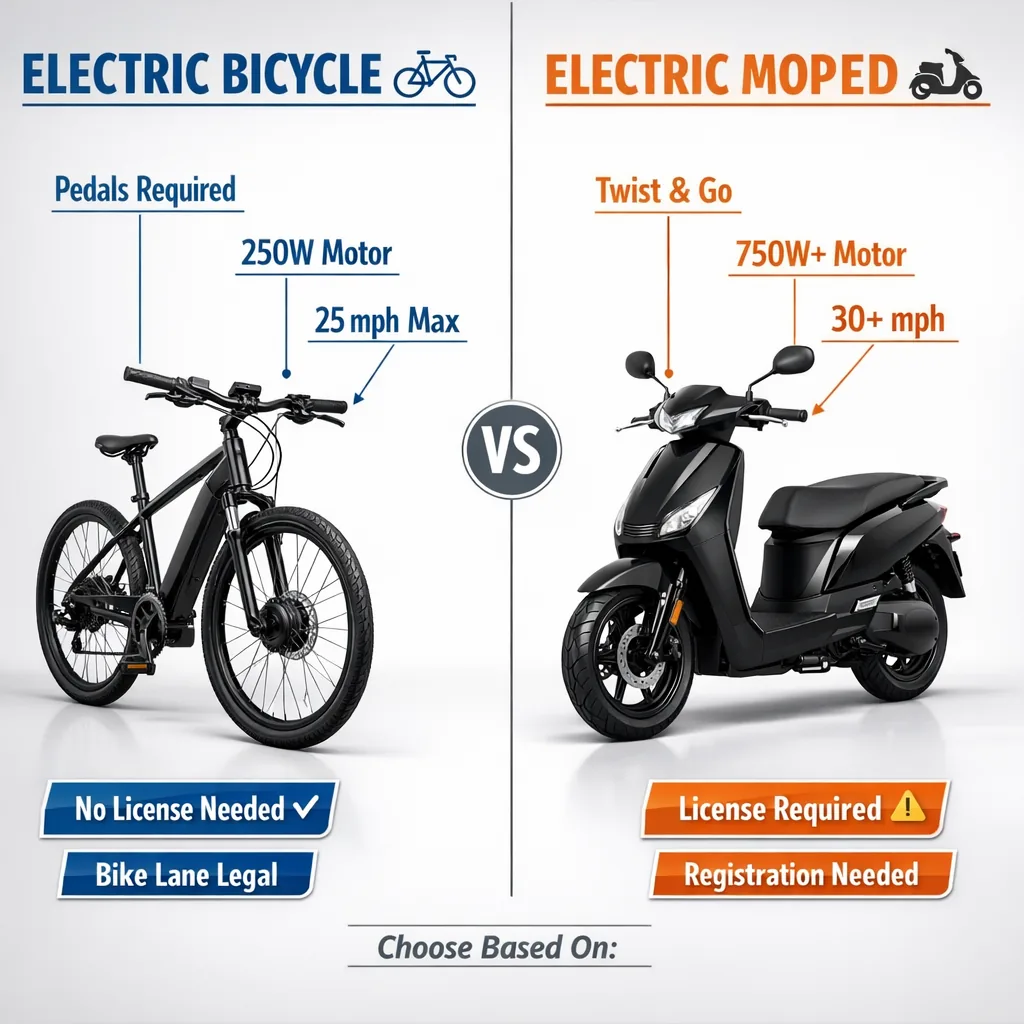
South Dakota draws a cleaner legal line than many quick summary pages suggest.
That split is the center of Motorized Bicycle Laws in South Dakota. South Dakota explicitly says an electric bicycle is not a moped, which means you should not assume every small powered two-wheeler is automatically in the same paperwork or riding lane.
South Dakota does not stop at a generic “e-bike” label. The state gives you distinct class 1, class 2, and class 3 definitions, and those class differences matter for age, helmets, speedometer rules, and path access.
This is one of the strongest South Dakota differentiators. Section 32-20-1 says the terms moped and motorcycle do not include an electric bicycle as defined in section 32-20B-9. That means a compliant 750-watt e-bike is not supposed to be analyzed through the same legal lane as a gasoline moped.
Section 32-20B-12 says a class 1 or class 2 e-bike may be operated on any bicycle path or multi-use path in South Dakota unless a governmental entity with jurisdiction says otherwise. For many South Dakota riders, that makes class 1 and class 2 the simplest legal choice for everyday mixed street-and-path riding.
A class 3 e-bike may not use a bicycle path or multi-use path unless the path is within or adjacent to a highway or roadway, or the governmental entity in charge expressly permits the use. South Dakota also says a class 3 e-bike may be used on a designated nonmotorized trail built by clearing or grading native soil without added surface material if the jurisdiction has not otherwise prohibited or restricted the operation.
South Dakota requires a class 3 operator to be at least 16 years old. It also requires a properly fitted and fastened bicycle helmet for any class 3 operator under 18 and for any passenger on a class 3 e-bike regardless of age. On top of that, section 32-20B-15 requires every class 3 e-bike to have a functioning speedometer.
Manufacturers and distributors must permanently label an electric bicycle with the class, maximum assisted speed, and motor wattage. If a person modifies the bike in a way that changes maximum speed or propulsion behavior, the label must be updated. Section 32-20B-11 also says the electric motor must disengage when the rider stops pedaling or when the brakes are applied.
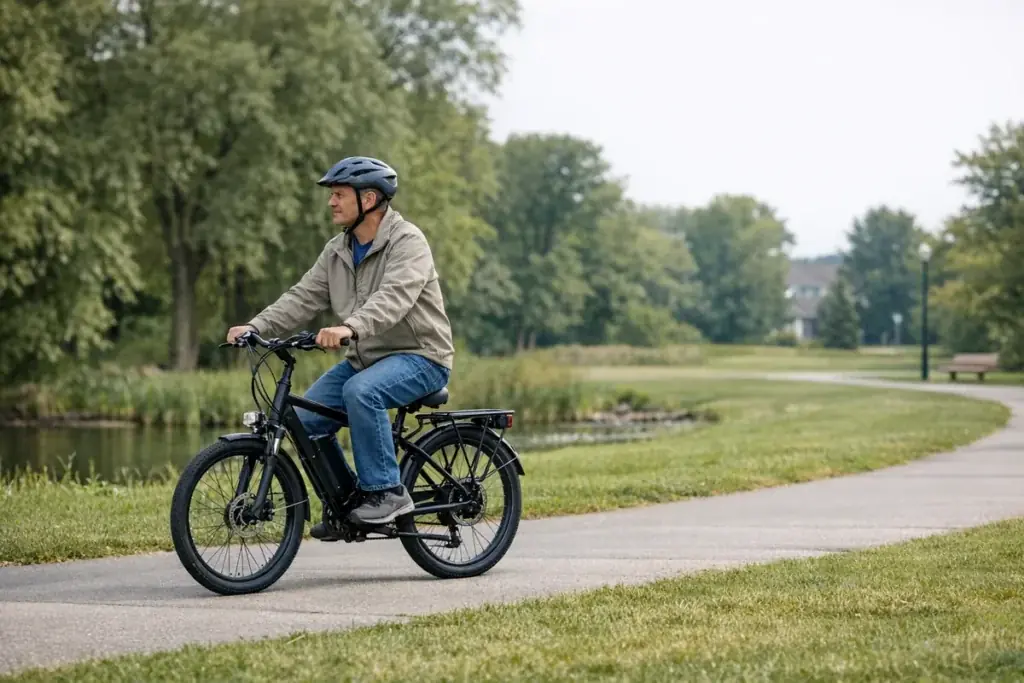
A South Dakota moped is not just “anything small with a motor.” The statute focuses on wheel count, a 50cc combustion cap when combustion power is used, and an automatic or direct power drive that does not require clutching or shifting after the system is engaged.
Section 32-20-2 says an operator of a moped on public streets or highways must have a valid motor vehicle driver license or permit. South Dakota carves mopeds out of the motorcycle-testing requirement, but it does not make the moped lane license-free.
South Dakota's under-18 helmet statute is written for motorcycles, but that matters here because the South Dakota motorcycle definition includes mopeds. The result is practical and direct: a person under 18 operating or riding on a moped on public streets or highways must wear a DOT-compliant protective helmet.
Section 32-20-4.1 requires motorcycle operators to wear an eye protective device unless the vehicle has a sufficient windscreen. Because South Dakota's motorcycle definition includes mopeds, that rule matters for moped riders too. Section 32-20-6.1 also says the operator must ride on a permanent regular seat, and a passenger is only allowed if the machine is designed to carry more than one person.
The reviewed statutory and agency sources were much clearer on moped licensing and riding rules than on a simple one-line registration answer for every under-50cc moped. The South Dakota Department of Revenue motorcycle page is framed for motorcycles, motorbikes, mopeds 51cc or larger, and bicycles with a motor attached. Because of that, the safest reading is this: do not assume every true small moped is automatically title-free or automatically handled exactly like a motorcycle. If paperwork matters for your build, confirm the current county-treasurer workflow before you buy or ride.
If it has operable pedals and really fits class 1, class 2, or class 3 under section 32-20B-9, you are likely in South Dakota's electric-bicycle lane instead of the moped lane. That means the path, age, and helmet answers will turn mainly on the class rather than on gasoline-style moped rules.
Class 1 and class 2 usually have the easiest answer because South Dakota allows them there unless the local jurisdiction says no. Class 3 is more restricted and needs either adjacency to a roadway or express permission from the jurisdiction in charge.
That does not fit the current South Dakota rule. A person must be at least 16 to operate a class 3 e-bike, though a younger passenger may ride if the bike is designed to carry a passenger.
Do not assume it gets the same treatment as an e-bike. South Dakota still requires a valid driver license or permit for public-street use, and under-18 riders must wear a helmet. Eye protection and passenger-design rules also matter.
You should not rely on this moped lane at all. South Dakota's reviewed Department of Revenue guidance specifically frames its title-and-registration process around motorcycles, motorbikes, mopeds 51cc or larger, and bicycles with a motor attached, which is a strong signal that bigger builds belong in a different compliance lane.
South Dakota gives important baseline rules for e-bikes, but local governments still control whether a specific bicycle path, multi-use path, or sidewalk area is open to a given class. Before riding on a city trail, shared-use path, campus route, or park trail, check the posted local rule instead of assuming the statewide default is the final answer everywhere.
This page is for general informational purposes only and is not legal advice. South Dakota statutes, Department of Revenue procedures, county-treasurer workflows, and local path rules can change. Verify the current rules before riding any e-bike, moped, scooter, or motorcycle on public roads, bicycle paths, trails, sidewalks, or other public property.