Choosing between a front wheel vs rear wheel ebike conversion kit usually comes down to fit, traction, installation difficulty, and how you want the bike to feel after the upgrade. Front hub kits are often simpler to install and can work well for lighter riding, while rear hub kits usually feel more natural and handle power better, especially if you ride hills, carry cargo, or want stronger acceleration.
Quick answer: Pick a front wheel ebike conversion kit if you want the easiest installation on a compatible bike and plan to ride mostly flat pavement. Pick a rear wheel ebike conversion kit if you want better traction, a more familiar ride feel, and a setup that can better handle moderate power or heavier loads.
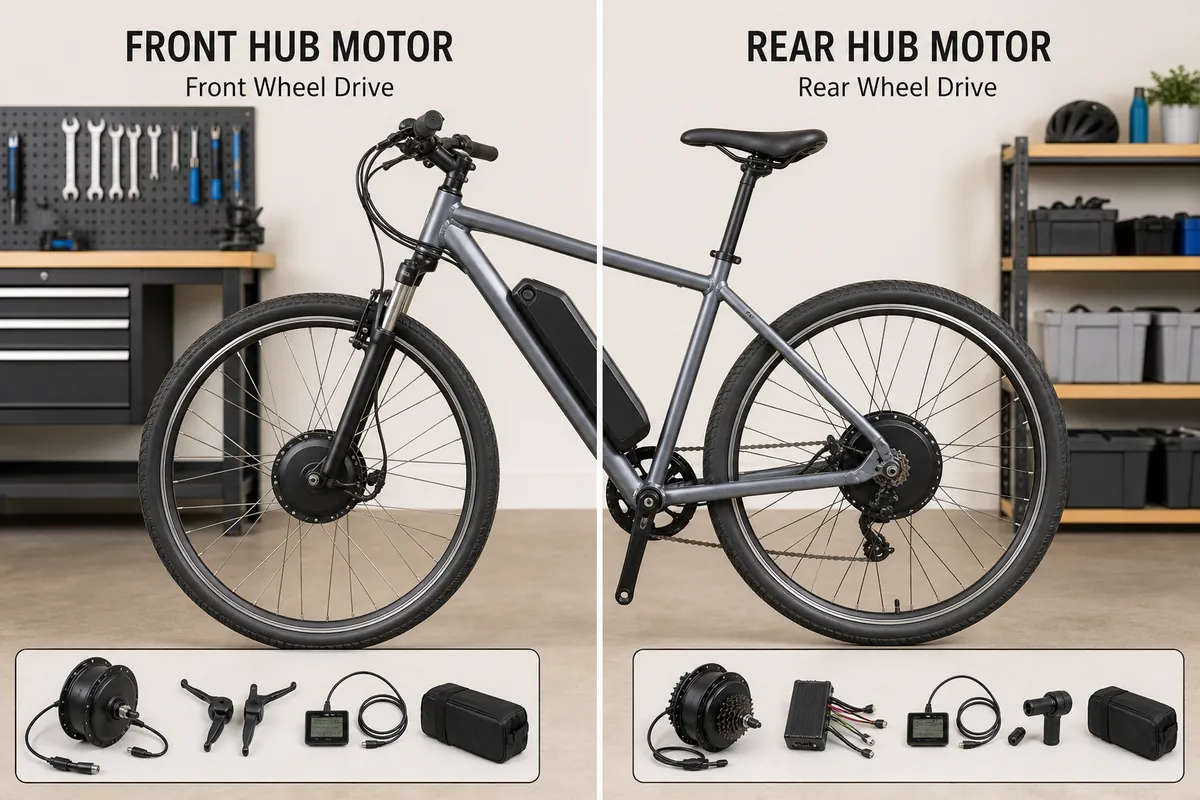
A front wheel conversion kit replaces the bike's front wheel with a motorized hub wheel. The original rear drivetrain stays mostly untouched, which is why front kits are popular with first-time DIY builders. If the fork, brakes, wheel size, axle spacing, and tire clearance all match, the mechanical side can be relatively direct.
A rear wheel conversion kit replaces the rear wheel instead. That means the motor pushes from the back of the bike, closer to how most riders expect power to feel. The tradeoff is that rear kits involve the drivetrain side of the bike: freewheel or cassette compatibility, derailleur clearance, chainline, axle hardware, and sometimes more patience during installation.
If you are still comparing motor layouts more broadly, MBHQ's guide to electric bike motors explained is a useful companion. For this article, though, the focus is hub conversion kits: front hub versus rear hub.
Decision shortcut: Front hub kits win on simplicity. Rear hub kits win on traction and ride feel. The right answer is not the one with the biggest watt number; it is the one your bike can safely accept.
| Factor | Front wheel kit | Rear wheel kit |
|---|---|---|
| Installation difficulty | Usually easier, because it avoids the rear drivetrain | More involved, because cassette/freewheel and derailleur fit matter |
| Ride feel | Can feel like the bike is being pulled from the front | Usually feels more natural, like power from the rear wheel |
| Traction | Weaker on loose, wet, or uphill surfaces because less rider weight sits over the front wheel | Better in most conditions because rider weight loads the rear tire |
| Best use case | Flat pavement, casual riding, simple commuter conversions | Hills, cargo, stronger acceleration, heavier riders, daily use |
| Compatibility risks | Fork strength, fork material, axle fit, brake alignment | Dropout spacing, gear compatibility, derailleur clearance, brake alignment |
| Typical recommendation | Best for simple low-to-moderate power builds on suitable forks | Best all-around choice when installation compatibility checks out |
A front wheel kit is the practical choice when you want a simpler conversion and your bike's front fork is a good match. Because the motorized wheel goes up front, you usually avoid messing with the cassette, freewheel, chain, derailleur, and rear axle hardware. That is a real advantage if you want the project to stay approachable.
Front hub kits can work well for flat neighborhoods, paved paths, short errands, and relaxed commuting. They also pair nicely with bikes where the rear wheel is awkward to modify, such as some internally geared or coaster-brake setups, though brake compatibility still needs careful checking.
The catch is traction. A bicycle naturally carries more rider weight over the rear wheel, especially when climbing or accelerating. Put the motor in the front and you may notice the tire slips more easily on gravel, wet paint, leaves, steep ramps, or loose shoulders. That does not make front kits bad, but it does mean they are best kept modest and matched to the surface.
A rear wheel conversion kit is usually the better choice if you want the bike to feel more settled under power. Since the motor drives the rear wheel, acceleration tends to feel more familiar. The rear tire also has more weight pressing it into the ground, which helps with traction when climbing, starting from a stop, or carrying extra gear.
That makes rear hub kits a stronger fit for commuters, heavier riders, rolling terrain, cargo racks, trailers, and riders who expect the converted bike to replace car trips more often. If you are already thinking about load and utility, MBHQ's explainer on e-bike cargo capacity can help you think beyond the motor alone.
The installation is the price you pay. Rear kits demand closer compatibility checks: wheel size, dropout spacing, brake type, axle dimensions, cassette or freewheel style, derailleur clearance, and the way the battery and controller wiring will route around the frame. For many riders, that extra work is worth it. For a quick first build, it can be the part that slows everything down.
Practical check: Before buying either kit, confirm wheel size, brake type, axle spacing, dropout style, fork or frame material, battery mounting space, controller location, and whether the kit supports your cassette or freewheel setup. A kit that almost fits can become an expensive parts puzzle.
The best front-versus-rear answer is useless if the kit does not fit your bike. Start with the basics: wheel diameter, tire clearance, brake type, axle spacing, and dropout style. Then look at the less obvious parts: torque arm requirements, cable routing, battery mount space, controller placement, and whether your frame can handle the added weight.
Be especially careful with front hub kits on lightweight suspension forks, carbon forks, or any fork that was not designed for motor torque. A torque arm is commonly recommended for hub conversions, but it is not a magic fix for every weak or incompatible fork. If the fork looks questionable, choose a different bike or a different conversion path.
Battery planning matters too. A conversion kit is not only a motor wheel; the battery changes the bike's weight, balance, range, and storage routine. If battery placement or replacement cost is part of your decision, review MBHQ's guide to e-bike battery replacement before committing to a kit ecosystem.
Neither front nor rear is automatically safer. Safety depends on the bike, the installation, the motor output, the brakes, and how the converted bike is ridden. A mild front hub kit on a sturdy steel fork can be a reasonable casual setup. A powerful front hub kit on a weak fork is a bad idea. A rear hub kit can feel more planted, but poor axle fit, weak brakes, messy wiring, or a loose battery mount can still create risk.
Braking deserves special attention because converted bikes often become heavier and faster than they were as standard bicycles. Disc brakes are common on modern e-bikes, but the specific brake condition matters more than the label. Pads, rotors, cables, hydraulics, and tire grip all need to be up to the job.
Legal fit also matters. Conversion kits may change how your bike is classified depending on power, speed, throttle behavior, and where you ride. For a broader starting point, MBHQ covers road-use questions in can you drive a motorized bike on the road.
For mild assist on flat ground, the difference between front and rear can feel smaller than people expect. Once you add hills, stop-and-go starts, loose surfaces, cargo, or a heavier rider, the rear wheel advantage becomes clearer. More weight over the driven wheel usually means less spin and a calmer launch.
That is why rear hub kits are often the better all-around recommendation. They are not always easier, and they are not always necessary, but they usually make more sense when the conversion is meant to feel like a dependable everyday e-bike rather than a light experiment.
Front hub kits still have a place. They are appealing when the goal is a simpler install, moderate assist, and a bike that will not be asked to climb steep grades or haul much weight. Think practical errands, campus riding, neighborhood cruising, or a low-stress commuter route.
When shopping, do not start with the highest watt rating. Start with fit. A lower-powered kit that fits cleanly, mounts securely, and works with your brakes is usually a better buy than a stronger kit that forces awkward compromises. Look for clear wheel-size options, brake compatibility notes, battery specifications, controller details, throttle or pedal-assist options, and return policies.
It also helps to compare front and rear kit listings side by side, especially when you are checking wheel size, battery inclusion, display type, and whether the listing includes the parts you actually need. The following buyer search is intentionally broad so you can compare both front and rear conversion kit options rather than being pushed into one brand or one power level.
For most riders, a rear wheel ebike conversion kit is the stronger default because it offers better traction, a more natural ride feel, and better support for hills or heavier use. Choose it if your bike is compatible and you are comfortable doing the extra installation checks.
A front wheel kit is still worth considering when simplicity matters most and your riding is mostly flat, paved, and moderate. It is often the easier project, but it asks more from the front fork and front tire. In plain terms: front is simpler; rear is usually better to ride.
* We may earn a commission when you buy through our links.