Buying a used e-bike can save money, but only if you check the parts that are expensive, safety-critical, or hard to replace. This used e-bike buying checklist helps you inspect the battery, charger, brakes, frame, electronics, and paperwork before you hand over cash.
Quick answer: Ask for the original charger, inspect the battery case and mount, test the brakes and electronics, verify the serial number and proof of purchase, and walk away from cracked battery packs, error codes, or bikes with unclear ownership history.
If you are meeting the seller today, bring this short list: a phone flashlight, a tire gauge, a helmet, a notepad, and enough time for a short test ride plus a charger check.
| Check | What to look for | Why it matters |
|---|---|---|
| Battery + charger | Original charger included, battery case not cracked, no swelling, no tamper marks | Battery replacement is one of the biggest second-hand costs |
| Brakes + tires | Strong braking, straight rotors, even tire wear, no sidewall damage | These are immediate safety items |
| Motor + display | No error codes, smooth assist engagement, display works, wiring looks intact | Electronics problems can be expensive and model-specific |
| Serial number + paperwork | Frame serial number visible, seller can explain bike history, proof of purchase if possible | Helps reduce theft and support-risk issues |
| Parts support | Brand still sells batteries, chargers, and wear parts for that model | A cheap used bike can become a dead-end fast |
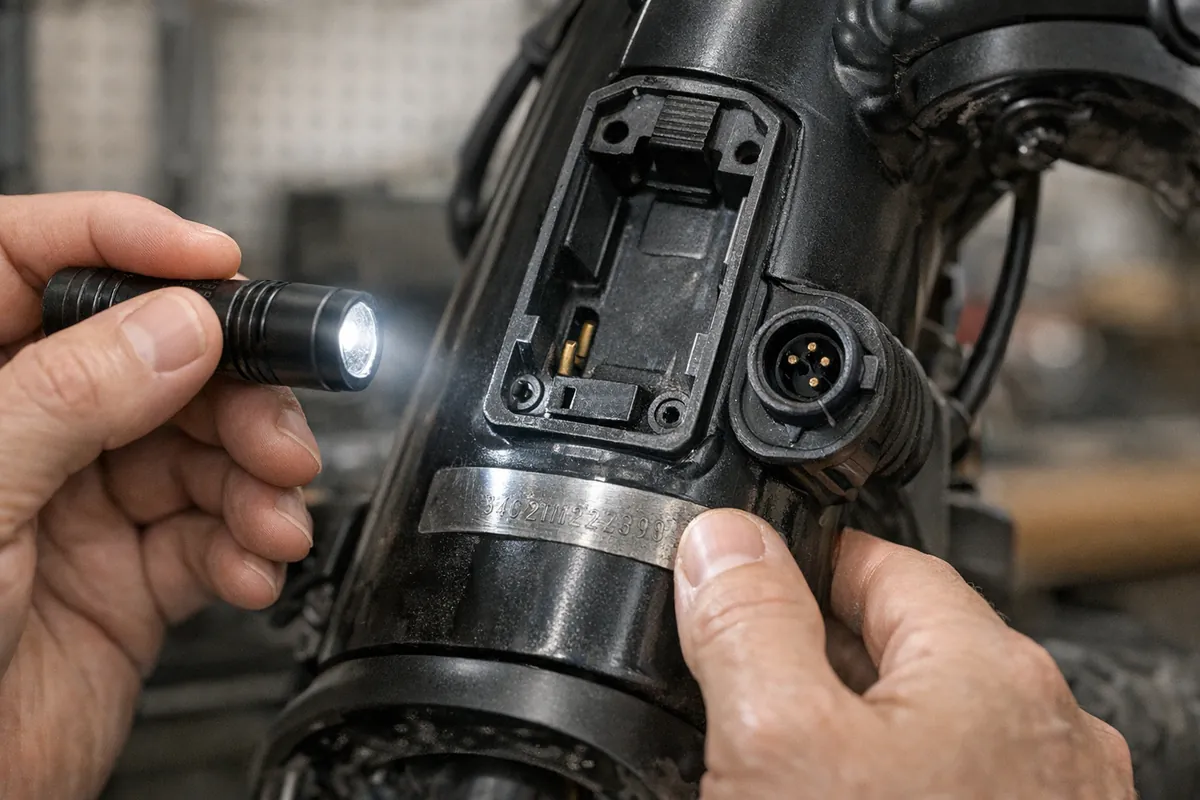
The battery is the first thing to check because it is costly, safety-critical, and often the hardest part to replace later.
Use this quick battery check:
Bosch specifically advises using the original charger, charging in a dry area with a working smoke detector, and not opening the battery housing yourself. Their battery-care guidance also recommends room-temperature storage and warns against improper repair because it can create safety and reliability problems. See Bosch battery care and maintenance for the underlying guidance: Bosch eBike battery care and maintenance.
If you want more context on removable packs and replacement practicality, MBHQ already has a removable battery guide plus a separate battery maintenance guide.
A used e-bike is still a bicycle first, so give the frame and touchpoints a slow visual inspection.
Look for:
Cosmetic scratches alone are not a deal-breaker. Structural damage, rushed repairs, or a bike that looks heavily neglected usually are.
You do not need a full workshop inspection to catch obvious problems. A short, careful ride plus a few simple checks can tell you a lot.
During the test ride, confirm that:
If you are newer to e-bike setups, MBHQ also has a hub vs mid-drive motor explainer and a broader set of general e-bike buying tips.
Turn the system on and cycle through the normal ride modes. You want to see a bike that behaves normally, not one that only looks clean in photos.
Check for:
A seller does not need to know every technical detail, but they should be able to explain what was replaced, what was serviced, and whether the bike ever had electrical issues.
If the bike is from a known brand, ask whether the battery/system was sold under recognized safety standards and whether replacement parts are still available. PeopleForBikes highlights UL 2849 and UL 2271 as the standards commonly used when discussing e-bike system and battery certification. Their overview is useful context when you want to understand why certification and battery provenance matter more than a vague “it works fine” claim: What You Should Know About E-Bike Battery Certification.
Also ask for:
If the seller avoids basic ownership questions or cannot explain where the bike came from, slow down.
These are the highest-signal reasons to skip the deal:
A good second-hand e-bike can be a smart buy, but the best deals usually come from clear ownership history, an intact battery-and-charger setup, and a bike that behaves normally on a short ride. If the battery looks questionable or the seller cannot answer basic history questions, keep shopping.
It can be, especially if the bike comes from a known brand with ongoing battery and parts support. The main risk is not cosmetic wear. It is getting stuck with a battery or electronics problem that costs too much to fix.
The battery-and-charger setup is the biggest single checkpoint because it affects safety, cost, and long-term usability. Start there before you worry about paint, accessories, or small cosmetic flaws.