Choosing between a Class 1 ebike vs Class 2 usually comes down to one question: do you want pedal-assist only, or do you want a throttle too? A Class 1 eBike assists only while you pedal and typically stops motor assistance at 20 mph. A Class 2 eBike can also use a throttle, usually with motor assistance capped at 20 mph.
Quick answer:
Buy a Class 1 eBike if you want the widest trail access, a more bicycle-like ride, and do not need throttle help from a stop. Buy a Class 2 eBike if you want easier starts, more help in stop-and-go riding, or a backup option when your legs need a break. For most commuters and casual riders, Class 2 is more convenient; for path and trail access, Class 1 is often the cleaner choice.
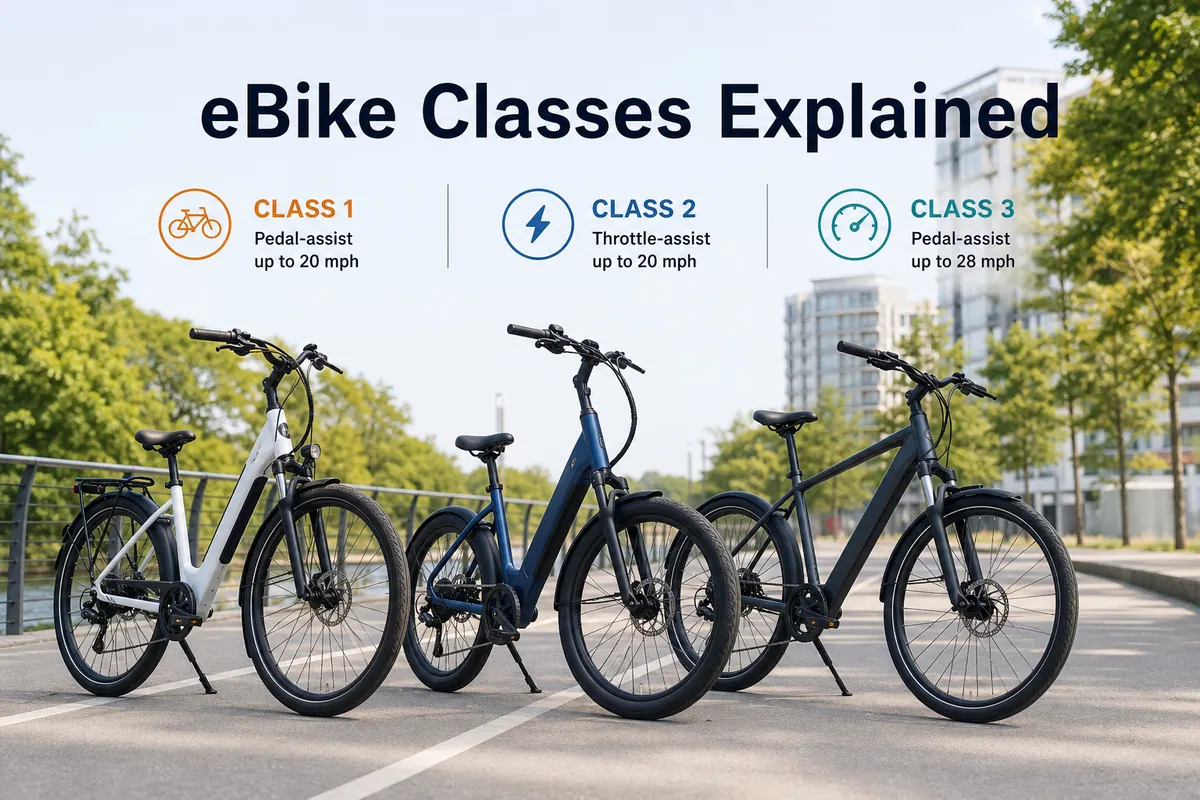
The tricky part is that both classes can look almost identical in a product photo. The difference is not frame shape or battery size; it is how the motor is allowed to help you. That small control difference can affect where you ride, how the bike feels in traffic, and which model makes the most sense for your budget.
A Class 1 eBike is pedal-assist only. The motor adds power when you pedal, then stops assisting when you reach the class speed limit, commonly 20 mph under the standard three-class system used in many U.S. states.
A Class 2 eBike includes a throttle. Depending on the bike, that throttle may work as a thumb lever, twist grip, or button-style control. You can still pedal it like a normal electric bike, but you also get motor power without pedaling, within the bike's legal operating limits.
That makes Class 2 feel more flexible in daily use. Starting at a stop sign, crossing an intersection, rolling through a parking lot, or getting moving with cargo can be easier when you have throttle assistance. If you are still deciding what style of electric bike fits your riding, our e-bike buying tips can help you narrow the bigger purchase questions before you compare individual models.
| Feature | Class 1 eBike | Class 2 eBike |
|---|---|---|
| Motor help | Pedal-assist only | Pedal-assist plus throttle |
| Typical assisted speed cap | 20 mph | 20 mph |
| Best for | Bike paths, trails where allowed, fitness-oriented riding | Commuting, errands, easier starts, mixed casual use |
| Main tradeoff | No throttle when you want instant help | May face more access limits in some areas |
| Ride feel | Closest to a traditional bicycle | More scooter-like convenience when using the throttle |
A Class 1 eBike is the better fit when access matters more than throttle convenience. Many riders choose Class 1 because it feels closer to regular cycling and is often easier to justify on shared-use paths, bike lanes, and some trail systems where throttle-equipped bikes may be restricted.
Class 1 also suits riders who want help on hills but still want the bike to reward steady pedaling. You still get meaningful motor assistance, especially with a good mid-drive or tuned hub motor, but the bike encourages a more active riding rhythm. If you want to understand how motor type changes that experience, start with electric bike motors explained.
Best fit for Class 1:
Choose Class 1 if your rides include shared paths, multi-use trails, fitness loops, or areas where throttle access may be questioned. It is the simpler, lower-friction choice when you want your eBike to behave as much like a bicycle as possible.
A Class 2 eBike makes sense when convenience is the point. The throttle is useful when you are starting on a hill, carrying groceries, riding with a child seat or cargo, recovering from fatigue, or trying to move confidently through stop-and-go city streets.
The throttle does not mean you have to ride lazily. Plenty of Class 2 owners pedal most of the time and use the throttle only as a tool. That is the real appeal: Class 2 gives you one more way to manage awkward moments without turning every ride into a throttle-only trip.
There is a practical tradeoff, though. Some local rules, parks, paths, and trail systems treat throttle-equipped eBikes differently. Before buying a Class 2 for a specific commute or recreation area, check local rules and signage. For broader legal context, MBHQ also covers whether you can drive a motorized bike on the road and whether you can ride a motorized bicycle without a license.
The Class 1 ride feels more natural if you already like cycling. You push, the bike helps, and the assistance fades when you stop pedaling. That makes speed control feel intuitive and keeps the bike from feeling too far removed from a normal bicycle.
Class 2 feels more forgiving. If you stall on a hill or need a quick push into traffic, the throttle can smooth out the moment. New riders often appreciate that safety margin, especially if they are not confident shifting gears or managing cadence yet.
Battery use can vary by rider, terrain, bike weight, assist level, and throttle habits. In general, leaning heavily on the throttle can drain a battery faster than steady low-to-moderate pedal assist, but the exact range difference depends on the bike and how it is ridden. Treat manufacturer range claims as estimates, not promises.
Many U.S. eBike discussions use the three-class framework, but the details are not identical everywhere. States, cities, parks, land managers, and trail systems can add their own restrictions. A bike that is legal on the road may still be restricted on a local path or natural-surface trail.
For this specific comparison, the most important access issue is the throttle. A Class 1 eBike is often the more accepted option where rules are written around pedal-assist riding. A Class 2 eBike may still be legal in many places, but throttle use can make access more complicated.
Before you buy:
Check the rules for the exact places you plan to ride most: your commute route, local bike paths, state parks, trail networks, and any apartment or workplace storage rules. The best eBike on paper is the wrong choice if you cannot use its main feature where you actually ride.
For a rider who mostly wants recreation, fitness, and broad access, Class 1 is the safer default. It keeps the experience simple, avoids the throttle debate, and usually feels closer to the kind of riding people expect from a bicycle.
For a rider who wants a practical car-replacement tool for errands, commuting, hills, or low-effort mobility, Class 2 has a strong case. The throttle can be genuinely helpful, not just fun. It is especially useful if you ride in traffic, carry weight, or need confidence getting started from a full stop.
If you are shopping by price, do not assume one class is automatically cheaper. You can find both Class 1 and Class 2 models across budget, midrange, and premium categories. Compare motor quality, battery size, brakes, fit, warranty support, and intended use before letting the class label make the decision for you.
When comparing models, filter by how you ride first, then by class. A throttle-equipped Class 2 commuter may be better than a Class 1 mountain-style bike for city errands, while a lightweight Class 1 hybrid may be better than a heavy Class 2 fat-tire model for path riding. The class label matters, but the whole bike still has to match the job.
If you want to browse current Class 1 and Class 2 options side by side, use a broad search first, then verify each bike's stated class, throttle behavior, speed cap, and local legality before buying.
The Class 1 vs Class 2 decision is not about which eBike is universally better. It is about whether throttle assistance is worth the possible access tradeoff. Choose Class 1 if you want the most bicycle-like ride and fewer questions on shared routes. Choose Class 2 if the throttle will make your real rides easier, safer-feeling, or more practical.
For most buyers, the best answer is simple: pick Class 1 for access and active riding; pick Class 2 for convenience and everyday utility.
* We may earn a commission when you buy through our links.