Are e-bikes legal on trails? Sometimes, but not by default. Trail access depends on who manages the land, what type of trail it is, your e-bike class, and any local rules posted for that route.
Quick answer: E-bikes are legal on some trails, restricted on others, and banned on many routes unless the managing agency has clearly allowed them. Check the trailhead sign, the land manager's website, and your e-bike class before riding. If the rule is unclear, treat the trail as closed to e-bikes until you can confirm otherwise.
The tricky part is that "trail" can mean a paved city greenway, a rail trail, a state park path, national forest singletrack, a BLM route, or a national park bike path. Those places may sit near each other and still follow completely different rules.
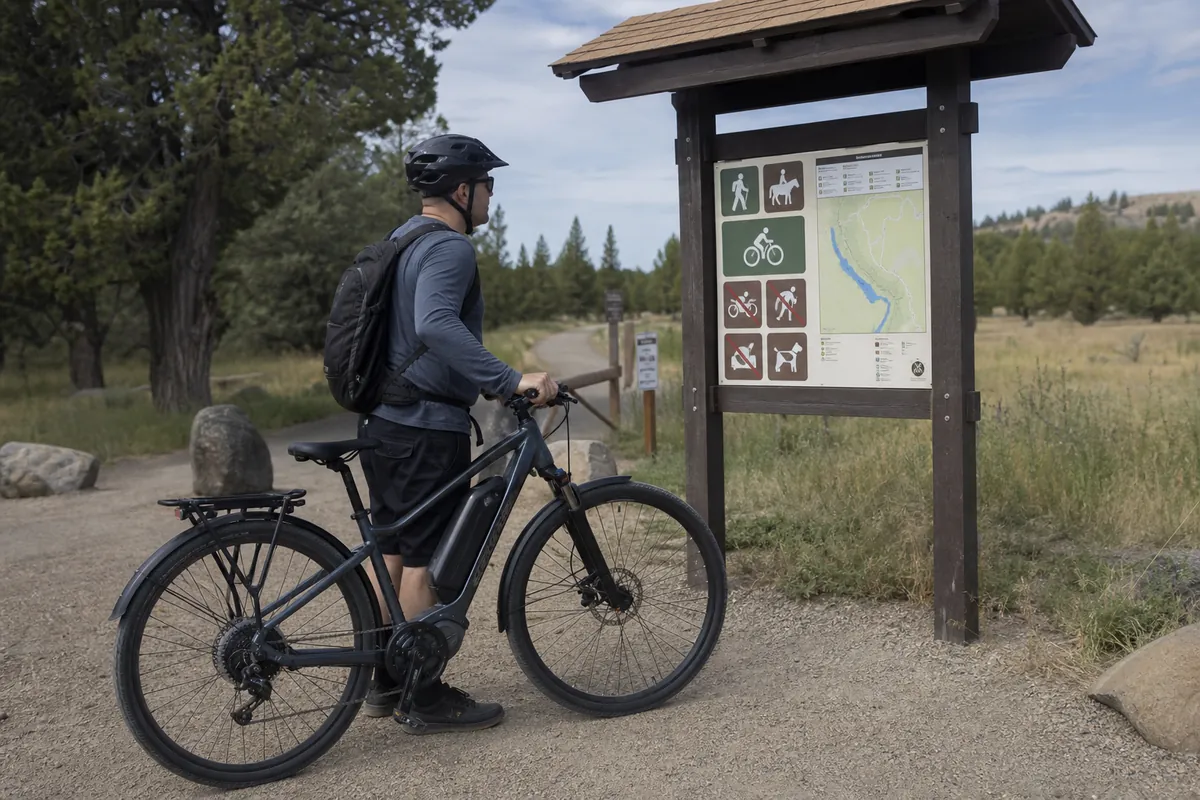
No. E-bikes are not legal on every trail, even where regular bicycles are allowed. The most reliable rule is simple: an e-bike is allowed only when the trail's managing authority says it is allowed.
Many U.S. rules use the three-class e-bike system. Class 1 e-bikes provide pedal assist up to 20 mph. Class 2 e-bikes can use a throttle up to 20 mph. Class 3 e-bikes provide pedal assist up to 28 mph.
A trail may allow one class, several classes, or none. A Class 1 e-bike might be fine on a paved multi-use path, while a Class 3 e-bike may be limited to roads. If you are still sorting out basic e-bike types, our guide to the best electric bikes can help you compare common categories before you buy.
Key distinction: "Bikes allowed" does not always mean "all e-bikes allowed." Trail managers may treat traditional bicycles, Class 1 e-bikes, throttle-equipped Class 2 e-bikes, faster Class 3 e-bikes, and motorized vehicles differently.
E-bike trail rules vary because trails are managed for different surfaces, users, speeds, safety concerns, and conservation goals. A wide paved commuter path is not the same as a narrow hiking trail, a shared horse trail, or backcountry mountain bike singletrack.
City greenways and park paths are often more e-bike friendly than backcountry trails, but local ordinances still matter. Some places allow Class 1 and Class 2 e-bikes, set posted speed limits, or restrict throttle use in crowded areas.
Do not assume a paved path is automatically open. Check the city, county, park district, or trail authority page for the exact route.
State park rules can vary widely. Some states allow certain e-bike classes where bicycles are allowed. Others let each park or trail system set more specific access rules.
Regional trail systems can also have their own policies. A rail trail may welcome e-bikes in one county and restrict them in another if management changes along the route.
Federal land adds another layer. The U.S. Forest Service generally allows Class 1, Class 2, and Class 3 e-bikes on motorized trails and roads in national forests and grasslands. Nonmotorized trails are commonly closed to e-bikes unless they are specifically designated open.
The National Park Service gives park superintendents authority to allow e-bikes where appropriate on roads and trails where traditional bicycles are allowed, but the details are park-specific. Always check the park's biking page, current alerts, and superintendent compendium before riding.
The Bureau of Land Management can authorize Class 1, Class 2, and Class 3 e-bikes on certain nonmotorized roads and trails through local planning decisions. That does not mean every BLM trail is open by default.
Start at the trailhead sign, but do not stop there if the sign is vague. Older signs may say "no motorized vehicles" without explaining how the local agency treats e-bikes. Newer signs may list exact class icons or spell out Class 1, Class 2, and Class 3 rules.
Look up who manages the route: city parks, county open space, a state park agency, a national forest, a national park, BLM, a private trail association, or a special district. The land manager's rule controls more than a general state e-bike summary.
Search the trail name plus "e-bike," "electric bicycle," "Class 1 e-bike," or "trail rules." If you still cannot confirm access, call or email the local office before riding.
Trail rules often depend on class. A compliant Class 1 e-bike is usually the easiest fit for shared-use trails, because the motor only assists while pedaling and stops assisting at 20 mph. Class 2 e-bikes can face more limits because of throttle operation. Class 3 e-bikes are more likely to be restricted from trails because they assist up to 28 mph.
Converted bikes deserve extra attention. If a conversion kit exceeds local e-bike limits, the bike may not be treated like a standard e-bike. Our guide to electric bike motors explains why motor type, throttle behavior, and assist cutoff speed can matter.
Seeing e-bikes on a trail is not proof that access is legal. Other riders may know the local rule, but they may also be guessing, ignoring signs, or misunderstanding the class limit.
This is especially common on popular paths where enforcement is light. Trail culture is not the same thing as trail permission.
| Trail type | Common e-bike access pattern | What to verify |
|---|---|---|
| Paved city or park path | Often allows some e-bikes, especially Class 1 or Class 2. | Local ordinance, posted speed limit, and class rules. |
| Rail trail or multi-use path | Frequently e-bike friendly, but not universal. | Trail authority policy, state law, and throttle restrictions. |
| Mountain bike singletrack | Varies sharply by trail system. | Trail map, land manager policy, and closure notices. |
| National forest trail | Generally open where motorized use is allowed; nonmotorized trails often remain closed unless designated. | Motor Vehicle Use Map, forest notices, and route designation. |
| National park route | Park-specific; some routes allow e-bikes where bicycles are allowed. | Park biking page, superintendent compendium, and signs. |
| BLM-managed trail | May be locally authorized, including on some nonmotorized routes. | Field office page, travel management plan, and posted trail status. |
"No motorized vehicles" is one of the most confusing trail signs for e-bike riders. Some jurisdictions treat certain compliant e-bikes more like bicycles. Others manage e-bikes as motorized use, especially on natural-surface or backcountry routes.
The legal answer is not based only on noise, weight, or how gently you ride. It depends on whether the land manager has authorized that specific e-bike use on that specific route.
When a sign or map says nonmotorized use only and does not mention e-bikes, be careful. Some areas publish separate e-bike guidance online, but if you cannot confirm the rule, the safer move is to choose another route.
Trailhead habit: Before unloading your e-bike, confirm three things: e-bikes are allowed, your specific class is allowed, and the route is open today. Seasonal closures, wildlife closures, fire restrictions, and wet-trail closures can change access even when e-bikes are normally permitted.
Legal access can still be fragile. Poor trail behavior gives land managers a reason to tighten rules later, especially on shared paths with hikers, children, horses, and traditional cyclists.
Slow down before blind corners. Announce passes early. Give horses and pedestrians extra room. Keep your speed reasonable for the surface, sight lines, and traffic.
Stay on designated routes. Cutting switchbacks, riding closed trails, or using unofficial paths can damage both the trail and the case for future e-bike access.
A bike can be legal on the street and still be restricted on a trail. Road-use rules, licensing questions, and trail access are related, but they are not the same issue.
For the road side of the question, see our guide on whether you can drive a motorized bike on the road. For basic safety gear planning before mixed public rides, our e-bike helmet guide is a useful companion.
E-bikes are legal on some trails, restricted on others, and prohibited on many routes where the land manager has not clearly authorized them. The answer comes from the trail's managing authority, not from the fact that the path is paved, that bicycles are allowed, or that other riders are using e-bikes there.
If you want the lowest-friction trail experience, a compliant Class 1 e-bike is often the easiest category to confirm for shared-use paths. Even then, check the posted rules, the agency page, and your route status before you ride. It is a small step that protects your ride, your wallet, and future e-bike access.