A Trek Class 3 e-bike is designed to provide pedal assistance at speeds up to 28 mph, rather than the 20 mph assistance limit commonly associated with Class 1 models. Trek has offered these faster configurations across several commuter and recreational families, often—though not universally—identified by an “S” in the model name.
Quick answer: Look for a Trek model whose U.S. specifications explicitly say “Class 3,” “speed electric bike,” or “assists up to 28 mph.” Trek has used names such as Allant+ S, Verve+ S, and FX+ S for certain speed-oriented configurations, but availability and classification can change by model year. Confirm the product page, frame label, and owner’s manual before assuming any Trek e-bike is Class 3.
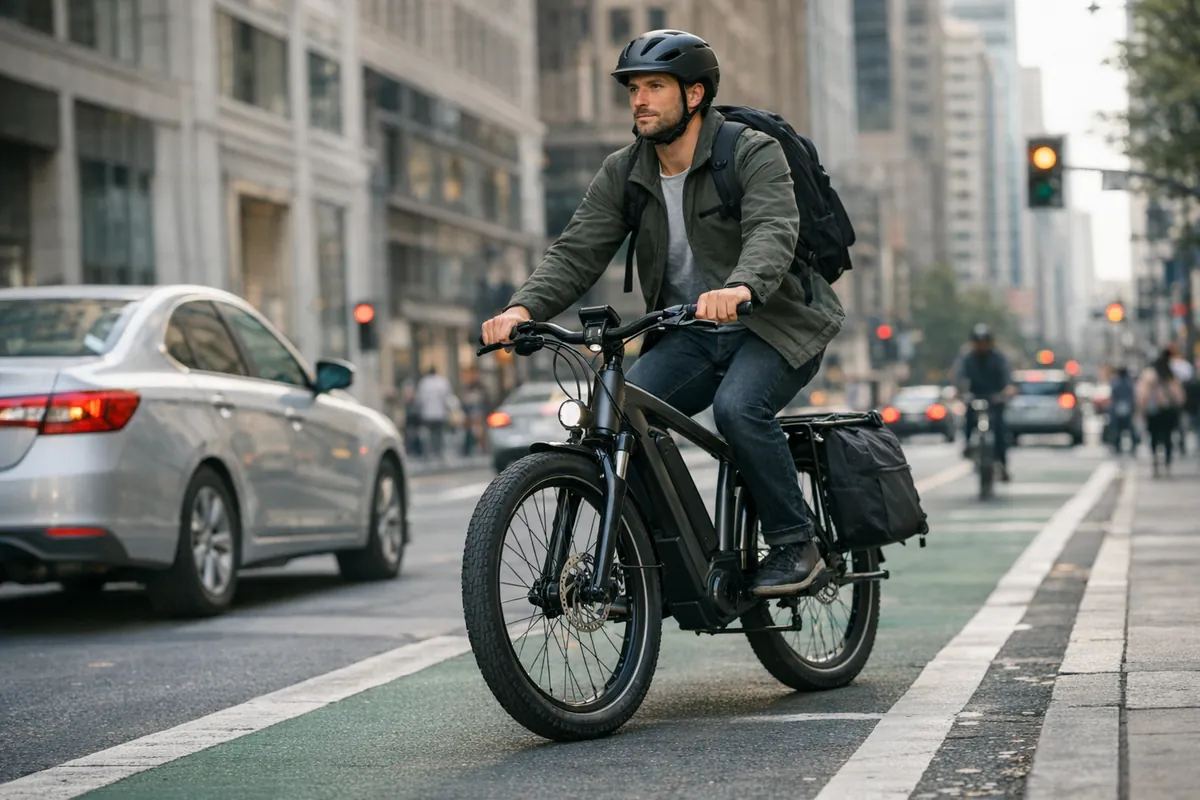
In the common U.S. three-class system, a Class 3 e-bike provides motor assistance only while the rider is pedaling and stops adding assistance at 28 mph. These bikes also generally include a speedometer. State definitions can vary, so the classification printed on the bike is more useful than assumptions based on motor wattage or appearance.
The 28 mph figure is an assistance limit, not a promise that the bike will maintain that speed everywhere. Rider weight, hills, tire pressure, wind, battery charge, motor mode, and riding position all affect real-world performance. The motor gradually reduces or stops its contribution at the programmed cutoff; the rider may still coast or pedal beyond it.
Trek’s faster e-bikes typically use a pedal-assist system rather than a throttle. Many employ a mid-drive motor, which applies power through the bicycle’s drivetrain and makes good use of the available gears. Our guide to how electric bike motors work explains why shifting technique matters on a mid-drive bike.
Do not rely on the model name alone: A familiar Trek family may be sold in several configurations, and a similarly named bike in another country may have a different assistance limit. Verify the exact model year, regional specification, and class label.
Trek’s catalog changes over time, so a permanent list of current Class 3 models can become inaccurate quickly. The safest approach is to understand the naming pattern and then check the specification of the individual bike.
In the United States, Trek has used an “S” suffix on various speed-oriented e-bikes. Depending on the model year, shoppers may encounter names from the Allant+, Verve+, or FX+ families with an S designation. Those names are useful search clues, but the suffix should not replace confirmation from the manufacturer’s specifications.
| Trek family or label | Typical emphasis | What to verify |
|---|---|---|
| Allant+ S variants | Faster commuting, paved recreation, and trekking | Class 3 designation and assistance up to 28 mph on the exact model year |
| Verve+ S variants | Upright comfort and everyday riding | Regional speed specification, included equipment, and local access rules |
| FX+ S variants | Fitness-oriented urban riding and commuting | Exact U.S. configuration, battery arrangement, and stated assistance limit |
| Trek e-bike without an S suffix | Varies by family and model | Do not assume Class 3; many standard versions are configured for lower assistance limits |
| Used or imported Trek e-bike | Depends on its original market | Frame label, motor display, serial information, original specifications, and legal status |
Start with the specification page for the full model name and year. Look for direct language such as “Class 3,” “speed e-bike,” or “assists up to 28 mph.” If the listing only mentions a motor’s nominal wattage or torque, that is not enough to establish the bike’s class.
Next, inspect the classification label attached to the bicycle. A legitimate label generally identifies the class, assisted-speed limit, and motor rating required by the applicable jurisdiction. On a used bike, compare that label with the motor, controller, display, and original sales documentation. Replacement electronics or unauthorized tuning may mean the bicycle no longer matches its label.
If you are shopping secondhand, apply the mechanical and battery checks in our used e-bike buying checklist. A speed-oriented e-bike deserves especially careful inspection because higher average speeds can increase wear on tires, brake pads, chains, and cassettes.
It can be, particularly on an open commute where a 20 mph assistance cutoff would otherwise interrupt the rider’s rhythm. The extra assisted-speed range may help a capable rider maintain momentum between intersections or cover a longer paved route more efficiently.
That does not mean every ride becomes an effortless 28 mph cruise. Air resistance rises sharply as speed increases, so riding near the upper limit consumes more energy and demands more from the rider and battery. Hills, frequent stops, cold weather, soft tires, and an upright posture can reduce both speed and range.
The practical benefit is flexibility, not constant maximum speed. A Class 3 Trek can still be ridden slowly in a low assistance mode. The faster cutoff is simply available when conditions, access rules, and rider judgment make it appropriate.
Manufacturer range estimates are usually presented as broad possibilities because no single number represents every rider. Sustained high-speed assistance is one of the quickest ways to move toward the lower end of the usable range. Higher assist modes, climbing, cargo, headwinds, and repeated acceleration further increase consumption.
For a more useful estimate, begin with a fully charged battery and repeat one of your normal routes in the assist mode you expect to use. Record the distance, remaining charge, temperature, elevation, and approximate pace. After several rides, that personal data will be more informative than a best-case marketing figure.
Owners can also preserve consistency by maintaining tire pressure, shifting before the drivetrain is heavily loaded, and storing the battery according to the manufacturer’s guidance. If you are still comparing configurations, our practical e-bike buying tips can help separate important ownership features from attractive but less useful specifications.
A bike capable of assisted travel near 28 mph needs predictable handling and strong, well-maintained brakes. Before faster rides, check both brake levers for a firm and consistent feel. Inspect the tires for damage, confirm proper pressure, and make sure both wheels are secure.
Brake-pad life varies widely with rider weight, terrain, weather, riding style, and brake design. Descents and stop-and-go commuting can wear pads much faster than steady riding on flat roads. Learn the warning signs in our guide to e-bike brake-pad replacement intervals, then follow Trek’s service guidance for the components installed on your bike.
Practical ownership check: Before a fast commute, squeeze both brakes, inspect the tires, check the battery mounting, and confirm that lights and the display work. A short pre-ride check is more valuable than discovering a loose component at speed.
Access rules are not identical across the United States. Class 3 e-bikes may be allowed on roads and certain bike lanes while facing restrictions on multi-use paths, natural-surface trails, or facilities that permit only Class 1 bicycles. Some jurisdictions also impose a minimum rider age or helmet requirement.
Check state law as well as city, county, park, campus, and trail-system rules. A route that is legal on the street may change status when it enters a greenway or managed recreation area. Signs posted at the entrance to a trail or path can be more specific than the statewide rule.
A suitable bicycle helmet is particularly important when riding at higher speeds. Choose one that fits securely, meets an applicable safety standard, and does not shift when you move your head. Confirm whether your jurisdiction mandates helmet use for Class 3 riders.
Do not assume a software setting can legitimately turn any Trek e-bike into a Class 3 model. Motors, controllers, batteries, brakes, displays, gearing, firmware, labeling, and regulatory approvals are selected as a complete system. A lower-speed model may not share the same components or certification as its faster relative.
Unauthorized tuning can create legal, warranty, reliability, and insurance problems. It may also cause the displayed speed or distance to become inaccurate. If you need a 28 mph assistance limit, the cleaner route is to choose a factory-configured Class 3 model sold for your market.
A Class 3 configuration makes the most sense for riders with longer paved commutes, open road sections, or schedules where the extra assisted-speed range provides a real benefit. It may be less useful for short neighborhood trips, crowded paths, technical trails, or areas where Class 3 access is limited.
Before buying, test the bike at ordinary speeds as well as near its assistance limit. Pay attention to fit, stability, braking feel, motor response, noise, display readability, and how naturally the bike handles with the motor switched to a lower mode. A comfortable, predictable bike you enjoy riding is usually a better choice than one selected only for its maximum assisted speed.
Bottom line: Trek has offered legitimate Class 3 options, often marked with an S suffix, but classification belongs to the exact bike—not merely the family name. Confirm the 28 mph specification, local access rules, fit, battery needs, and maintenance condition before committing.