The best lock for ebike security is usually a hardened U-lock or heavy chain lock, backed up by a second lock when you leave the bike in public for more than a quick stop. E-bikes are heavier, more expensive, and more attractive to thieves than basic pedal bikes, so the right answer is less about one magic lock and more about matching lock strength to where you park.
For most e-bike owners, start with a high-security U-lock that fits around the frame and a fixed rack. Add a chain or folding lock if you need more reach, carry a second lock for the front wheel, and remove the battery when the bike will sit for a while. If your e-bike often stays outside, use two different lock types and park in a visible, well-lit place.
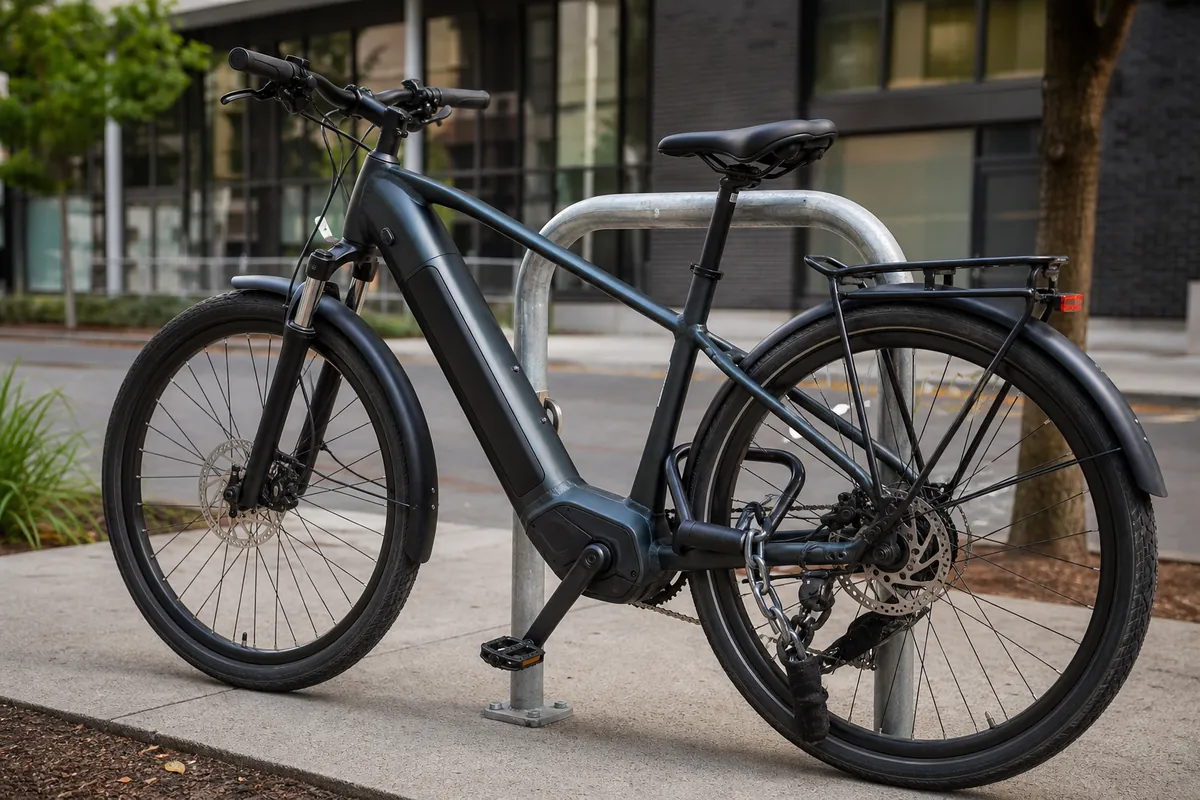
An e-bike lock has to do three jobs: resist basic cutting tools, fit the real places you park, and stay convenient enough that you actually carry it. A huge chain left at home protects nothing. A tiny café lock may feel tidy, but it can leave too much of the bike exposed.
The strongest setup for many riders is a two-lock system: one serious primary lock through the frame, and a second lock that secures the front wheel or fills a gap the first lock cannot reach. That matters even more if your bike has removable parts, a quick-release wheel, or a high-value battery.
If you are buying your first serious e-bike lock, make the primary lock the strongest one you are willing to carry. For most riders, that means a high-security U-lock with a shackle large enough to capture the frame and a rack without leaving lots of open space.
A U-lock is often the best starting point because it is compact, rigid, and hard to twist when used correctly. The tradeoff is reach. Some racks, cargo frames, and fat-tire e-bikes make a standard U-lock feel tight, especially if you are trying to include the rear wheel.
A heavy chain lock gives you more flexibility. It can wrap around awkward racks, thick posts, and unusual e-bike frames. The catch is weight. Good chains are not light, and the strongest ones can feel annoying on short errands unless you carry them in a basket, pannier, or frame bag.
Folding locks sit in the middle. They are tidy, easy to mount, and more flexible than a U-lock. They can be useful for low-to-moderate risk stops, but many riders still pair one with a stronger U-lock or chain for city parking.
Simple rule: if your e-bike costs enough that replacing it would hurt, do not rely on a thin cable lock as your main lock. Cable locks are better as accessory locks for wheels, helmets, or quick secondary use.
Each lock type has a place. The mistake is treating them as equal just because they all say “bike lock” on the package.
| Lock type | Best use | Main tradeoff |
|---|---|---|
| High-security U-lock | Daily e-bike parking at racks, railings, and regular stops | Limited reach on bulky frames or awkward racks |
| Heavy chain lock | Higher-risk areas, outdoor parking, cargo bikes, and odd lock points | Heavy to carry unless mounted or stored well |
| Folding lock | Convenient errands and moderate-risk stops | Usually not the strongest choice for long unattended parking |
| Cable lock | Securing accessories or adding a light second layer | Not enough as the only lock for most e-bikes |
Choose a U-lock if you usually park at standard bike racks and want a compact lock with strong theft resistance. Look for a size that lets you lock the frame and rear wheel without leaving a large empty space inside the shackle.
Smaller U-locks can be stronger in practice because they leave less room for leverage attacks. But too small can become frustrating fast. If your e-bike has a thick downtube, wide tires, fenders, or a rear rack, check the usable internal dimensions before buying.
A chain lock is often the better choice for cargo e-bikes, fat-tire e-bikes, apartment riders, and anyone who parks near awkward posts. Chains also work well as a home lock when you can leave the heavy setup in a garage, shed, or parking area.
For street parking, a chain can be excellent when paired with a U-lock. Use the U-lock on the frame and rear wheel, then use the chain to grab the front wheel, frame, or a larger fixed object. The goal is to make the bike harder and slower to attack from more than one angle.
Folding locks are convenient. They mount cleanly, pack neatly, and work with more lock points than many U-locks. For quick stops in lower-risk areas, that convenience can be the difference between locking properly and rushing.
Still, folding locks should be chosen carefully. If your parking situation is high risk, consider a folding lock as a secondary or convenience lock, not your only serious layer.
Security ratings are useful, but they are not perfect. Different brands and independent programs use different systems, so do not compare every badge as if it came from the same test. A lock marketed for high-security bike or motorcycle use is generally a better fit for an e-bike than a lightweight lock made for short daytime stops.
Focus on the practical signs: hardened steel, a reputable locking mechanism, good user reviews for real-world durability, and enough size for your frame. Avoid locks that look thick only because they have bulky plastic around a thin cable.
If you ride a high-value e-bike, think in layers. A strong lock helps, but so do smart parking habits, battery removal, indoor storage, and knowing how to securely lock your bike when the rack setup is less than ideal.
Start with the frame. If the frame is not locked to something fixed, the bike can be carried away even if the wheel is secured. On many e-bikes, the best lock point is the main triangle or a sturdy rear frame section near the wheel.
Next, include a wheel if your lock size allows it. The rear wheel is often more valuable and harder to replace than the front, especially on hub-drive e-bikes. If you cannot capture the frame and rear wheel with one U-lock, use a second lock or chain.
Keep the lock off the ground when possible. A lock lying against concrete can be easier to attack with blunt force. Also avoid leaving a large open gap inside the lock. More empty space can give thieves more room to twist, pry, or position tools.
For outdoor storage, locking technique is only part of the picture. Weather, battery care, and visibility matter too. If your bike stays outside often, read our guide to storing an e-bike outside so the lock setup works with the rest of your storage plan.
Your lock choice should match your parking risk. A five-minute stop outside a busy coffee shop is not the same as overnight parking behind an apartment building.
Use a solid U-lock or folding lock through the frame and a fixed rack. If your front wheel is quick-release, add a light secondary lock or replace the skewer with a security skewer. Do not let the quick stop turn into an unlocked stop.
Use a high-security U-lock plus a chain or second lock. Lock the frame and at least one wheel. Choose a visible rack with foot traffic, and avoid leaving the bike in the exact same spot every day if the area feels exposed.
Use the heaviest lock you can tolerate because you do not have to carry it far. A thick chain around the frame and a ground anchor can add meaningful protection. If the battery is removable, store it indoors when practical.
If you are still choosing the bike itself, theft risk should be part of the buying decision. A lighter commuter e-bike may be easier to carry upstairs, while a heavier cargo model may need better home storage. Our e-bike buying tips cover those tradeoffs before you commit to a bike.
Before buying an e-bike lock, check the actual places you park. Measure the rack shape, your frame tube size, and the distance from the frame to the rear wheel. This small step prevents the most common lock mistake: buying something strong that does not fit your real setup.
Also think about carry style. A U-lock with a bad frame mount can rattle or get left behind. A chain may work better in panniers. A folding lock may be cleaner on a compact commuter bike. The best lock is the one that is both strong and boring enough to use every ride.
Battery security matters too. Many removable batteries have their own lock, but that does not make them theft-proof. If you park for a long time, removing the battery can make the bike less attractive and protect one of the most expensive components. For more battery care context, see e-bike battery maintenance.
If you are comparing current options, start with high-security e-bike U-locks, heavy chain locks, and folding locks from established lock brands. Check the dimensions first, then compare weight, mounting method, and security rating. For a higher-value e-bike, it is reasonable to spend more on the lock than you would for a basic pedal bike.
Use the product page as a filter, not as the final authority. Confirm the internal lock size, steel thickness claims, included mount, return policy, and whether the lock can secure your specific frame to your usual rack.
The first mistake is using only a cable lock. A cable can help secure a front wheel or helmet, but it is not a strong primary lock for most e-bikes.
The second mistake is locking only the wheel. If the frame is not secured, the bike can still disappear. This is especially risky with quick-release wheels.
The third mistake is buying too much lock to carry. A very strong chain is useful only if it goes with you or stays where you park. Be honest about your routine before choosing the heaviest option.
Finally, do not ignore the rack itself. A strong lock around a weak signpost, loose rack, or removable railing can fail because the object failed. The lock is only as good as what you lock it to.
For most riders, the best e-bike lock setup is a high-security U-lock for the frame plus a second lock for the wheel or added reach. If your e-bike is heavy, expensive, or parked outside often, upgrade the second lock to a strong chain.
If you want one simple buying path, choose a serious U-lock first. If the fit is too tight for your frame or racks, choose a heavy chain. If convenience is your main barrier, a quality folding lock is better than leaving a stronger lock at home.
No lock makes an e-bike impossible to steal, but a good setup changes the equation. It makes your bike harder, slower, and less appealing to target. That is the real goal: enough friction that a thief moves on before your ride does.
* We may earn a commission when you buy through our links.