A Class 1 eBike is a pedal-assist electric bike that helps only while you are pedaling and stops providing motor assistance at 20 mph. In plain terms: it feels like a regular bicycle with a quiet push behind your legs, not like a throttle-powered scooter.
Quick answer: A Class 1 eBike has pedal assist, no throttle-only riding, and motor assistance that cuts off at 20 mph. It is usually the most bike-like and widely accepted eBike class for paths, commuting, fitness riding, and everyday errands, though local rules still matter.
Class 1 is often the easiest eBike category for new riders to understand because the motor does not replace pedaling. You still choose the gear, turn the cranks, and control the bike like a normal bicycle. The difference is that the motor adds support when sensors detect your pedaling effort or cadence.
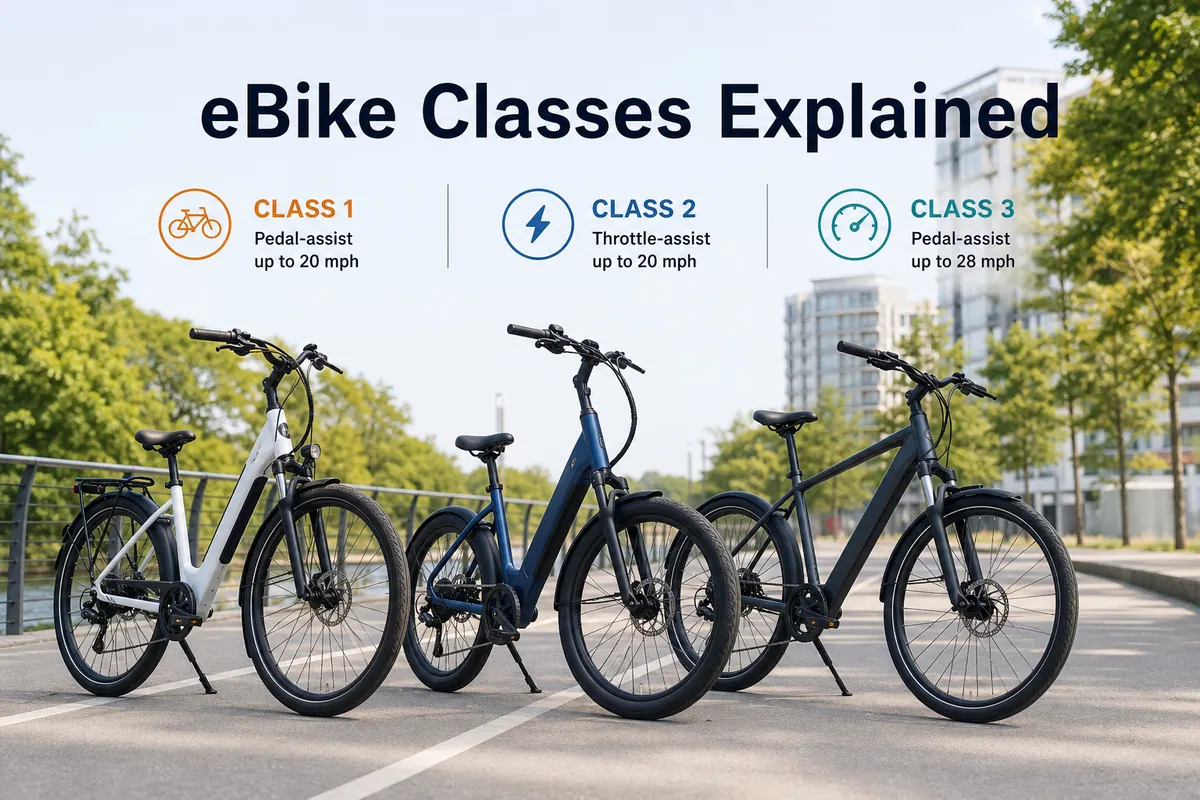
The defining feature of a Class 1 eBike is pedal assist only. The motor is there to support your pedaling, not to move the bike on its own from a standstill with a throttle.
Most Class 1 definitions in the United States also use a 20 mph assisted-speed limit. You can ride faster than 20 mph if your legs, gravity, or a tailwind get you there, but the electric assist should stop helping once you reach that threshold.
Many state-level eBike laws use a three-class framework, but the exact wording can vary by state, city, trail system, and land manager. If you are trying to decide where you can ride, pair the class label with local rules rather than assuming the sticker on the frame settles everything.
Worth knowing: Class 1 usually means pedal assist up to 20 mph, but access rules are local. A bike can fit the Class 1 pattern and still face restrictions on certain trails, sidewalks, parks, or shared-use paths.
| Feature | Class 1 eBike |
|---|---|
| Motor activation | Pedal assist only |
| Throttle | No throttle-only propulsion under the standard Class 1 definition |
| Assisted speed limit | Motor assistance stops at 20 mph |
| Ride feel | Closest to a traditional bicycle, with added support |
| Best fit | Commuting, fitness rides, paths, errands, and riders who still want to pedal |
| Rule reminder | Local access rules can still vary |
A good Class 1 eBike feels natural. When you press on the pedals, the motor adds a measured boost. When you stop pedaling, the assistance stops. That makes the bike predictable in traffic, smooth on shared paths, and easy to control around pedestrians.
The amount of help depends on the assist level you choose. Eco mode may simply take the sting out of hills. A higher assist mode can make starts, headwinds, and loaded commutes feel much easier. If you want the mechanics behind that support, our guide to electric bike motors explains hub motors, mid-drives, torque sensors, and cadence sensors in more detail.
The big appeal is that a Class 1 eBike still rewards effort. You can ride lightly and conserve battery, or you can work harder and use the motor as a backup. For many riders, that balance is the whole point: less barrier, not less biking.
The class system exists because not all eBikes behave the same way. Class 1 is pedal assist up to 20 mph. Class 2 usually adds a throttle that can move the bike without pedaling, typically up to 20 mph. Class 3 is pedal assist with assistance up to 28 mph, and it may face tighter access rules in some places.
That does not automatically make one class better than the others. A Class 2 throttle can be helpful for riders who need easier starts. A Class 3 commuter can make longer road routes faster. But for riders who want a bike that blends into normal cycling habits, Class 1 is often the cleanest fit.
If you are shopping, do not stop at the class label. Look at the motor type, battery size, weight, brakes, tire style, rack compatibility, and how you plan to store the bike. Our eBike buying tips can help you sort those choices before you pay for features you may not need.
In many places, Class 1 eBikes are treated more like bicycles than mopeds, but this is exactly where riders should be careful. State laws and local rules can differ, especially for age limits, helmet requirements, road access, path access, and where the bike can be used.
If your main question is licensing, start with the state-specific rule instead of assuming all eBikes are treated alike. Our guide on whether you can ride a motorized bicycle without a license is a useful next step because it separates bicycle-like eBikes from vehicles that may be regulated differently.
Practical check: Before riding a new route, confirm three things: whether Class 1 eBikes are allowed there, whether helmets or age limits apply, and whether the route includes parks, trails, sidewalks, or private paths with their own posted rules.
A Class 1 eBike is a strong match for riders who want help without turning the ride into a throttle-first experience. It works especially well for commuters who still want exercise, older riders who want smoother hills, people returning to cycling, and anyone carrying groceries, work gear, or a child seat on moderate routes.
It can also be a smart choice for shared-use paths because the 20 mph assist cutoff keeps the bike closer to ordinary cycling speeds. That does not mean you should ride at the limit around walkers or slower riders. It means the bike’s design is generally more compatible with places where speed and predictability matter.
For road use, the rules can become more nuanced. If your route mixes bike lanes, neighborhood roads, paths, and short street connections, review whether your eBike is considered a bicycle or a motorized vehicle in that context. Our explainer on whether you can drive a motorized bike on the road covers the broader distinction.
Start with the ride you actually plan to do. A lightweight commuter with fenders and a rack may be better than a heavy fat-tire model if your rides are mostly pavement. A mid-drive motor may feel more natural on steep climbs, while a hub motor can be simpler and more affordable for flatter routes.
Pay close attention to the sensor style. A torque sensor responds to how hard you press on the pedals and often feels smoother. A cadence sensor responds to pedal movement and can feel more on-off, though many riders are perfectly happy with it. Neither is automatically wrong; the better choice depends on your budget and ride expectations.
Also check the brakes, tire width, battery placement, frame weight, and whether the bike is comfortable at low assist. A Class 1 eBike should not feel like a burden when the motor is off. Battery range matters, but comfort and control matter more than a big number on a spec sheet.
One common misunderstanding is that a Class 1 eBike cannot go over 20 mph. It can, but the motor should stop assisting at 20 mph. Past that point, extra speed comes from your pedaling, terrain, or momentum.
Another misconception is that Class 1 always means trail-legal. It is usually the most accepted eBike class, but land managers can still restrict eBikes by trail type, surface, park policy, or local ordinance. The class label helps, but it is not a universal permission slip.
Finally, some riders assume Class 1 is only for beginners. In reality, experienced cyclists often like Class 1 bikes because they preserve a bicycle-like feel while making longer rides, hills, and daily transportation more practical.
A Class 1 eBike is the best fit if you want electric help while still riding like a cyclist. It gives you pedal assist up to 20 mph, avoids throttle-only operation, and usually fits the broadest range of everyday riding situations.
Choose Class 1 if your priorities are path-friendly manners, natural pedaling, commuting support, light fitness, and simple ownership. Consider another class only if you specifically need throttle assistance or faster assisted road commuting. For most riders asking what a Class 1 eBike is, the practical answer is simple: it is the eBike class that keeps the bike part of the experience front and center.