Motorized Bicycle Laws in North Carolina are easiest to understand once you separate the state's simple electric assisted bicycle definition from its much stricter moped rules. A compliant electric assisted bicycle is not handled like a registered moped, but a true moped in North Carolina must be registered, insured, and ridden with a motorcycle-style helmet.
Note: This page is for general informational purposes only and is not legal advice. North Carolina rules can change, and local greenway, sidewalk, park, or property rules can be narrower than the statewide baseline. Verify current requirements with the North Carolina General Assembly, NCDMV, NCDOT, and the local authority where you plan to ride. Last checked: 2026-03-16.
| Topic | Quick answer |
|---|---|
| Electric assisted bicycle definition | Two or three wheels, seat or saddle, fully operable pedals, motor of no more than 750 watts, and no more than 20 mph on a level surface when powered solely by the motor. |
| Class system | The reviewed North Carolina statutes do not use a modern class 1 / 2 / 3 framework in the current electric assisted bicycle definition. |
| Moped definition | NCDMV says a moped is a two- or three-wheeled vehicle with a motor under 50cc, no external shifter, and a top speed of no more than 30 mph on a level surface. |
| Driver license | For riding a moped, North Carolina exempts operators from a driver license if they are at least 16. For moped registration, NCDMV requires a valid North Carolina driver license or ID. |
| Registration / title | Electric assisted bicycles are outside the reviewed moped registration scheme. Mopeds must be registered, but they do not have to be titled. |
| Insurance | Mopeds must carry liability insurance because North Carolina's financial-responsibility law specifically includes mopeds. |
| Helmet / age | Moped operators and passengers must wear FMVSS 218 helmets. Moped operators must be at least 16. The reviewed statewide sources do not add a separate helmet rule for ordinary electric assisted bicycles. |
| Local caveat | North Carolina's statewide bike-law summary does not include local ordinances, so cities, greenways, campuses, parks, and private property rules can still be more restrictive. |
North Carolina gets misread when riders import rules from other states and assume every e-bike label maps cleanly onto current North Carolina law. The state does recognize electric assisted bicycles, but the reviewed statutes use a simple watt-and-speed definition instead of the class-based language many riders expect.
North Carolina defines an electric assisted bicycle as a bicycle with two or three wheels, a seat or saddle, fully operable pedals, and an electric motor of no more than 750 watts. The reviewed statute also says the bike's maximum speed on a level surface when powered solely by the motor can be no greater than 20 mph.
That matters because the reviewed official sources do not say North Carolina currently sorts e-bikes into class 1, class 2, and class 3 buckets in the operative statutory definition. If a seller markets your bike with a class label, that label may still be useful for comparison shopping, but the legal starting point in the sources reviewed here is the State's own electric assisted bicycle definition.
North Carolina treats bicycles and electric assisted bicycles as vehicles for the traffic rules in Chapter 20 that naturally apply on a highway. In plain English, that means a compliant electric assisted bicycle is closer to the bicycle side of the legal map than the registered-moped side.
The reviewed statewide sources also do not create a special North Carolina registration, title, or moped-insurance requirement for a compliant electric assisted bicycle. The bigger caution is local access: NCDOT's own bicycle-law summary warns that it does not include local ordinances, so path, sidewalk, campus, greenway, or park rules can still differ from place to place.
North Carolina's official DMV guidance uses a narrower moped definition than many riders expect. A moped is a two- or three-wheeled vehicle with all of the following:
That definition is important because once your machine fits the moped bucket, North Carolina stops treating it like a simple electric assisted bicycle. If your build has an external shifter, exceeds 50cc, or goes faster than 30 mph on level ground, you should not assume the lighter moped rules still apply.
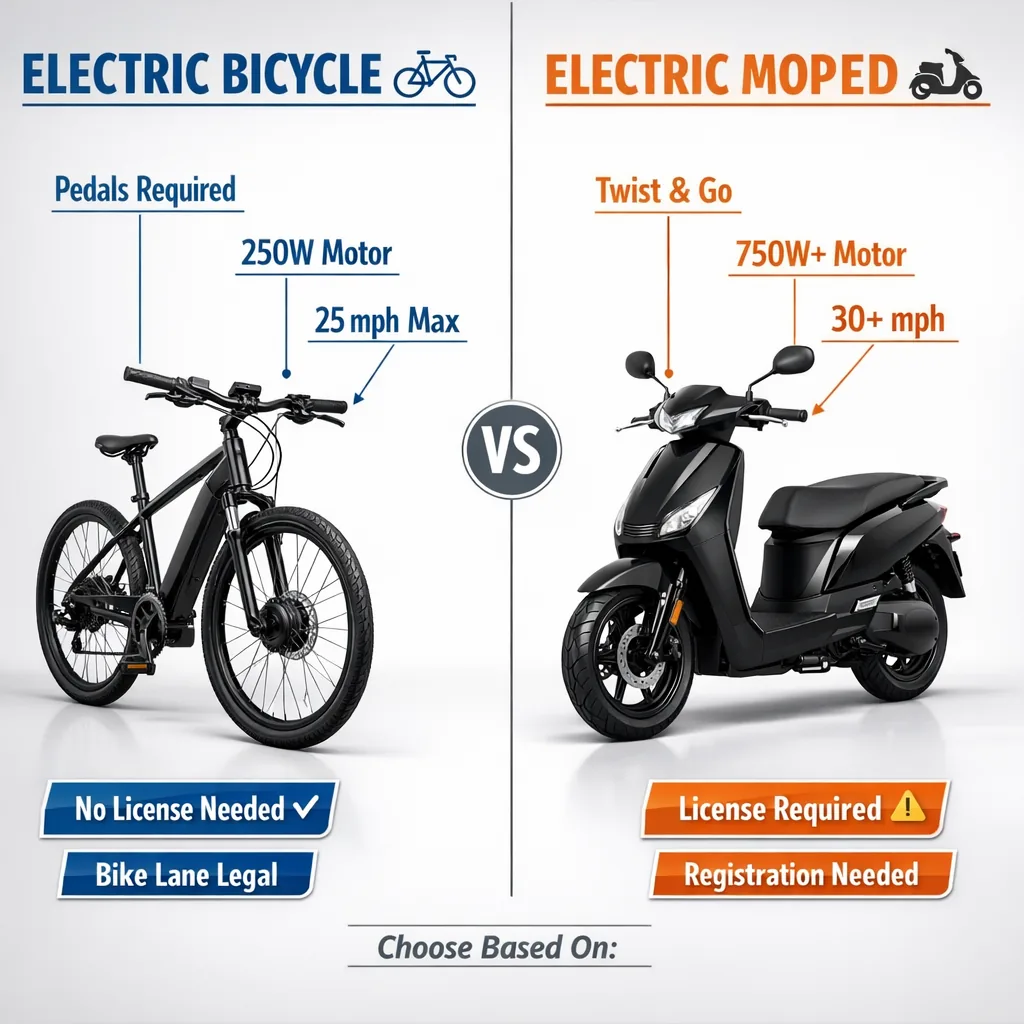
This is where North Carolina makes the biggest legal split.
For a moped, North Carolina's reviewed sources say:
That mix catches a lot of riders off guard. North Carolina is lenient on the operator-license side for mopeds, but it is not lenient on registration and insurance.
For an electric assisted bicycle, the reviewed statewide sources do not place the bike into the moped registration and insurance system. That is one of the biggest practical benefits of staying inside the electric assisted bicycle definition.
North Carolina has a bright-line helmet rule for mopeds. Operators and passengers on mopeds must wear a safety helmet that complies with FMVSS 218. North Carolina also says a motorcycle or moped cannot carry more people than it was designed to carry.
The reviewed official statewide sources do not add a separate bicycle-style helmet mandate for ordinary electric assisted bicycles. That does not mean riding without a helmet is smart. It only means the reviewed statewide legal sources here are much clearer on moped helmets than on e-bike-specific helmet mandates.
For street use, the biggest question is whether you are riding a true electric assisted bicycle or a registered moped. That classification drives almost everything else.
For path, greenway, sidewalk, and park access, North Carolina's statewide bicycle-law summary is more limited than many riders assume. NCDOT explicitly says its statewide bike-law page does not include local ordinances. That means a route that looks bike-friendly at first glance can still have city, county, campus, park, HOA, or other property-specific restrictions.
If your ride plan depends on a local greenway or multi-use path, check the local authority before you assume statewide bicycle rules settle the question.
That is the cleanest legal setup in North Carolina. Your bike starts on the electric assisted bicycle side of the law, not the moped side. The main follow-up question becomes where you plan to ride and whether local rules narrow access.
That is the classic North Carolina moped profile. You do not need a standard driver license to operate it if you are at least 16, but you still need registration and liability insurance, and you must wear a proper helmet.
Do not assume North Carolina's moped rules still protect you. Once the machine falls outside the DMV's moped definition, you may be in motorcycle territory instead.
Be careful. The reviewed North Carolina statutes do not use the modern class-based framework in the operative electric assisted bicycle definition. If your buying decision or riding plan depends on a class label, verify current state and local treatment before assuming the label decides the legal answer.