Electric bike laws by state can look similar at first glance, but the details change quickly once you get into Class 3 access, helmet rules, age limits, sidewalks, trails, and local ordinances. The short answer: most compliant low-speed e-bikes are treated closer to bicycles than mopeds, but your exact rights depend on the bike’s class and the place you ride.
Quick answer: Check your e-bike class first, then check your state, then check the road, path, park, campus, or trail where you plan to ride. Class 1 and Class 2 e-bikes usually face fewer access restrictions than Class 3 e-bikes. A state may allow e-bikes on public roads while still letting local authorities restrict them on sidewalks, shared paths, or natural-surface trails. State law is the starting point, not the whole rulebook.
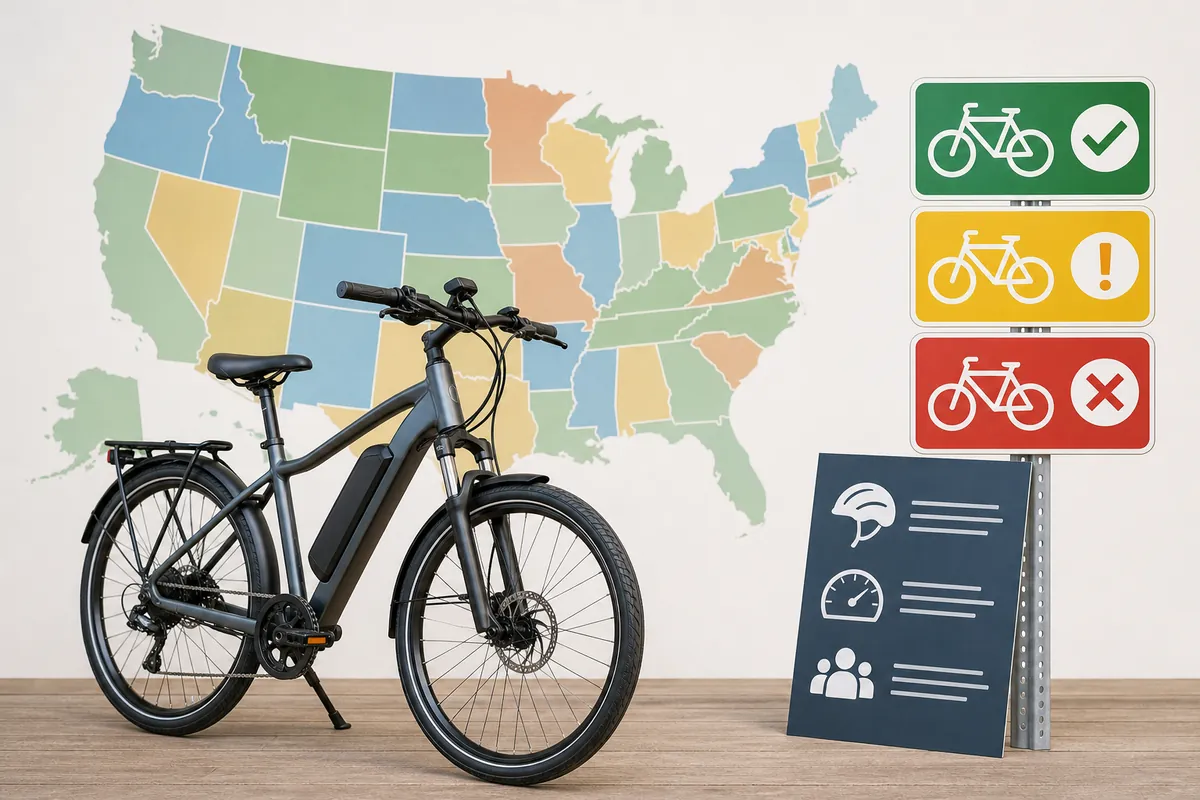
This guide is meant to help riders, buyers, and travelers know what to verify before they ride. It is not legal advice, and it should not replace the current text of your state code or a posted local rule. E-bike policy keeps moving, so the most useful approach is a layered one: identify the machine, identify the jurisdiction, then confirm the route.
Many states use the three-class system for low-speed electric bicycles. That system separates pedal-assist bikes, throttle-capable bikes, and faster pedal-assist commuter bikes from mopeds, scooters, and electric motorcycles.
| E-bike class | How the motor works | Typical assisted speed limit | Why riders should care |
|---|---|---|---|
| Class 1 | Pedal assist only | 20 mph | Usually the easiest class for road, bike-lane, and shared-path access. |
| Class 2 | Throttle may move the bike without pedaling | 20 mph | Often treated like a bicycle, but throttle access can matter on paths and trails. |
| Class 3 | Pedal assist only in the standard model | 28 mph | More likely to trigger helmet rules, age limits, speedometer rules, and path restrictions. |
At the federal product-safety level, a low-speed electric bicycle generally has fully operable pedals, an electric motor under 750 watts, and a motor-only top speed under 20 mph. That federal definition helps with product classification, but road use is mainly handled by state and local law.
If you are deciding whether your ride is really an e-bike, a moped, or a motorized bicycle, the line matters. Our guide to e-bike vs moped differences explains why a bicycle-style electric assist bike is not treated the same way as a faster motor vehicle. For broader road-use questions, see can you drive a motorized bike on the road.
The key legal distinction: A bike sold as an “e-bike” is not automatically legal as an e-bike in every state. If it exceeds the state’s power, pedal, speed, throttle, or class definition, it may fall into a moped, motorized bicycle, motor-driven cycle, motorcycle, or other vehicle category. That can change license, registration, insurance, equipment, and roadway requirements.
The table below avoids pretending every state can be reduced to one permanent rule. Instead, it gives you the first legal question to answer before you ride. For current cross-checking, PeopleForBikes maintains a public electric bike policy resource, and NCSL publishes a broader state electric bicycle law primer. Use those as references, then verify the current state code and local rules.
| State or district | Best first check | Common rider issue to verify |
|---|---|---|
| Connecticut | Check the three-class framework and helmet rules. | Helmet requirements, Class 3 operation, and local path restrictions. |
| Delaware | Check the state e-bike definition and bicycle-equipment rules. | Youth helmet rules and local path access. |
| Maine | Check the three-class framework. | Youth helmet rules and Class 3 path access. |
| Maryland | Check the three-class framework and local rules. | Youth helmet rules, trail access, and Class 3 limits. |
| Massachusetts | Check whether your bike fits current electric bicycle or motorized bicycle treatment. | License, registration, helmet, speed, and roadway rules. |
| New Hampshire | Check the three-class framework. | Class 3 age, helmet, and trail access restrictions. |
| New Jersey | Check the current low-speed e-bike and motorized-bicycle framework carefully. | License, registration, insurance, helmet, and faster-bike treatment. |
| New York | Check the three-class framework and city rules. | Class 3 restrictions, helmets, sidewalks, and local access. |
| Pennsylvania | Check the state pedalcycle-with-electric-assist definition. | Weight, speed, age, equipment, and trail access. |
| Rhode Island | Check the state e-bike definition and local rules. | Youth helmet rules, path access, and vehicle classification. |
| Vermont | Check the current state e-bike statute. | Local access, paths, and posted restrictions. |
| Washington, D.C. | Check District rules separately from state law. | Helmet, age, sidewalk, speed, and street-use rules. |
| State | Best first check | Common rider issue to verify |
|---|---|---|
| Alabama | Check the current three-class e-bike statute. | Class 3 age, helmet, label, and path-access rules. |
| Arkansas | Check the three-class framework. | Class 3 age, helmet, and trail limits. |
| Florida | Check the three-class framework. | Local trail rules, sidewalk rules, and youth helmet requirements. |
| Georgia | Check the three-class framework. | Class 3 helmet rules and local access restrictions. |
| Kentucky | Check current bicycle and administrative rules for electric-assisted bikes. | Equipment, local rules, and whether the bike fits the state definition. |
| Louisiana | Check the three-class framework. | Class 3 age, helmet, and local access rules. |
| Mississippi | Check the current three-class e-bike statute and local rules. | Class labeling, trail access, and municipal restrictions. |
| North Carolina | Check the current state e-bike definition. | Youth helmet rules, roads, paths, and local restrictions. |
| Oklahoma | Check the three-class framework. | Local paths, parks, and trail access. |
| South Carolina | Check whether your bike fits the state’s bicycle-style e-bike treatment. | Road access, local rules, and speed or power limits. |
| Tennessee | Check the three-class framework. | Class 3 age, helmet, and local restrictions. |
| Texas | Check the three-class framework. | Local restrictions, parks, and path access. |
| Virginia | Check the three-class framework. | Class 3 helmet rules and path restrictions. |
| West Virginia | Check the state class framework carefully. | Class 2 treatment, Class 3 helmet rules, and age limits. |
| State | Best first check | Common rider issue to verify |
|---|---|---|
| Illinois | Check the three-class framework and local authority rules. | Class 3 age rules and possible local regulation. |
| Indiana | Check the three-class framework. | Class 3 age, helmet, and path restrictions. |
| Iowa | Check the current e-bike definition and bicycle-style rules. | Local trail and park rules. |
| Kansas | Check the state e-bike definition. | Youth helmet rules and local access. |
| Michigan | Check the three-class framework. | Class 3 age, helmet, and trail access. |
| Minnesota | Check the current three-class e-bike statute. | Path access, trail rules, and local restrictions. |
| Missouri | Check the current three-class e-bike statute. | Class 3 age, speedometer, label, and path-access rules. |
| Nebraska | Check the state definition for electric-assisted bicycles. | Equipment, local trails, and path access. |
| North Dakota | Check the current three-class e-bike statute. | Licensing changes, local access, and trail rules. |
| Ohio | Check the three-class framework. | Class 3 helmet rules and local path restrictions. |
| South Dakota | Check the three-class framework. | Class 3 helmet, passenger, and access rules. |
| Wisconsin | Check the three-class framework. | Class 3 age rules and local trail restrictions. |
| State | Best first check | Common rider issue to verify |
|---|---|---|
| Alaska | Verify whether the bike is treated under bicycle, moped, or motorized-cycle rules. | License, registration, and road access. |
| Arizona | Check the three-class framework and local access rules. | Paths, parks, and posted trail restrictions. |
| California | Check the three-class framework plus local ordinances. | Class 3 helmets, age limits, speed modification rules, and path access. |
| Colorado | Check the three-class framework. | Class 3 access, youth helmet rules, and natural-surface trails. |
| Hawaii | Check state registration and county rules. | One-time registration, age rules, and where e-bikes may operate. |
| Idaho | Check the three-class framework. | Trail manager rules and local path restrictions. |
| Montana | Check the state e-bike definition and bicycle rules. | Local trail access and posted restrictions. |
| Nevada | Check the current three-class e-bike statute. | Path access, local ordinances, and whether your bike fits the state definition. |
| New Mexico | Verify whether moped-style rules apply. | License, registration, age, helmet, and road-use rules. |
| Oregon | Check the state electric-assisted bicycle definition. | Minimum age, sidewalk or path rules, and local restrictions. |
| Utah | Check the three-class framework and current state updates. | Class 3 youth rules, helmets, equipment, and trail access. |
| Washington | Check the three-class framework. | Natural-surface trails, local restrictions, and park rules. |
| Wyoming | Check the three-class framework and local authority rules. | Local registration fees, ordinances, and trail access. |
Many states that use the three-class system recognize Class 3 e-bikes, but “recognized” does not mean “allowed everywhere.” Class 3 is the higher-speed pedal-assist category, so it is the class most likely to come with extra restrictions.
Common Class 3 restrictions include minimum rider ages, helmet requirements, speedometer requirements, and limits on multi-use paths or natural-surface trails. If your e-bike assists above 20 mph, treat it as a higher-scrutiny ride. The faster the assist, the more local access rules matter.
Helmet law is especially easy to miss because some states apply it to young riders only, while others apply it specifically to Class 3 riders. If you are riding faster commuter routes, our e-bike helmet guide can help you think through the safety side alongside the legal side.
In most states with a modern three-class law, a compliant low-speed e-bike does not require a driver’s license, title, registration, or insurance. That is one of the main reasons the class system exists: it separates bicycle-like electric assist from mopeds and motorcycles.
The clean path can disappear when the bike no longer fits the state definition. Red flags include a motor above the legal wattage limit, disabled pedals, an unlocked controller, throttle behavior that exceeds Class 2 limits, or marketing that calls a high-powered electric vehicle an e-bike even though it performs more like a moped.
Riders often ask whether pedals alone mean no license is needed. Pedals help, but they are not the whole test. For a deeper look at the licensing line, read can you ride a motorized bicycle without a license.
Before you ride in a new state: Check five things in this order: e-bike class, motor wattage, top assisted speed, throttle behavior, and the exact road or trail rule. If any one of those does not match the state’s e-bike definition, pause and verify whether moped, motorized bicycle, or motor-vehicle rules apply.
One of the biggest e-bike law mistakes is assuming state recognition creates universal access. It does not. A state can classify an e-bike like a bicycle for road purposes while still allowing cities, counties, state parks, federal land managers, campuses, private communities, and trail systems to restrict certain classes.
Compliant Class 1 and Class 2 e-bikes are often allowed where conventional bicycles are allowed, especially on roads and bike lanes. Class 3 e-bikes may also be allowed on roads, but they are more likely to carry helmet, age, speedometer, or equipment rules.
Sidewalks deserve their own check. Even when bicycles are allowed on some sidewalks, e-bikes may be restricted by class, speed, business district, rider age, or local ordinance. Shared paths can be similar: a route that welcomes a Class 1 e-bike may restrict a throttle-equipped or faster bike.
Trail access is often controlled separately from street access. A city greenway, state park trail, rail trail, mountain-bike trail, and federal land route can all have different rules. Posted signs matter, and local trail managers may limit classes even when the statewide e-bike statute is permissive.
Start with the bike. Look for a class label, motor wattage, top assisted speed, and throttle behavior in the manual or on the frame. A compliant label is required in many three-class states, and it gives you the language you need when comparing your bike to the law.
Search your state code for terms like “electric bicycle,” “low-speed electric bicycle,” “motorized bicycle,” “moped,” and “motor-driven cycle.” Then check city, county, park, and trail rules for the exact place you plan to ride. Posted signs and local ordinances can be stricter than the broad statewide rule.
Rules can change, and a neighboring state may treat the same bike differently. Re-check before a road trip, vacation rental, campus commute, or long-distance trail ride. This is especially important for Class 3 riding, youth riders, labeling rules, and trail systems.
The first mistake is assuming that anything sold online as an e-bike is street legal. Retail availability is not the same thing as legal classification. Some fast electric vehicles are marketed with bicycle language while exceeding the limits that make an e-bike an e-bike.
The second mistake is treating trails like roads. Road access, paved path access, mountain-bike trail access, and park access may be controlled by different authorities. A Class 1 e-bike may be allowed where a Class 3 e-bike is restricted.
The third mistake is ignoring the rider. Age and helmet rules can apply to the person operating the bike, not just the bike itself. For families, teens, guests, and shared household e-bikes, the legal rider can matter as much as the legal machine.
Electric bike laws by state are easiest to handle when you break the question into layers. First, confirm that your bike fits a legal e-bike definition. Second, identify whether your state uses the common three-class system or a different framework. Third, check the exact local road, lane, sidewalk, path, trail, or park where you plan to ride.
For many compliant Class 1 and Class 2 e-bikes, the legal path is fairly straightforward. Class 3 riders need to be more careful about helmets, age limits, and access. If your bike is faster, more powerful, unlabeled, modified, or throttle-heavy, verify the rules before assuming bicycle treatment applies.