If you are comparing a class 2 vs class 3 ebike, the practical difference is simple: a Class 2 ebike usually gives you throttle assistance up to 20 mph, while a Class 3 ebike is built for faster pedal assist, commonly up to 28 mph. Class 2 is usually the easier everyday pick. Class 3 is usually the better road-commuter pick.
Quick answer: Choose a Class 2 ebike if you want throttle help, easy starts, casual errands, or a calmer ride around town. Choose a Class 3 ebike if your route rewards higher assisted speed, you mainly ride on roads, and you are willing to check local rules for faster electric bikes.
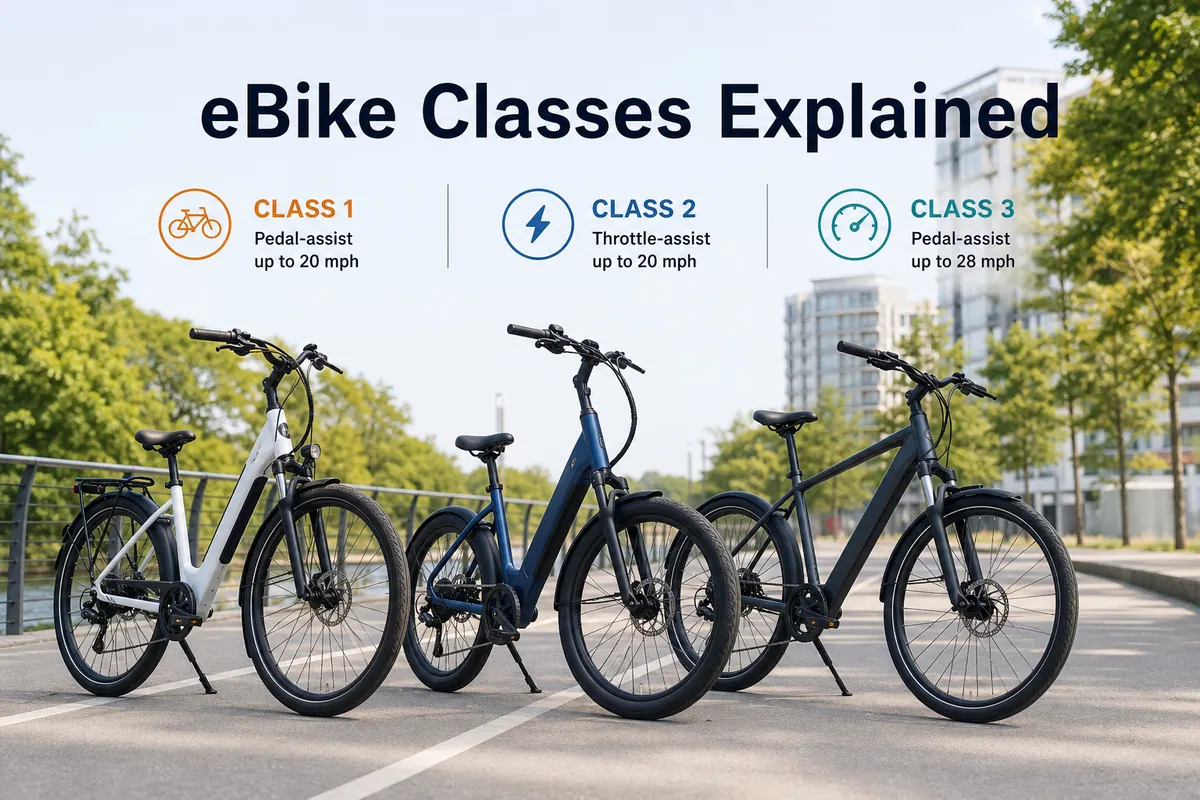
The two classes overlap enough to confuse buyers. Both are electric bikes. Both can be useful for commuting, errands, and hills. The class label still matters because it affects how the bike feels, where it may be allowed, how quickly it blends with traffic, and whether the motor can help without pedaling.
A Class 2 ebike has a motor that can assist with a throttle, typically up to 20 mph. You can still pedal, but the defining feature is that the motor can move the bike without active pedaling.
A Class 3 ebike is centered on faster pedal assist, typically up to 28 mph. In common three-class language, the motor keeps helping while you pedal until it reaches the higher assisted-speed limit. Some models blur the line with configurable settings or throttles limited to lower speeds, so the label on the bike and your local rules both matter.
If you want to understand why two bikes in the same legal class can feel different, MBHQ’s guide to electric bike motors explained is a useful next stop. Motor placement, controller tuning, and sensor type can change the ride as much as the class badge.
| Feature | Class 2 Ebike | Class 3 Ebike |
|---|---|---|
| Typical assist limit | Up to 20 mph | Up to 28 mph with pedal assist |
| Throttle | Usually yes | Depends on model and local rules |
| Best fit | Errands, casual rides, stop-and-go use | Road commuting, longer routes, faster pacing |
| Rider effort | Can be low because throttle help is available | Usually requires pedaling for higher-speed assist |
| Rule sensitivity | Often simpler, but still location-dependent | More important to verify road, path, age, and helmet rules |
A Class 2 ebike is the practical pick when convenience matters more than top assisted speed. The throttle can help you get rolling from a stop, creep through a parking lot, recover on a hill, or finish short errands without turning every ride into a workout.
That makes Class 2 especially appealing for riders who value confidence. If you are carrying groceries, restarting on an incline, towing light cargo, or dealing with repeated stop signs, throttle assist can feel less like a gimmick and more like the feature that keeps the bike useful.
Class 2 can also be the calmer choice for mixed-use riding. You may not need 28 mph assist if most of your trips are neighborhood routes, bike lanes, local paths, or short commutes with frequent stops. At those speeds, handling, brakes, tires, lights, and fit often matter more than the headline number.
If budget is part of the decision, compare the class question alongside overall value. MBHQ’s guide to the best electric bikes under $2000 can help you judge what you are getting for the money, not just which class is printed on the frame.
Good fit for Class 2: Class 2 is usually the better match for riders who want throttle help, lower-speed comfort, simple errands, and less pressure to ride at traffic-like speeds. It is not automatically “less capable”; it is tuned for a different kind of use.
A Class 3 ebike earns its keep when your route rewards speed. If you commute several miles on roads, ride near faster traffic, or want to cut trip time without moving to a moped-style vehicle, the extra assisted speed can matter.
The tradeoff is that Class 3 asks more from the rider and the bike. At 25 to 28 mph, you want stable geometry, strong brakes, quality tires, visible lighting, and a helmet you actually like wearing. The ride can be excellent, but it is less casual. Class 3 feels best when the whole bike is built for speed, not just unlocked for it.
Legal details can also become more important with Class 3. Some places treat faster ebikes differently on paths, trails, sidewalks, and shared-use routes. Rules can vary by state, city, park system, and facility, so treat the class label as a starting point rather than a universal permission slip.
The throttle question is where many buyers should slow down. A throttle is not just about laziness, and pedal assist is not automatically more serious. They create different riding rhythms.
Throttle help is useful when the hard part is getting started. That includes hills, heavy cargo, intersections, fatigue, or moments when you need a small push without finding the perfect gear. For many newer riders, that extra control makes the bike feel friendlier.
Pedal assist feels more bicycle-like. The motor responds as you pedal, so your legs remain part of the system. On a Class 3 ebike, that can create a fast, efficient commuter feel: you still ride, but the bike helps you hold a pace that would be hard to maintain on a traditional bicycle.
Neither approach is morally better. The useful question is more practical: Do you want the motor to help you start, or help you sustain speed?
Class 3 speed can be addictive, but higher speed usually uses more energy. Wind resistance rises quickly as you go faster, and a bike cruising near 28 mph may drain the battery sooner than the same bike ridden around 16 to 20 mph.
Class 2 riders can also drain a battery quickly if they rely heavily on throttle, especially on hills or with cargo. Throttle use feels effortless to the rider, but the battery is still doing the work.
Published range estimates are best treated as rough comparisons. Your route, tire pressure, rider weight, cargo, weather, assist level, and stop-and-go pattern all affect the final number. Before you buy, use MBHQ’s e-bike buying tips to compare the whole bike: brakes, battery, motor, fit, serviceability, and warranty support.
Practical buying tip: If two ebikes cost about the same, do not automatically choose the faster one. A well-built Class 2 with good brakes, a comfortable fit, and a useful rack may serve you better than a cheaper Class 3 that feels nervous at speed or cuts corners on components.
For short urban commutes, Class 2 often wins on convenience. You can use the throttle from stops, ride comfortably at bike-lane speeds, and avoid buying more speed than your route can use. If your commute is full of lights, crossings, and tight turns, 28 mph assist may rarely matter.
For longer road commutes, Class 3 becomes more compelling. The higher assist limit can shrink travel time and help you maintain a steadier pace. That is especially valuable when your route includes long straight roads, wide shoulders, or bike lanes where faster travel feels appropriate.
Still, faster commuting raises the safety bar. At Class 3 speeds, think about mirrors, daytime running lights, reflective gear, puncture protection, hydraulic disc brakes, and a helmet built for the way you ride. MBHQ’s e-bike helmet guide is worth reading before you treat higher speed as a free upgrade.
When you are ready to compare actual models, start with your route instead of the biggest wattage number. Look for the class label, throttle behavior, assisted-speed limit, brake type, battery capacity, frame fit, rack compatibility, and whether the brand clearly explains local-use limitations.
For most buyers, the best shortlist includes one practical Class 2 and one road-friendly Class 3. That makes the real tradeoff visible: easy throttle control versus faster pedal-assisted commuting. The better buy is the one that matches your roads, not the one with the louder spec sheet.
Buy a Class 2 ebike if you want the friendliest all-around electric bike for errands, starts from a stop, casual rides, and throttle-assisted convenience. It is the better default for many riders because it solves everyday friction without pushing you into faster riding.
Buy a Class 3 ebike if your main goal is a quicker commute and your route supports higher assisted speeds. The extra pace can be genuinely useful, but it works best when the bike has the brakes, tires, lighting, and stability to match.
The cleanest decision is this: Class 2 is about easy help; Class 3 is about faster travel. Choose the one that fits your real routes, not the one that sounds more impressive on paper.
* We may earn a commission when you buy through our links.