The best lights for ebike commuting are bright enough to help you see the road, visible enough to help drivers notice you, and sturdy enough to stay aimed on a heavier, faster bike. For most commuters, the right setup is a front road light, a rear taillight, side visibility, reliable mounting, and enough runtime to cover your full round trip with margin.
Quick answer: For everyday e-bike commuting, choose a front light around 500 to 1,000 lumens for lit city streets, and consider more output if your route includes dark paths, rural shoulders, or rough pavement. Pair it with a bright rear light that has steady and pulsing modes. The best commuter setup is not just the brightest one; it is visible from the front, rear, and sides, easy to charge, and secure enough that the beam stays where you aimed it.
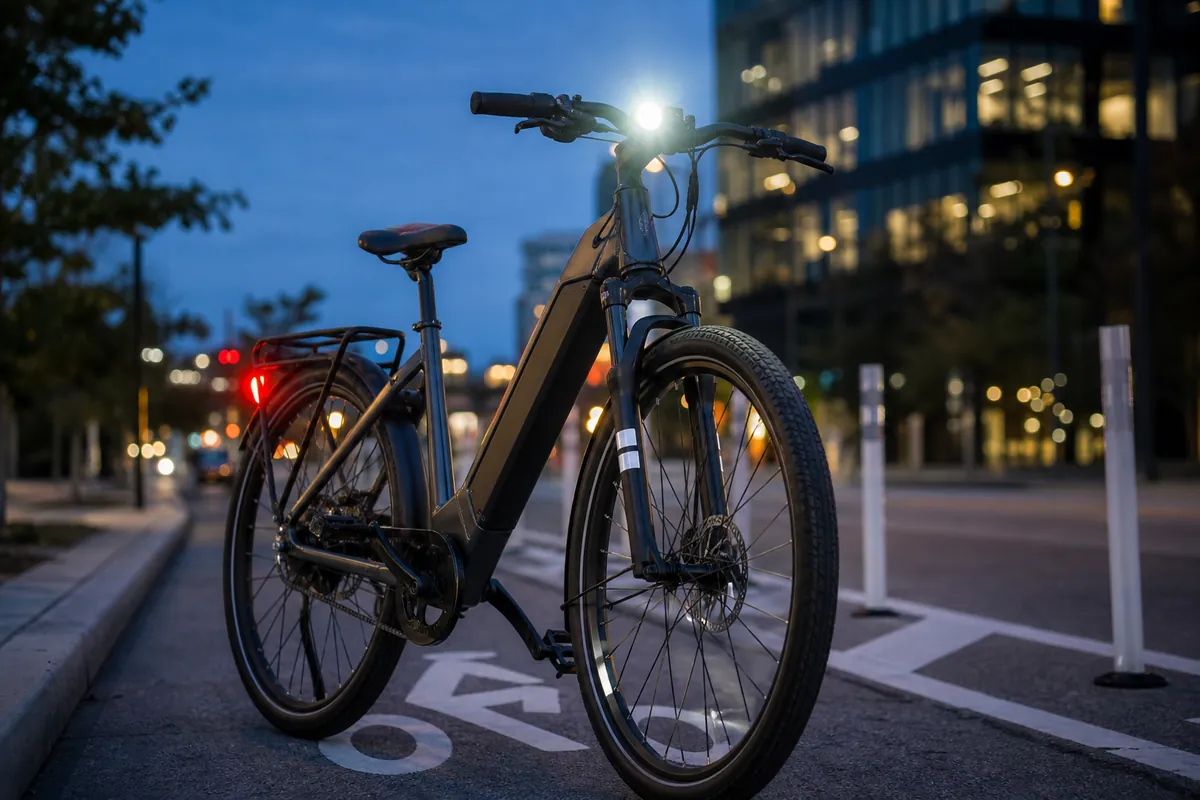
E-bikes make lighting more important, not less. You may be riding with traffic more often, accelerating faster from stops, and covering longer distances after work. A tiny “be seen” light that feels acceptable on a slow neighborhood bike can feel underpowered once your commute includes winter darkness, rain, uneven pavement, or busier roads.
A good commuter lighting setup has three jobs: illuminate the road ahead, make your bike recognizable from behind, and help cross traffic notice you from the side. One powerful front light alone does not solve all three.
The practical baseline is a front headlight plus a rear taillight. From there, add side visibility with reflective tire sidewalls, spoke reflectors, reflective bags, ankle bands, or side-facing LEDs. The goal is not to make the bike look overloaded. It is to make your speed, position, and direction easier to read from multiple angles.
Commuter lighting rule of thumb: If your route includes cars, intersections, or unlit stretches, buy your lights as a system. A bright front beam helps you avoid potholes and debris; a rear light and side visibility help everyone else understand where you are.
Lumens are the number most shoppers notice first, but they are not the whole story. Beam shape, mounting position, runtime, and glare control all matter. A 700 lumen light with a useful commuter beam can be better than a higher-lumen light that throws light everywhere and blinds oncoming riders.
For lit city streets, many commuters are well served by a front light in the 500 to 1,000 lumen range. If your ride includes dark trails, country roads, rough shoulders, or poor street lighting, more output or a second light may be worth it. The rear light does not need to light the road, but it should be bright and consistent enough to stand out during rain, twilight, and stop-and-go traffic.
Do not buy only by the biggest lumen number. Look for a beam that puts light where you need it: down the lane, across the shoulder, and far enough ahead that you have time to react at e-bike speeds.
| Lighting need | What to look for | Why it matters for commuting |
|---|---|---|
| Front road light | Roughly 500-1,000 lumens for lit routes; more for dark roads | Helps you spot potholes, debris, curbs, and lane edges |
| Rear visibility | Bright taillight with steady and pulsing modes | Makes your position clearer to drivers approaching from behind |
| Side visibility | Reflective tires, spoke reflectors, side LEDs, or reflective bags | Improves visibility at driveways, intersections, and cross streets |
| Runtime | Enough battery for the full commute plus extra margin | Prevents the light from fading before you get home |
| Mounting | Secure brackets that fit your handlebar, rack, seatpost, fork, or helmet | Reduces slipping, vibration, and awkward beam angles |
The front light is where most of your lighting budget usually belongs. It should be bright, easy to aim, and secure on the bike. E-bikes can vibrate more than casual bicycles because they are heavier, faster, and often ridden on imperfect pavement. A loose mount that droops every few miles is more than annoying; it can turn a good light into a bad one.
A commuter beam should cover the lane without blasting oncoming riders and drivers. Some lights have a broad flood pattern, some reach farther down the road, and better commuter lights balance both. If you ride around pedestrians or other cyclists, a controlled beam is a real quality-of-life upgrade.
Many e-bikes have crowded handlebars: display, throttle, bell, phone mount, mirror, brake levers, and sometimes a suspension control or controller. Before choosing a light, look at the space you actually have. A compact light may fit better than a larger high-output unit.
If your bike already has an integrated light, you may still want a secondary rechargeable light. Built-in lights are convenient, but output and aim vary widely by bike. A backup front light also helps if your main system fails, your display settings change, or your bike battery is lower than expected.
Rear visibility is easy to underestimate until you ride in traffic. A good rear light should be noticeable without being chaotic. Many commuters prefer a steady mode at night and a pulsing or daytime flash mode in brighter conditions, depending on local rules and courtesy around other riders.
Some rear lights include brake-sensing features that brighten when you slow down. These can be useful, especially on faster commuter e-bikes, but they are not a substitute for predictable riding, clear lane position, and good braking habits. If you are evaluating your broader safety setup, pair lighting with a proper helmet choice; our e-bike helmet guide covers what to consider for everyday riding.
Side visibility matters most at intersections. Drivers turning across a bike lane may not see a front or rear light clearly. Reflective tires, reflective frame decals, ankle bands, and side-facing LEDs can make the bike easier to notice from a cross angle.
Practical commuter tip: After installing lights, check them from a driver’s eye level if you can. Stand 30 to 50 feet away in front, behind, and to the side. A light that looks bright from the saddle may be aimed too low, too high, or partly blocked by a basket, bag, jacket, or rack.
For commuting, runtime is less about the maximum number printed on the box and more about your real route. A light might last many hours on low mode but far less on high. Cold weather can also reduce battery performance, and winter commuting often demands more light for more of the ride.
A simple rule: choose lights that can cover your round trip on the mode you actually expect to use, then add buffer. If your commute is 45 minutes each way, do not rely on a light that barely claims 90 minutes on high. You want margin for detours, errands, missed charges, and aging batteries.
USB-C charging is convenient if you already charge your phone, helmet communicator, or bike accessories at your desk. Removable battery lights can still make sense for riders who prefer carrying a spare. Either way, build charging into your routine, just like you would with broader e-bike battery maintenance.
Commuter lights should be ready for wet roads and surprise weather. Look for clear water-resistance claims from the manufacturer, sealed charging ports, and mounts that do not loosen when the bike gets sprayed with road grit.
Water resistance is especially important because lights often sit in exposed positions: handlebar, fork, rack, seatpost, or helmet. If your commute includes wet months, our guide to whether you can ride an e-bike in the rain is a useful companion piece. Lights are only one part of staying visible and protecting the bike.
A helmet light can be helpful because it points where you look. That makes it useful for reading street signs, checking turns, or getting a driver’s attention at an intersection. Still, a helmet light should usually be a supplement, not your only light.
Bike-mounted lights show where the bike is. They are more stable, easier for others to interpret, and less likely to shine directly into someone’s eyes when you turn your head. For commuting, the stronger setup is usually a handlebar or fork-mounted front light, a rear light on the bike, and optional helmet lighting for extra awareness.
Avoid tiny novelty lights if your commute puts you near traffic. They may satisfy a bare-minimum visibility need in calm neighborhoods, but they are often not enough for faster e-bike travel.
Also be cautious with ultra-cheap lights that make big brightness claims but provide little detail about runtime, beam pattern, mount quality, or water resistance. A commuter light is safety gear. You do not need the most expensive option, but you do want one that feels dependable every workday.
Finally, do not ignore theft and removal. Quick-release lights are convenient for charging, but they are also easy to take. If you park outside, remove your lights along with your battery or other accessories when practical. For a broader parking setup, see our guide on how to securely lock your bike.
Before you buy, run through this short checklist:
If you are ready to compare current options, use the search below as a starting point for commuter-focused e-bike light sets and individual front or rear lights. Match the product to your route, not just the headline lumen claim.
The best lights for e-bike commuting are the ones that match your route, your speed, and your parking routine. Start with a reliable front light and rear light, then add side visibility if you ride near intersections or traffic. Prioritize secure mounting, real runtime, weather resistance, and a beam that helps you see without creating glare.
A good light setup is one of the simplest upgrades you can make to an e-bike. It makes early mornings, late evenings, cloudy weather, and winter rides feel more controlled. More importantly, it helps other road users understand where you are and what you are doing.
* We may earn a commission when you buy through our links.