The best ebike for hunting is usually a quiet fat-tire electric bike with strong low-speed control, enough battery margin for cold and loaded rides, and a frame that can carry gear without feeling unstable on rough ground. For most hunters, that means prioritizing torque, traction, payload, braking, and serviceable parts before top speed or flashy accessories.
Quick answer: Look for a hunting ebike with 4-inch fat tires, strong hill-climbing torque, hydraulic disc brakes, a removable battery, attachment points for racks or trailers, and a realistic range estimate based on loaded off-road riding. A throttle can be useful for slow technical sections, but trail and land-use rules vary, so confirm access before riding into public hunting areas.
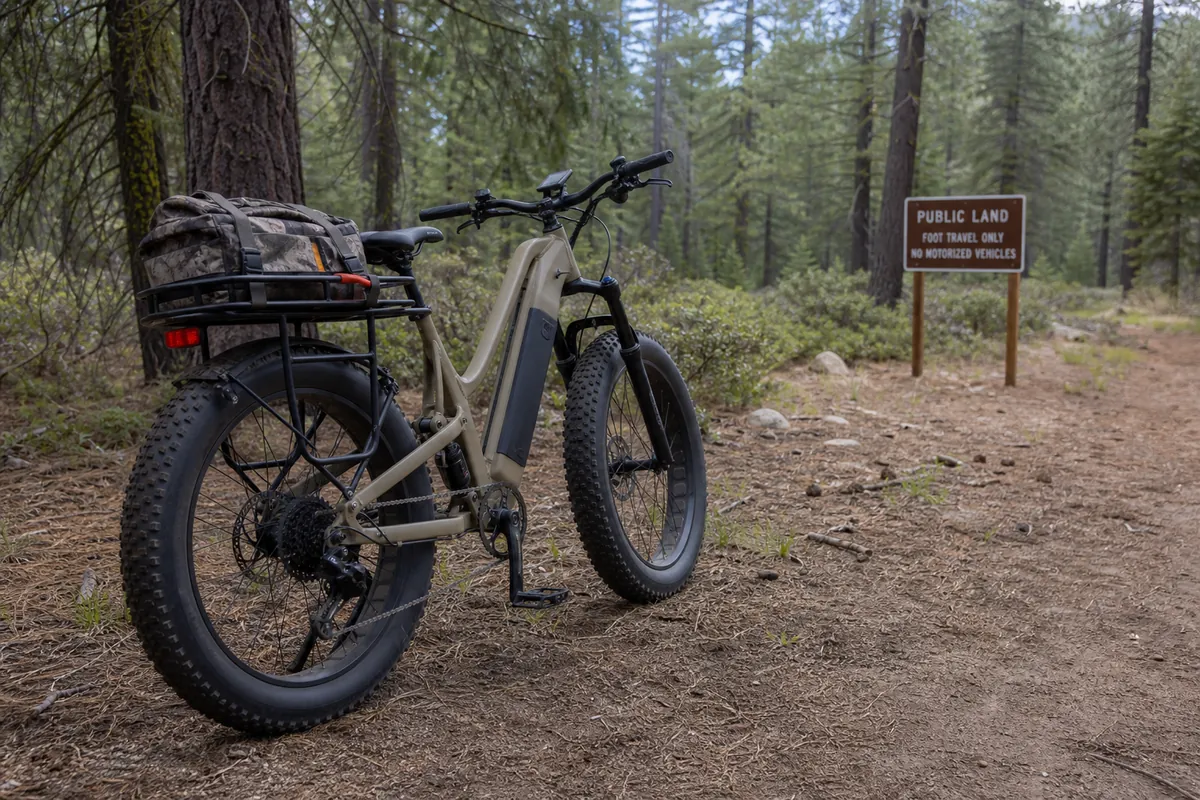
A hunting ebike is not just a commuter bike with camouflage paint. It has to move quietly over ruts, sand, mud, gravel, grass, leaves, and old logging roads while carrying more than a rider. It may need to haul a bow, a legal firearm case, a tree stand, layers, water, field pack, or a trailer. That extra load changes what “good” means.
If you are still comparing broad electric bike categories, start with the wider best electric bikes guide first. For hunting use, though, the shortlist gets narrower fast: you want stability, low-speed control, and enough battery reserve to get back after a long sit or a cold morning.
The strongest hunting ebike is the one that helps you get closer without creating new problems. It should be quiet, controlled, and dependably practical. A bike that feels exciting on pavement can feel underbuilt when it is loaded with gear on a washed-out trail.
For hunting, the big questions are simple:
That last point matters more than many buyers expect. A hunting bike may see mud, dust, creek crossings, freezing mornings, and long stretches in storage. If the parts are unusual or hard to replace, a small issue can sideline the bike during the season.
Buyer note: Manufacturer range claims are usually made under easier conditions than loaded hunting rides. Treat advertised range as a best-case number, then build in a buffer for hills, soft surfaces, cold weather, and cargo weight.
There is no single perfect spec sheet for every hunter. A whitetail hunter riding farm lanes has different needs than someone climbing rocky western terrain. Still, the best hunting ebikes usually share a few traits.
For off-road hunting access, fat tires are often worth the extra weight. A tire around 4 inches wide can add stability over sand, snow, leaves, grass, and soft dirt. It also helps the bike feel calmer when you are moving slowly with gear strapped to the rear rack.
Do not judge tires by width alone. Look for tread that matches your terrain. A mild tread may roll more efficiently on gravel roads, while a deeper tread can help in mud or loose climbs. If your rides include long paved sections before the trail, a very aggressive tire can feel slow and loud.
For hunting, torque matters more than a big speed number. You want smooth help at low speeds, especially when starting on an incline or crawling through uneven ground. Mid-drive motors can feel natural on climbs because they work through the bike’s gears, while hub motors can be simpler and often cost less.
The right choice depends on terrain and budget. If your route is mostly flat roads, two-track, and moderate dirt, a quality hub-drive fat bike may be enough. If you regularly climb steep trails with cargo, a torque-rich setup becomes more important. Our guide to electric bike motors can help you understand the tradeoffs before you buy.
Battery capacity is important, but range is never just a battery number. Rider weight, tire pressure, assist level, temperature, terrain, wind, cargo, and stop-start riding all matter. A bike that feels generous on summer pavement can lose useful range on a cold morning with soft ground under the tires.
A removable battery is strongly preferred for hunting. It lets you charge indoors, store the battery at a friendlier temperature, and reduce theft risk when the bike is parked. If battery care is new to you, read e-bike battery maintenance before your first season; good habits can help preserve range and reliability.
Payload rating is not a decorative spec. It tells you how much combined rider and cargo weight the bike is designed to handle. For hunting, leave margin. Gear adds up quickly, and a successful pack-out can push a bike well beyond the casual weekend load it was built around.
Look for sturdy rear rack mounts, front rack compatibility, bottle or accessory mounts, and trailer support if you plan to haul heavier loads. A trailer can be useful, but it changes handling and braking distance. The better setup is the one you can control when tired, cold, and riding slowly.
Hydraulic disc brakes are a smart baseline for loaded hunting use. Larger rotors can help with heat and control on descents, especially when the bike is heavy. Mechanical disc brakes can work, but they often require more hand effort and adjustment.
Suspension depends on terrain. Front suspension can take the edge off rough trails, while full suspension may help in rocky areas. The tradeoff is cost, weight, and maintenance. For many hunters, a solid fat-tire frame with a decent suspension fork is a practical middle ground.
| Priority | What to Look For | Why It Matters for Hunting |
|---|---|---|
| Traction | Fat tires with terrain-appropriate tread | Improves control on mud, sand, grass, leaves, and rutted access roads |
| Power | Strong low-speed torque, not just high wattage claims | Helps with loaded starts, climbs, and technical sections |
| Range | Removable battery with a realistic reserve | Cold weather, hills, and cargo can reduce usable range |
| Hauling | High payload rating, rack mounts, trailer compatibility | Lets the bike carry field gear without unsafe improvisation |
| Control | Hydraulic disc brakes and stable frame geometry | Loaded off-road riding requires predictable stopping and handling |
The best way to narrow your choice is to start with where you actually ride. A bike that is perfect for flat timber access may be the wrong pick for steep mountain roads.
For flatter routes, you can usually prioritize range, cargo setup, and comfort. A rear hub motor may be perfectly reasonable if the surfaces are firm and grades are mild. Choose tires that do not waste too much energy on long gravel or dirt-road approaches.
Steep ground pushes the motor, battery, brakes, and drivetrain harder. Look for stronger torque, lower gearing, good cooling behavior, and brakes that inspire confidence. If your route includes long climbs, be conservative with range estimates and avoid buying the lowest-capacity battery that “should” work.
Soft surfaces reward flotation and throttle control. Fat tires, appropriate pressure, and smooth power delivery matter here. A bike that surges abruptly can break traction, while one with predictable assist is easier to place on narrow or uneven lines.
Before buying, check the rules for the exact land where you plan to ride. Electric bike access can vary by agency, trail, class, motor behavior, and local policy. Some areas may treat throttle-equipped bikes differently from pedal-assist models. Do this check before you commit, not after the bike is already in your garage.
Practical callout: Do one loaded shakedown ride before hunting season. Pack the bike the way you plan to use it, ride the roughest section of your route, test braking on a descent, and confirm you can still lift, turn, and park the bike safely.
A hunting ebike can be a great tool, but the category also attracts overbuilt-looking bikes with vague specs. Be careful with any model that leans on camouflage, extreme range promises, or huge wattage numbers while skipping the basics.
Watch for these red flags:
Also be realistic about weight. Many hunting ebikes are heavy even before you add racks, bags, and tools. That weight can be fine while riding, but awkward when loading into a truck, lifting over a gate where permitted, or recovering from a bad line. If you cannot move the bike confidently off the saddle, it may be too much bike for your use case.
If you are shopping now, use a simple three-step filter.
First, define the route: distance, elevation, surface, expected temperature, and whether you need to transport the bike by truck, hitch rack, or trailer. Heavy hunting ebikes can exceed the limits of ordinary racks, so confirm your setup before buying. If you are unsure, this guide to whether your car rack can carry an e-bike is worth reading before the bike arrives.
Second, set a realistic spec floor. For most hunting buyers, that means fat tires, hydraulic disc brakes, a removable battery, useful cargo mounts, and enough motor torque for your steepest loaded section. Nice-to-have features include integrated lights, fenders, puncture-resistant tires, walk mode, and a quiet drivetrain.
Third, compare available bikes by support, not just specs. Warranty clarity, replacement battery availability, brake and tire standards, and local service access can matter more than a small difference in claimed range.
For a broad marketplace scan, use the search below to compare current hunting-oriented electric bikes and accessories. Treat it as a starting point, then verify the exact model specs, seller reputation, warranty, return policy, and local access rules before purchasing.
The best hunting ebike is not necessarily the most powerful or most expensive model. It is the bike that matches your terrain, carries your gear safely, gives you enough real-world range, and stays serviceable after muddy, cold, stop-and-go use.
For most buyers, start with a fat-tire electric bike with strong low-speed torque, hydraulic disc brakes, a removable battery, and real cargo capability. Then narrow the field by terrain: flatter access routes can favor range and comfort, while steep or soft ground demands more torque, traction, and braking control. Buy with a margin, test the bike loaded, and confirm access rules before you rely on it for a hunt.
* We may earn a commission when you buy through our links.