If you want ebike helmet laws explained in plain English, start here: there is no single U.S. helmet rule that covers every electric bike rider, every e-bike class, and every riding location. Helmet requirements usually depend on your state, city, rider age, e-bike class, and the specific road, path, park, campus, or trail where you ride.
Quick answer: Most U.S. e-bike helmet laws are set by states, local governments, or property managers rather than one universal national riding rule. Adults on Class 1 or Class 2 e-bikes may not always be required to wear helmets, while minors and Class 3 riders are more likely to face helmet requirements. Before assuming you are exempt, check your e-bike class, your rider age category, your state law, your local ordinance, and any posted trail or park rules.
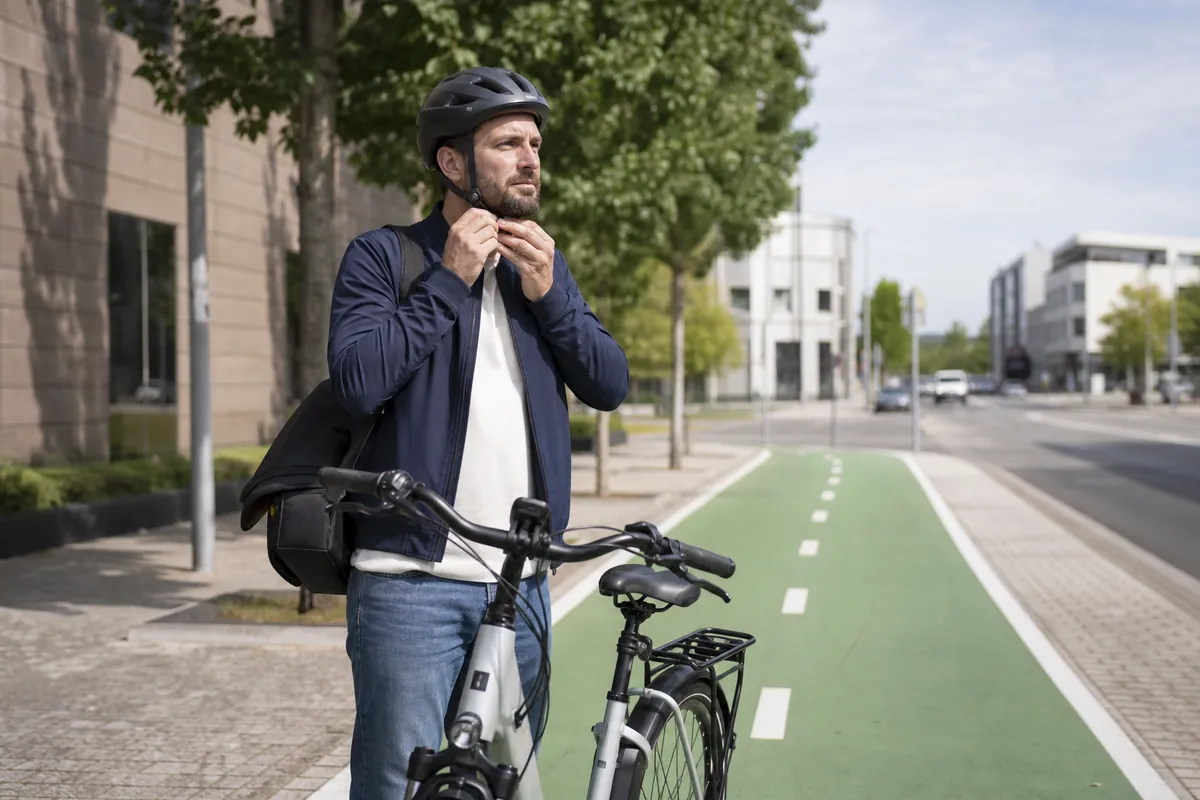
The confusing part is that e-bike rules stack in layers. A ride that appears legal without a helmet under one statewide rule may still require one on a local path, in a park system, on a school campus, under a rental agreement, or on private property. The practical move is to treat helmet law as a pre-ride checklist, not a single yes-or-no answer.
Most U.S. e-bike law discussions start with the three-class system. A Class 1 e-bike provides pedal assist up to 20 mph. A Class 2 e-bike can use a throttle up to 20 mph. A Class 3 e-bike provides pedal assist up to 28 mph and is often treated more cautiously because it operates at higher assisted speeds.
That class label matters. Some states and cities treat Class 1 and Class 2 e-bikes much like traditional bicycles, while Class 3 e-bikes may trigger extra helmet, age, equipment, or access rules. If you are still choosing a bike, check the legal category before you buy; our e-bike buying tips guide can help with the purchase side while this guide focuses on helmet-law basics.
The rule of thumb: If the rider is a minor, the e-bike is Class 3, the route includes public paths, or the device is faster than a standard three-class e-bike, do a direct legal check before riding. Being technically exempt from a helmet mandate is not the same thing as being well protected.
At the federal level, the most important helmet rule is about helmet safety standards, not a universal command that every e-bike rider must wear one on every ride. The Consumer Product Safety Commission states that bicycle helmet requirements are published in 16 CFR Part 1203, which sets the U.S. safety standard for bicycle helmets sold for bicycle use.
In other words, federal rules help define what a compliant bicycle helmet must be. Helmet-use laws are usually handled by states, cities, counties, park systems, trail managers, campuses, and other local authorities. The National Conference of State Legislatures’ electric bicycle law primer shows how states vary on e-bike classifications, access rules, age limits, and helmet requirements, including different treatment for Class 3 e-bikes in some states.
Every jurisdiction deserves its own check, but e-bike helmet laws often follow a few familiar patterns. Knowing the pattern helps you spot the details that matter before a ride.
| Law pattern | What it usually means | What to verify |
|---|---|---|
| Age-based helmet rule | Children or teens under a stated age must wear a helmet on bicycles, e-bikes, or both. | The age cutoff and whether the rule covers passengers as well as operators. |
| Class 3 helmet rule | Higher-speed pedal-assist e-bikes may have stricter helmet requirements. | Whether the rule applies to all Class 3 riders or only riders under a certain age. |
| Local path or park rule | A city, county, campus, trail manager, or park authority can add its own safety rules. | Posted signs, municipal code, park pages, and trail-use policies. |
| No statewide adult mandate | Adults may not be required by state law to wear a helmet in some e-bike situations. | Local rules, route restrictions, rental rules, employer policies, and insurance terms. |
| Device falls outside e-bike limits | A high-powered or modified vehicle may be treated as a moped, motorcycle, or another vehicle type. | Motor wattage, assisted speed, pedals, throttle behavior, registration, and license rules. |
Class 3 e-bikes can assist up to 28 mph, which puts them in a faster operating range than a typical casual bicycle ride. That does not automatically make them mopeds or motorcycles, but it does explain why some lawmakers attach stricter helmet, age, or access rules to Class 3 use.
This is where buyers can get surprised. A commuter may choose a faster e-bike for traffic flow, then later discover that the faster class changes where the bike can be ridden or whether a helmet is required. If you are comparing a fast electric bike with something closer to a moped, read our e-bike vs moped breakdown before assuming the rules are the same.
The cleanest way to check your helmet requirement is to move from broad to specific. Start with your state transportation department, DMV, legislature, or official e-bike page. Then check your city or county rules. Finally, check the place you plan to ride, because a park road, paved trail, boardwalk, college campus, state park, or private property can have its own posted requirements.
When you check, look for these details:
Practical legal check: Before riding somewhere new, search the official state source first, then the city, county, park, or trail authority. If summaries conflict, rely on the government or managing-agency source. Retailer pages and blog posts can help with orientation, but they may lag behind newer laws.
Sometimes yes, sometimes no. Adult helmet requirements vary by location and e-bike class. In many places, adults on Class 1 or Class 2 e-bikes may not face a statewide helmet mandate. In other places, adults may need helmets for Class 3 riding, rental fleets, park paths, local trails, or specific road uses.
The mistake is assuming that “no adult bicycle helmet law” automatically means “no e-bike helmet law.” E-bikes can be regulated separately, and rules are still being updated as cities respond to faster devices, youth riders, delivery use, crowded paths, and modified vehicles.
Minors are more likely to be covered by helmet requirements. Many bicycle helmet laws apply to riders below a certain age, and some e-bike-specific rules add stricter limits for younger riders or higher-speed classes. In some places, a teen may face both a helmet rule and an age restriction for certain e-bike classes.
Parents should check two questions before allowing a child or teenager to ride: is the rider old enough to operate that e-bike class, and does the helmet rule apply to operators, passengers, or both? For family riding, the simpler house rule is often the better one: helmets every ride, even if the law has an exception.
For standard Class 1 and Class 2 riding, many riders start with a properly fitted bicycle helmet that meets the CPSC bicycle helmet standard. Check the label inside the helmet, replace helmets after a crash, and be careful with old helmets that have unknown impact history, brittle straps, cracked foam, or damaged retention systems.
Faster riding changes the protection conversation. Some e-bike riders choose helmets with more rear coverage, stronger retention systems, integrated lights, or e-bike-oriented certifications. The law may only require a bicycle helmet, but your route may call for more protection if you ride at Class 3 speeds, mix with traffic, commute at night, or regularly brake hard on rough pavement.
For fit checks, feature tradeoffs, and shopping details, use our e-bike helmet guide. The legal question and the buying question overlap, but they are not identical: a helmet can be legal while still being a poor match for your speed, visibility needs, or comfort.
Helmet rules can change completely when the vehicle is not legally an e-bike. A device with no usable pedals, too much motor power, a modified controller, or a top speed beyond the e-bike class limits may be regulated closer to a motorized bicycle, moped, or motorcycle.
That matters because the helmet requirement may shift from bicycle-style rules to moped or motorcycle helmet rules, and the device may also need registration, licensing, insurance, or restricted road use. If your bike sits near that boundary, our guide on whether you can drive a motorized bike on the road is a better next legal check than relying only on bicycle helmet summaries.
The first mistake is treating every electric two-wheeler as the same kind of e-bike. A Class 1 commuter bike, a throttle e-bike, a Class 3 speed pedelec, and a high-powered modified device can land in different legal buckets.
The second mistake is checking only a national chart. Charts are useful for orientation, but state laws change, and local governments can add rules for busy paths, beach routes, school areas, campuses, and parks. PeopleForBikes maintains an e-bike policy and laws resource that can be a helpful starting point, but riders should still confirm the final answer against official state and local sources.
The third mistake is treating the law as the full safety standard. Helmet laws set a minimum. Real-world risk depends on speed, traffic, road surface, visibility, rider skill, bike weight, and braking distance. The law may answer “must I?”; your route should still answer “should I?”
E-bike helmet laws are not one-size-fits-all. The right answer depends on your e-bike class, age, location, and route. The safest habit is simple: wear a well-fitting helmet every ride, then verify the law when you change states, cities, trail systems, parks, or e-bike classes.
That approach keeps the legal side manageable. Check the class label, confirm the local requirement, choose a helmet that fits your speed and route, and treat posted path rules as part of the rulebook for that ride.