eBike classes explained simply means understanding how electric bikes are grouped by assist type and assisted speed. In many places, eBikes are sorted into Class 1, Class 2, and Class 3, but the details can still vary by state, city, trail system, and local rulebook.
Quick answer: Class 1 eBikes usually provide pedal assist only, up to 20 mph. Class 2 eBikes usually include a throttle and assist up to 20 mph. Class 3 eBikes usually provide pedal assist up to 28 mph. Always check your local rules before riding, because access, helmet, age, and path restrictions can differ.
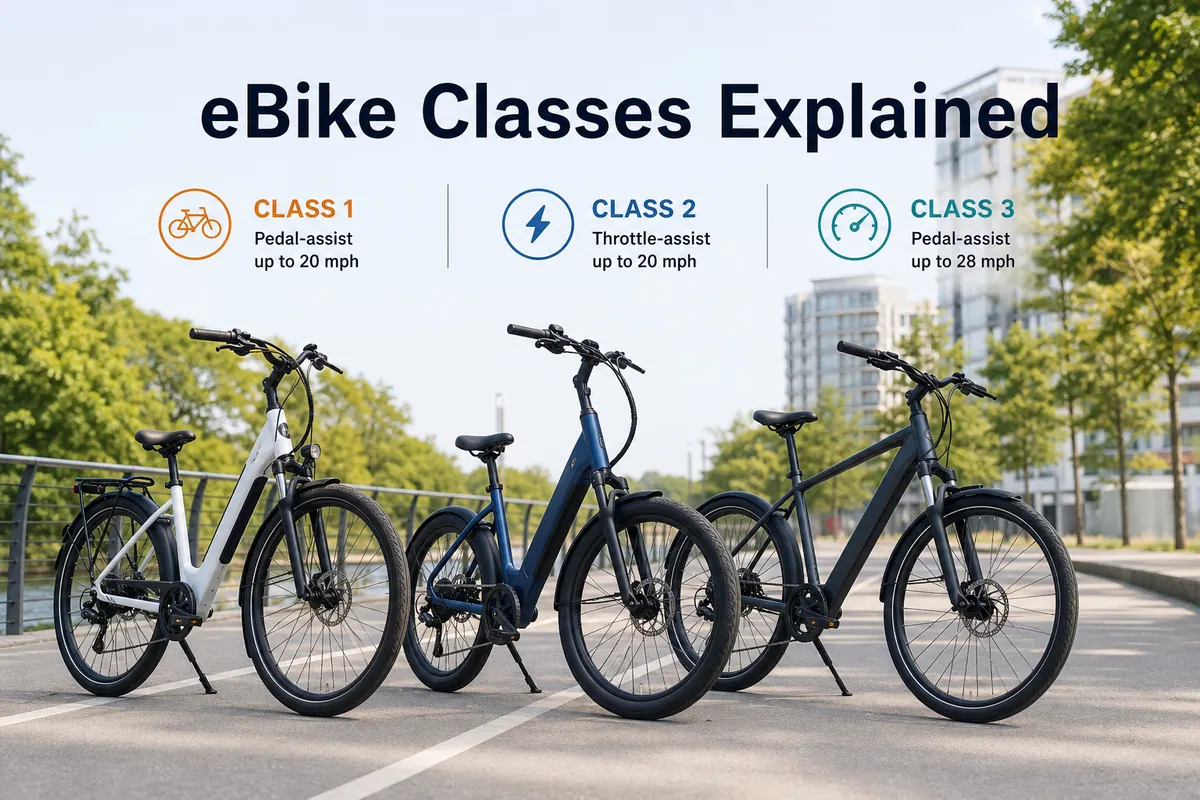
The three-class system is a helpful starting point, not the whole law. A bike’s class can affect where you ride, but local rules decide the final answer.
The most common eBike class system separates electric bikes by how the motor helps you and how fast that assistance continues. This framework is widely used in the United States, but it is not a substitute for checking your state, city, park, or trail rules.
The basic idea is simple. Class 1 bikes assist only while you pedal. Class 2 bikes can use a throttle. Class 3 bikes usually assist at a higher speed, but often come with more restrictions. If you are comparing eBikes before buying, it also helps to review our e-bike buying tips guide so the legal category matches the way you plan to ride.
| eBike class | Common definition | Why it matters |
|---|---|---|
| Class 1 | Pedal assist only, commonly up to 20 mph | Often the most accepted class on bike paths and trails |
| Class 2 | Throttle-capable, commonly up to 20 mph | Useful for starts and low-speed help, but access can vary |
| Class 3 | Pedal assist, commonly up to 28 mph | Faster commuting potential, often with more restrictions |
| Throttle rules | Usually tied to Class 2, but details vary | Some areas limit or restrict throttle use |
| Helmet and age rules | Often stricter for Class 3 | Can affect who may ride and what gear is required |
| Access rules | Set by state, local, park, or trail authorities | The same bike may be allowed in one place and restricted in another |
A Class 1 eBike usually provides motor help only while you are pedaling. When you stop pedaling, the motor assistance stops. In many three-class systems, that assistance cuts off around 20 mph.
Class 1 is often treated as the most bicycle-like category because it does not include throttle-only movement. That can make it a common choice for riders who want access to more paths, trails, and shared spaces, although access is never guaranteed everywhere.
A Class 2 eBike usually includes a throttle, which means the motor can help move the bike without pedaling. In many class systems, that throttle assistance is limited to about 20 mph.
Throttle help can be useful for starting from a stop, getting through awkward low-speed moments, or riding when pedaling is harder. Still, the throttle is exactly why some areas treat Class 2 bikes differently. A path, park, or trail may allow pedal-assist bikes but restrict throttle-capable models, so always check before assuming access.
A Class 3 eBike usually provides pedal assist up to a higher assisted speed, often around 28 mph. These bikes can make sense for commuting, longer road rides, or keeping pace on faster routes.
The tradeoff is that Class 3 bikes may face more rules. Some areas require helmets, set age limits, restrict path access, or treat Class 3 differently from Class 1 and Class 2. If you are trying to understand where motorized or electric bikes can be used on public roads, our guide on whether you can drive a motorized bike on the road adds helpful context.
Practical tip: check the label on the eBike, then check the rules for where you actually plan to ride. The class printed on the bike is only useful if you know how your local roads, paths, and trails treat that class.
eBike class can influence access to bike lanes, multi-use paths, natural-surface trails, sidewalks, parks, and roads. The more a bike looks or behaves like a faster motor vehicle, the more likely it is to face extra limits.
That does not mean Class 3 is bad or Class 2 is unsafe. It means the legal category should match your riding environment. A Class 3 commuter might be great on roads, while a Class 1 model may be a better fit for riders who prioritize path access.
Helmet and age rules often vary by state and sometimes by class. Class 3 riders may face stricter requirements in some places. Some local rules may also treat younger riders differently depending on speed, throttle, or access area.
License questions can also create confusion because eBikes, mopeds, and motorized bicycles are not always treated the same. If you are comparing categories, read can you ride a motorized bicycle without a license and our e-bike vs moped guide to understand why definitions matter.
Even when state law recognizes a class of eBike, a trail manager, park agency, or local authority may still set access rules for specific paths. Natural-surface trails, shared-use paths, and protected areas can have their own limits.
This is where riders get caught off guard. A bike may be legal to own and ride on some roads, but not allowed on a certain trail. Legal classification and local access are related, but they are not identical.
Start with where you ride most. If you want broad path compatibility and a natural bicycle feel, Class 1 may be the cleanest fit. If you value throttle help for starts or low-speed support, Class 2 may make sense. If you commute farther or want higher assisted speed on appropriate routes, Class 3 may be worth considering.
Also think about comfort with rules. Riders who do not want to think much about access may prefer simpler, lower-speed options. Riders who choose faster or throttle-capable bikes should be more careful about checking local restrictions.
eBike classes explained in the simplest terms: Class 1 is usually pedal assist up to 20 mph, Class 2 usually adds throttle assistance up to 20 mph, and Class 3 usually offers faster pedal assist up to 28 mph. That framework helps you compare bikes, but it does not answer every legal question by itself.
Before buying or riding somewhere new, confirm the rules for your state, city, road, path, or trail. The right eBike class is not just the one with the best specs; it is the one that fits how and where you actually ride.