Motorized Bicycle Laws in Texas start with one key question: does your vehicle qualify as an electric bicycle under Texas Transportation Code Chapter 664? If it has fully operable pedals, an electric motor of fewer than 750 watts, and a top assisted speed of 28 mph or less, Texas treats it under the state's e-bike rules. If it is gas-powered or otherwise falls outside that definition, check Texas DPS, TxDMV, and the Texas Transportation Code definitions before riding on public roads.
Note: This page is informational only, not legal advice. Laws and local rules can change. Verify current requirements with the official Texas sources linked below.
Last reviewed / source-checked: 2026-05-04
| Texas e-bike definition | Fully operable pedals, electric motor of fewer than 750 watts, and top assisted speed of 28 mph or less. |
| Texas class system | Texas recognizes Class 1, Class 2, and Class 3 electric bicycles. |
| Gas-powered bikes | A gas-powered bicycle does not fit Texas Chapter 664's electric-bicycle definition. Treat it as a separate classification question and verify moped, motorcycle, title, registration, and local rules before riding on public roads. |
| License / registration | For Chapter 664 electric bicycles, the official Texas sources cited here focus on classification and equipment rules. If your vehicle falls outside the e-bike definition, verify the exact license and registration rules with Texas DPS and TxDMV before riding. |
| Helmet / age / passenger rules | No universal statewide helmet or passenger rule is clearly stated in the Texas sources cited below for every e-bike situation. Texas Chapter 551 does say a Class 3 e-bike operator must be at least 15. Check current local, trail, campus, and property-specific rules before riding. |
| Power / speed limits | The electric motor must be under 750 watts and the top assisted speed must be 28 mph or less. Class 1 and Class 2 are limited to 20 mph or less, while Class 3 is more than 20 mph but less than 28 mph. |
| Where you can ride | Statewide ride-location rules can still vary by city, park, campus, trail operator, or private property owner. Always check posted local access rules before riding. |
| Local-rules caveat | Even if your bike qualifies as a Texas e-bike under Chapter 664, cities, trails, campuses, and private property can still impose additional rules. |

Texas Transportation Code § 664.001 defines an electric bicycle as a bicycle with fully operable pedals, an electric motor of fewer than 750 watts, and a top assisted speed of 28 mph or less.
Texas also uses a three-class system that makes Motorized Bicycle Laws in Texas more specific than the older two-type language still floating around online:
| Texas class | How the motor works | Top assisted speed |
|---|---|---|
| Class 1 | Motor assists only while pedaling | 20 mph or less |
| Class 2 | Motor may propel the bike without pedaling | 20 mph or less |
| Class 3 | Motor assists only while pedaling | More than 20 mph but less than 28 mph |
Important: If your machine does not fit the Texas electric-bicycle definition—for example, it is gas-powered, does not have fully operable pedals, exceeds the wattage cap, or exceeds the assisted-speed cap—do not assume Chapter 664 e-bike rules apply. Texas may treat the vehicle under moped, motorcycle, motor vehicle, off-highway, or local rules depending on its design and use.
Gas-powered motorized bicycles are the tricky part of Texas search intent. Texas Chapter 664 is written for electric bicycles, so a bike with a gasoline engine is not covered by that e-bike definition. To be treated as a Texas moped, the vehicle needs to fit the Chapter 541 definition below.
| Texas moped requirement | What it means for a gas-powered bicycle |
|---|---|
| Rider's saddle | The vehicle must be equipped with a rider's saddle. |
| No more than 3 wheels | It must be designed to have no more than three wheels on the ground when propelled. |
| 30 mph or less | It cannot attain a speed in one mile of more than 30 mph. |
| 5 brake horsepower or less | The engine cannot produce more than five brake horsepower. |
| 50 cc or less if gas/internal combustion | If it uses an internal combustion engine, piston displacement must be 50 cc or less. |
| No gear shifting required | The power drive system cannot require the operator to shift gears. |
Bottom line: a gas bicycle kit is not automatically a legal Texas moped. If the vehicle does not fit the moped definition, Texas may treat it closer to a motorcycle or another motor vehicle category. TxDMV lists mopeds and motorcycles as registered vehicle categories, while Texas DPS publishes separate Class M motorcycle licensing guidance. For a gas-powered build, verify the exact classification, title/registration path, insurance/inspection requirements, and local rules before riding on public roads.
Looking for the simpler path? If you want to avoid the classification headaches that can come with gas-powered builds, start by comparing e-bikes that are designed around Class 1, Class 2, or Class 3 rules.
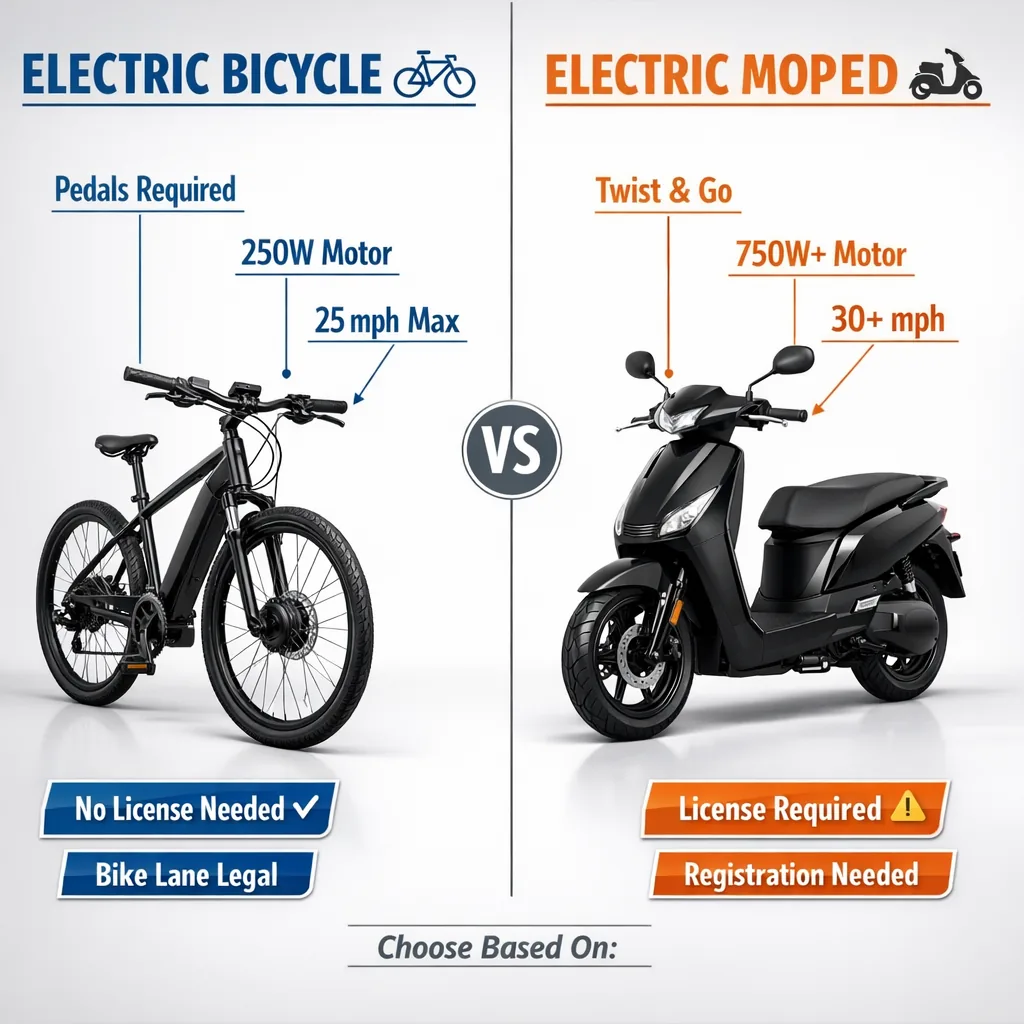
Read our e-bike vs. moped guide before you buy. Always verify the specific model specs and your local rules before riding.
If your bike has pedals, stays under 750 watts, and stays within the Texas assisted-speed limits, start with Chapter 664. That chapter is the clearest official source for how Texas classifies e-bikes.
If your vehicle falls outside Texas's electric-bicycle definition, verify the exact classification with Texas DPS and TxDMV before riding on public roads. Texas DPS publishes separate Class M motorcycle licensing guidance, and TxDMV separately publishes vehicle-registration guidance for mopeds and motorcycles.
Texas requires manufacturers and sellers of Class 3 electric bicycles to ensure the bike is equipped with a speedometer. Texas also requires permanent e-bike labeling that identifies the class, top assisted speed, and motor wattage. If a bike is modified in a way that changes its motor-powered capability, the label must be updated.
State law is only part of the answer. A path, park, campus, HOA, or private property owner can still post narrower access rules, so check the local signage or operator rules before riding.
Before riding in places like Austin, Dallas, Houston, San Antonio, on local trails, on university property, or in parks, check the posted local or property-specific rules. Even when Texas state law allows a certain class of e-bike, local access rules can still be narrower.
This page is for general informational purposes only and is not legal advice. Texas laws, agency guidance, and local rules can change. Verify current requirements with official Texas sources before riding.