Motorized bicycle laws in Nebraska split small-engine mopeds and modern electric bicycles into different lanes. If your ride fits Nebraska’s moped definition, you need a valid operator’s license and highway helmet compliance. If it is a class 1, 2, or 3 electric bicycle, the big questions shift to bicycle rules, local path rules, and property-specific restrictions.
Note: This Nebraska guide is for general informational purposes only and is not legal advice. State rules can change, and local trail, park, and city rules can be narrower than the statewide baseline. Last checked: 2026-03-15.
| Topic | Quick answer |
|---|---|
| Moped definition | Fully operative pedals, automatic transmission, 50cc or less, no more than 2 brake horsepower, and no more than 30 mph on level ground. |
| Electric bicycle definition | Nebraska recognizes class 1, 2, and 3 electric bicycles with operable pedals and a motor of no more than 750 watts. |
| License | Mopeds require a valid operator’s license on highways. Nebraska’s reviewed sources do not answer the e-bike license question as directly, so borderline machines should be confirmed locally before street use. |
| Title / registration / insurance | Mopeds are exempt from title, registration, and motor-vehicle safety-responsibility requirements. Nebraska’s reviewed e-bike sources focus on classification and local regulation rather than a separate DMV paperwork summary. |
| Helmet / eye protection | On highways, moped riders need compliant helmet and eye protection unless they qualify for Nebraska’s limited 21+ helmet exception path. No separate statewide e-bike helmet rule was identified in the sources reviewed here. |
| Where you can ride | Mopeds can use normal roads but not interstates or sidewalks. Electric bicycle access can be narrowed by local bicycle ordinances and by state or local property rules. |
| Big local caveat | If you remove the pedals from a Nebraska moped, DMV says it becomes off-road only unless it meets motorcycle requirements. |
Nebraska’s small-engine bucket is the moped, not a separately named “motorized bicycle” category. Under section 60-637, a moped must have:
That definition matters because the rest of Nebraska’s moped rules build off it. If your machine loses the pedals, exceeds the motor limits, or no longer fits the automatic-transmission requirement, do not assume the lighter Nebraska moped rules still apply.
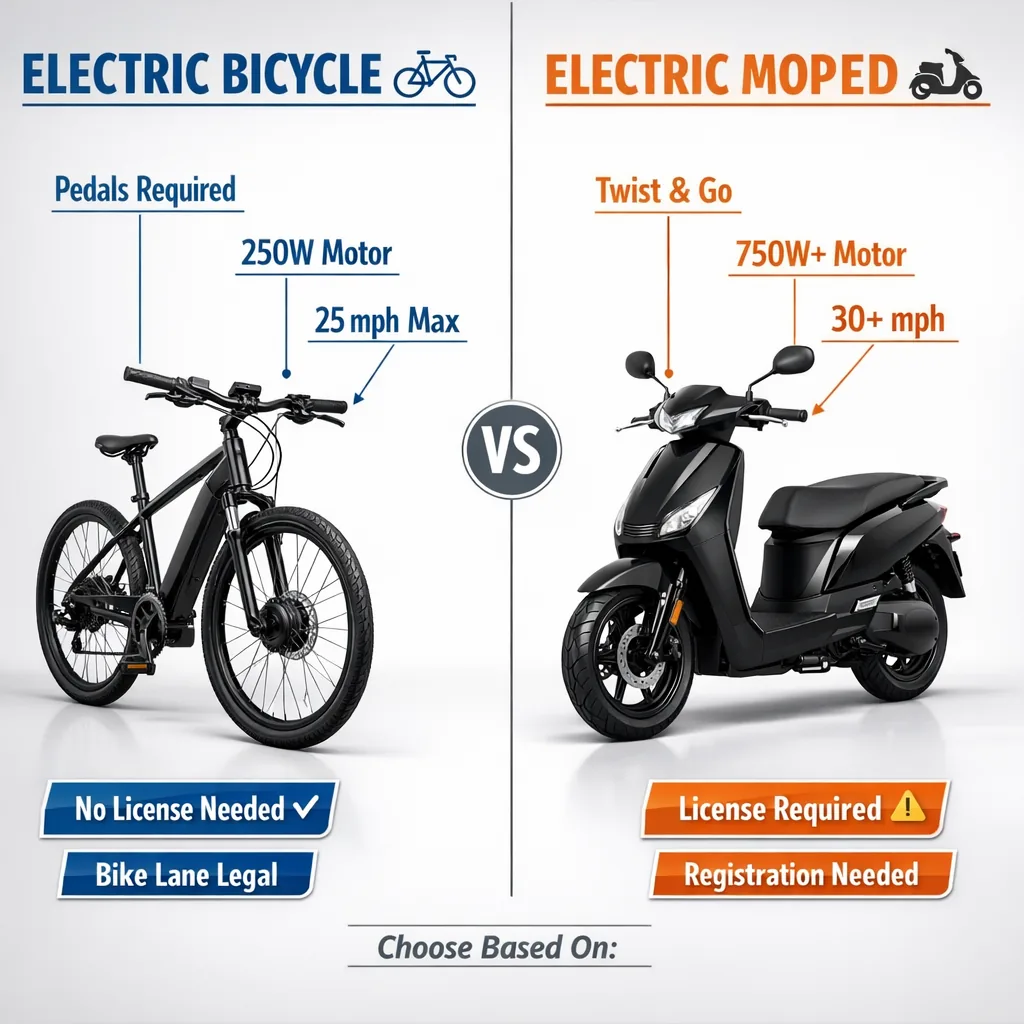
Nebraska now recognizes class I, class II, and class III electric bicycles. The reviewed statutes define them as bikes with operable pedals, a seat or saddle, and an electric motor of no more than 750 watts / one brake horsepower.
This is one of the biggest Nebraska-specific updates. Riders who once treated every powered bike like a moped now need to sort true classed e-bikes into a separate category first.
For mopeds, Nebraska is clear:
For electric bicycles, the Nebraska sources reviewed here speak more directly to classification, bicycle-style operation, and local regulation than to a separate DMV paperwork summary. Riders with a borderline build should confirm treatment locally rather than assuming a classed e-bike and a moped are handled the same way.
Nebraska gives moped riders more roadway rights than many people expect, but it also sets clear limits.
Electric bicycles are a little more local. Nebraska’s bicycle rule lets local authorities further regulate bicycles, and section 60-678 lets state and local entities permit, prohibit, or control electric bicycles on property they own or manage. In practice, that means a city trail, campus, park, or public recreation area can be narrower than the statewide baseline.
If it still has fully operative pedals and stays inside Nebraska’s 50cc / 2 brake horsepower / 30 mph definition, it is likely a moped. That means a valid operator’s license is required on highways, but title, registration, and safety-responsibility requirements are lighter than for a full motorcycle.
This is one of the biggest Nebraska traps. DMV says once the pedals are removed, the vehicle becomes off-road only unless it separately meets motorcycle requirements. A minor mechanical change can move the bike out of the Nebraska moped lane.
You are not automatically banned, but the rules get tighter. On roads above 45 mph, Nebraska requires moped riders to stay near the right side and ride single file. If the route is an interstate, the answer is simpler: mopeds are not allowed.
Nebraska’s statewide sources do not promise universal access. Local authorities may further regulate bicycles, and public entities can permit or prohibit electric bicycles on property they control. Check the posted trail rule before assuming the statewide class system answers the access question.
For mopeds on highways, Nebraska requires helmet and eye protection unless the rider qualifies for the state’s limited 21+ helmet exception path. That is a more specific rule set than many neighboring states use.
For electric bicycles, the reviewed Nebraska sources did not identify a separate statewide helmet statute comparable to the moped rule. Riders should still use lights, ride predictably, and treat faster class 3 operation with extra caution even where the statute is quieter.