Motorized Bicycle Laws in Maryland depend on whether your ride is a true electric bicycle, a pedal-equipped moped, or a nonpedal motor scooter. Maryland gives electric bicycles their own class 1, 2, and 3 rules, but Maryland MVA separately requires titles, decals, proof of insurance, and a valid license or moped permit for mopeds and motor scooters used on public roads.
Note: This Maryland guide is informational only and is not legal advice.
Last checked: 2026-03-15
Local-rule warning: Maryland lets local authorities and state agencies restrict some bicycle-path and trail access, so statewide rules are your starting point, not your only check.
In Maryland, the legal answer changes fast once a bike stops being an electric bicycle and starts fitting the state's moped or motor-scooter rules.
Motorized Bicycle Laws in Maryland: quick answer
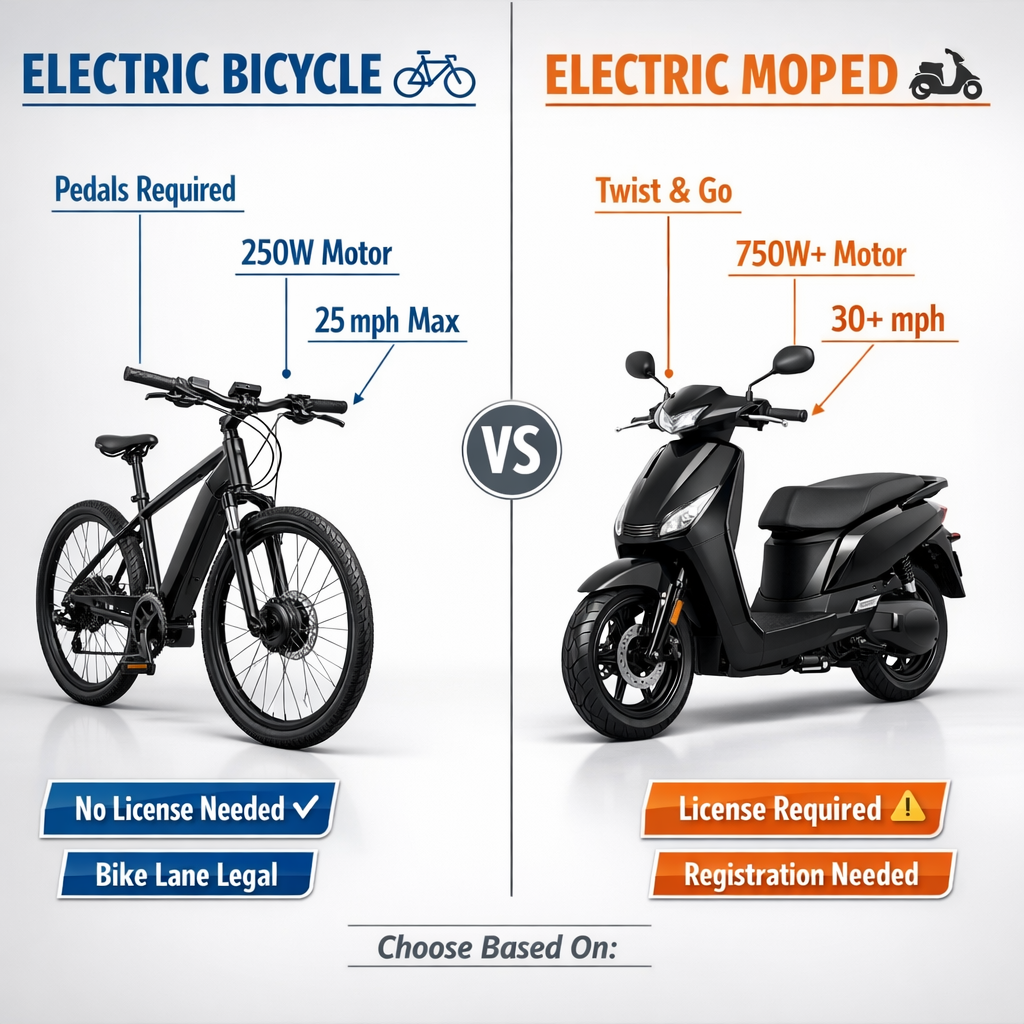
Electric bicycle: Maryland defines this as a pedal bike with 2 or 3 wheels, fully operable pedals, a motor of 750 watts or less, and class 1, 2, or 3 speed limits.
Class 3 rule: A class 3 electric bicycle is pedal-assist only up to 28 mph, must have a speedometer, and a rider under 16 may not operate one on a public highway.
Bike-path rule: Electric bicycles may ride where bicycles are allowed, including bike lanes, but path and trail access can be narrowed by a local authority or state agency.
Moped: Maryland defines a moped as a pedal bicycle with a small motor, wheel-size limits, and no more than 1.5 brake horsepower and 50cc if gas-powered.
Motor scooter: Maryland defines this as a nonpedal step-through vehicle with an automatic transmission and low-power engine limits.
Moped and motor scooter paperwork: Maryland MVA requires a title, decal, proof of insurance, and either a valid driver's license or a moped operator's permit for road use.
Helmet rules: Riders and passengers under 16 on bicycles must wear a bicycle helmet, while moped and motor-scooter operators and passengers must wear a DOT-compliant motorcycle helmet and eye protection.
How Maryland splits the main categories
Maryland is easier to understand than many states once you stop using one label for every powered bike. The state keeps separate buckets for electric bicycles, mopeds, and motor scooters, and those buckets do not share the same rules.
Electric bicycle: pedal bike, 750 watts or less, class 1 / 2 / 3 framework.
Moped: pedal-equipped bicycle with a smaller helper motor and a wheel over 14 inches.
Motor scooter: nonpedal vehicle with a seat, step-through chassis, automatic transmission, and low-power engine limits.
That separation is one of the biggest Maryland differentiators. A rider who assumes every small powered bike follows the same rule set can easily end up in the wrong lane.
Motorized Bicycle Laws in Maryland for electric bicycles
If your ride really fits Maryland's electric-bicycle definition, the state treats it very differently from a moped or motor scooter.
1) Maryland uses the standard 3-class e-bike system
Class 1: pedal-assist only, with assistance ending at 20 mph.
Class 2: motor assistance can work whether or not you are pedaling, but it stops at 20 mph.
Class 3: pedal-assist only, with assistance ending at 28 mph.
Maryland also requires a permanent label showing the e-bike's classification, top assisted speed, and motor wattage.
2) Maryland gives class 3 e-bikes extra restrictions
A class 3 electric bicycle in Maryland must have a speedometer. Maryland also says a person under 16 may not operate a class 3 electric bicycle on a public highway, although a younger passenger may ride on one if the bike is built to carry passengers.
3) Maryland ties e-bike access to bicycle access, then adds path exceptions
Maryland says electric bicycles may be operated where bicycles are allowed, including bike lanes. But Maryland does not make every path identical:
a local authority or state agency may prohibit class 1 or class 2 e-bikes on a bicycle path
a class 3 e-bike may not use a bicycle path unless the path is within or adjacent to a highway right-of-way, or the authority in charge specifically allows it
natural-surface nonmotorized trail access may be regulated for any e-bike class
That means Maryland is friendly to e-bikes, but not careless about where higher-speed or motor-assisted bikes can go.
4) Maryland's current cited e-bike statutes focus on bicycle-style operation, not MVA titling
The Maryland materials cited below define electric bicycles separately from motor vehicles and set operating and equipment rules for them. In contrast, the MVA titling, decal, insurance, and license pages reviewed for this guide apply to mopeds and motor scooters rather than to class 1, 2, or 3 electric bicycles.
Maryland's biggest classification mistake is treating an e-bike, a moped, and a motor scooter as if they share one universal rule set.
Motorized Bicycle Laws in Maryland for mopeds and motor scooters
This is the more regulated side of Maryland law. Once your ride fits the state's moped or motor-scooter definitions, MVA paperwork and roadway rules matter much more.
Maryland moped definition
A Maryland moped must:
be designed to be operated by human power with the assistance of a motor
have pedals that mechanically drive the rear wheel or wheels
have 2 or 3 wheels, with one wheel more than 14 inches in diameter
have no more than 1.5 brake horsepower and, if gas-powered, no more than 50cc
Maryland expressly says a moped does not include an electric bicycle.
Maryland motor-scooter definition
A Maryland motor scooter is a nonpedal vehicle with:
a seat for the operator
2 wheels, with one at least 10 inches in diameter
a step-through chassis
an automatic transmission
a motor with no more than 2.7 brake horsepower or, if gas-powered, no more than 50cc
MVA paperwork is the big Maryland split
Maryland MVA says mopeds and motor scooters used on public roads must be titled and display a decal. MVA also says the operator must carry proof of insurance and have either a valid driver's license of some class or a Maryland moped operator's permit.
Road-use rules are stricter than many riders expect
Maryland MVA and Maryland transportation law combine to create several practical limits for mopeds and motor scooters:
top speed: may not be operated above 30 mph
high-speed roads: may not be used on a roadway with a posted speed limit above 50 mph or on an expressway / other controlled-access highway
lane positioning: bike-lane or shoulder rules can apply where a smooth bike lane or paved shoulder is present
helmet and eye protection: DOT-compliant motorcycle helmet plus approved eye protection unless a windscreen is present
passengers: only if the moped or motor scooter is equipped to carry one
What is different in Maryland?
Maryland keeps a sharp legal split between electric bicycles, mopeds, and motor scooters.
Maryland gives electric bicycles a detailed class 1 / 2 / 3 framework with separate path rules for class 3 bikes.
Maryland requires a permanent e-bike class label, and class 3 bikes must have a speedometer.
Maryland MVA requires title, decal, proof of insurance, and a valid license or moped permit for mopeds and motor scooters used on roads.
Maryland has an unusual roadway detail where a 3-wheeled motor scooter or moped is lawful only in Ocean City.
Maryland's path rules are more nuanced than a simple “e-bikes are bicycles” summary, especially for class 3 bikes and natural-surface trails.
Common rider situations under Motorized Bicycle Laws in Maryland
If you ride a normal class 1 or class 2 e-bike around town
This is the cleanest Maryland scenario. If the bike truly fits the electric-bicycle definition, Maryland's cited statute text places you in the e-bike lane rather than the moped or motor-scooter lane. You still need to follow bicycle-style rules and local path restrictions, but this is not the same compliance path MVA describes for mopeds and motor scooters.
If you want to ride a class 3 e-bike on a bike path
This is where Maryland gets more specific. A class 3 e-bike is not automatically allowed on every bicycle path. You need to check whether the path is within or next to a highway right-of-way or whether the local authority or state agency in charge has expressly allowed class 3 use.
If your bike has pedals and a small helper motor but fits Maryland's moped definition
Do not assume bicycle-style treatment. Maryland MVA says a roadway moped needs title and decal paperwork, proof of insurance, and a qualified operator with either a valid driver's license or a moped permit.
If your ride is a step-through 50cc-style scooter with no pedals
You are in Maryland's motor-scooter lane, not the e-bike lane. That means the 30 mph ceiling, high-speed-road restrictions, helmet and eye-protection rules, and MVA title / decal / insurance rules all matter.
Maryland allows e-bikes where bicycles are allowed, but path and trail access still depends on the class of bike and the local or state authority managing the route.
Helmet, age, and safety details in Maryland
Bicycles: riders and passengers under 16 must wear a qualifying bicycle helmet.
Class 3 e-bikes: under 16 may not operate one on a public highway.
Mopeds and motor scooters: operators and passengers must wear a DOT-compliant motorcycle helmet, and approved eye protection is also required unless the vehicle has a windscreen.
Local ordinance and path-access caveat
Maryland's statewide rule lets electric bicycles ride where bicycles are allowed, but local authorities and state agencies still control many of the details that matter in real life. Before riding on a city bike path, park connector, or natural-surface trail, check posted signs and the authority that manages the route.
This page is for general informational purposes only and is not legal advice. Maryland statutes, MVA procedures, local ordinances, and agency path rules can change. Verify current rules before riding on public roads, bicycle paths, or trails.
Warranty Protection
Have a problem? Bike repairs and replacement parts are covered through our manufacturer warranty for up to two years after purchase.
Verified Secure Checkout
Your information is kept 100% protected and private. Payments are handled through trusted third-party providers and never stored on our servers.
To provide the best experiences, we use technologies like cookies to store and/or access device information. Consenting to these technologies will allow us to process data such as browsing behavior or unique IDs on this site. Not consenting or withdrawing consent, may adversely affect certain features and functions.
Functional
Always active
The technical storage or access is strictly necessary for the legitimate purpose of enabling the use of a specific service explicitly requested by the subscriber or user, or for the sole purpose of carrying out the transmission of a communication over an electronic communications network.
Preferences
The technical storage or access is necessary for the legitimate purpose of storing preferences that are not requested by the subscriber or user.
Statistics
The technical storage or access that is used exclusively for statistical purposes.The technical storage or access that is used exclusively for anonymous statistical purposes. Without a subpoena, voluntary compliance on the part of your Internet Service Provider, or additional records from a third party, information stored or retrieved for this purpose alone cannot usually be used to identify you.
Marketing
The technical storage or access is required to create user profiles to send advertising, or to track the user on a website or across several websites for similar marketing purposes.