Enjoy FREE shipping anywhere within the US!

Motorized Bicycle Laws in Illinois

Motorized Bicycle Laws in Illinois make much more sense once you separate a true low-speed electric bicycle from a moped and from a broader motor-driven cycle. Illinois gives low-speed electric bicycles a bicycle-style ruleset, but once a machine fits the moped or motor-driven-cycle definitions, licensing and registration treatment become more demanding.

Note: This Illinois guide is based on current Illinois Vehicle Code sections and Illinois Secretary of State guidance. It is informational only, not legal advice.

Last reviewed / source-checked: 2026-03-15

Local rule warning: Illinois lets a municipality, county, or local authority prohibit a low-speed electric bicycle or a specific e-bike class on a path, so statewide rules are your starting point, not the final word on every trail or local route.

Quick answer: are motorized bicycles legal in Illinois?

Yes, but Illinois does not put every powered bike in the same legal bucket. A qualifying low-speed electric bicycle is treated much closer to a bicycle. A qualifying moped can be ridden with any valid current Illinois driver’s license regardless of classification, but it is still a different legal category with registration-plate treatment. A broader motor-driven cycle falls into Illinois motorcycle licensing rules, including the proper Class L or Class M license classification.
  • Low-speed electric bicycle definition: Fully operable pedals, motor under 750 watts, and class 1, 2, or 3 treatment.
  • E-bike ride access: Illinois allows low-speed electric bicycles on highways, streets, and roadways authorized for bicycles, including bike lanes, and on bicycle paths unless the local authority prohibits a class on that path.
  • E-bike sidewalk rule: Illinois says a low-speed electric bicycle may not be operated on a sidewalk.
  • Class 3 rule: The operator must be at least 16, and the bike must have a speedometer.
  • Moped definition: A motor-driven cycle capable of at least 20 mph but not more than 30 mph, with 2 brake horsepower or less, plus a 50cc cap if gas-powered and no shifting required by the operator.
  • Moped license rule: Illinois law says any person may operate a moped with a valid current Illinois driver’s license, regardless of classification.
  • Motor-driven cycle license rule: Illinois Secretary of State guidance says operation of a motorcycle or motor-driven cycle requires a valid license with the proper classification, with Class L for less than 150cc and Class M for 150cc or greater.
  • Registration note: Illinois registration statutes specifically provide for moped registration plates, so mopeds are not in the same paperwork lane as low-speed electric bicycles.
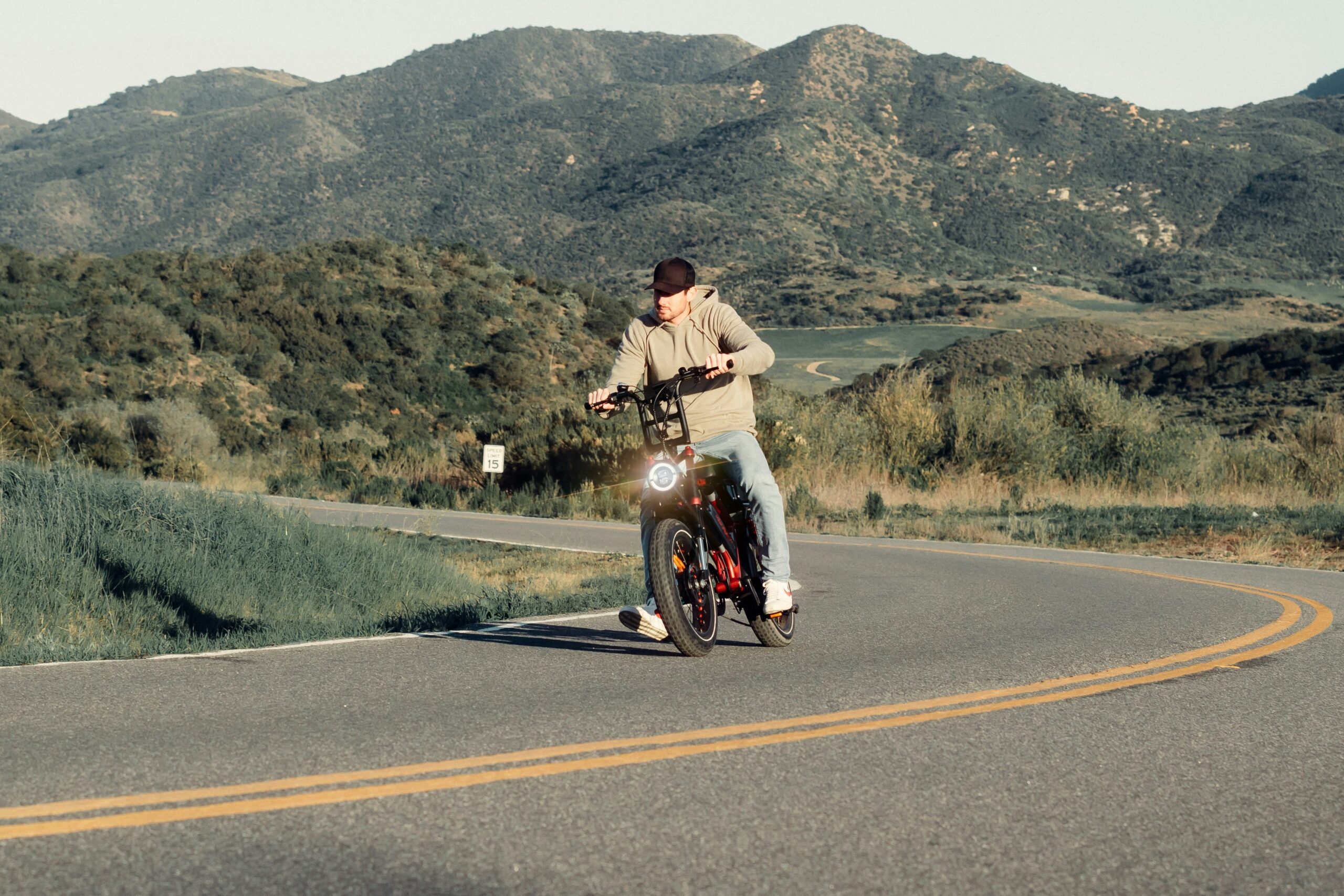
Motorized bicycle laws in Illinois road riding example
In Illinois, the first legal question is not just speed. It is whether the state sees your ride as a low-speed electric bicycle, a moped, or a motor-driven cycle.

How Illinois defines the main categories

Illinois uses three different legal lanes that riders often blend together by mistake.

  • Low-speed electric bicycle: A bicycle with fully operable pedals and an electric motor of less than 750 watts that meets the state’s class 1, class 2, or class 3 definition. Illinois expressly says a low-speed electric bicycle is not a moped or a motor-driven cycle.
  • Moped: A motor-driven cycle, with or without optional pedals, whose attainable speed in one mile is at least 20 mph but not greater than 30 mph and whose motor produces 2 brake horsepower or less. If it uses an internal-combustion engine, displacement cannot exceed 50cc and the power drive system cannot require the operator to shift gears.
  • Motor-driven cycle: Every motorcycle and every motor scooter with less than 150cc piston displacement, including motorized pedalcycles.

That separation is the key to understanding Motorized Bicycle Laws in Illinois, because the rules are much lighter for a true low-speed electric bicycle than for a moped or motor-driven cycle.

Motorized Bicycle Laws in Illinois for low-speed electric bicycles

If your ride actually meets Illinois’ low-speed electric bicycle definition, the state puts you in a bicycle-style framework rather than a moped or motorcycle-style one.

1) Illinois uses the standard 3-class e-bike system

  • Class 1: pedal-assist only, with assistance ending at 20 mph.
  • Class 2: the motor may propel the bicycle, but assistance stops at 20 mph.
  • Class 3: pedal-assist only, with assistance ending at 28 mph.

2) Bicycle rules generally apply to low-speed electric bicycles

Illinois says the bicycle provisions in this part of the Vehicle Code also apply to low-speed electric bicycles unless the section says otherwise. That is a major differentiator from the moped and motor-driven-cycle lanes.

3) Illinois allows low-speed electric bicycles in bike-authorized road space

A person may operate a low-speed electric bicycle on a highway, street, or roadway authorized for bicycle use, including bicycle lanes. That gives low-speed electric bicycles broad statewide roadway access wherever bicycles are otherwise allowed.

4) Path access exists, but local authorities can narrow it

Illinois allows a person to operate a low-speed electric bicycle on a bicycle path unless the municipality, county, or local authority with jurisdiction prohibits low-speed electric bicycles or a specific class on that path. That means path access is broad by default, but local carve-outs still matter.

5) Sidewalk riding is not allowed for low-speed electric bicycles

Illinois explicitly says a person may not operate a low-speed electric bicycle on a sidewalk. That is an easy rule to miss if you only read generic summaries.

6) Class 3 riders must be at least 16 and use a speedometer-equipped bike

Illinois requires every class 3 low-speed electric bicycle to have a speedometer, and it says a person may operate a class 3 low-speed electric bicycle only if he or she is 16 or older. A younger passenger may still ride on a class 3 e-bike that is designed to carry passengers.

7) Illinois also requires a permanent e-bike label

Manufacturers and distributors must place a permanent label in a prominent location showing the bike’s classification number, top assisted speed, and motor wattage. Illinois also prohibits tampering with the bike’s speed capability or engagement without replacing that label.
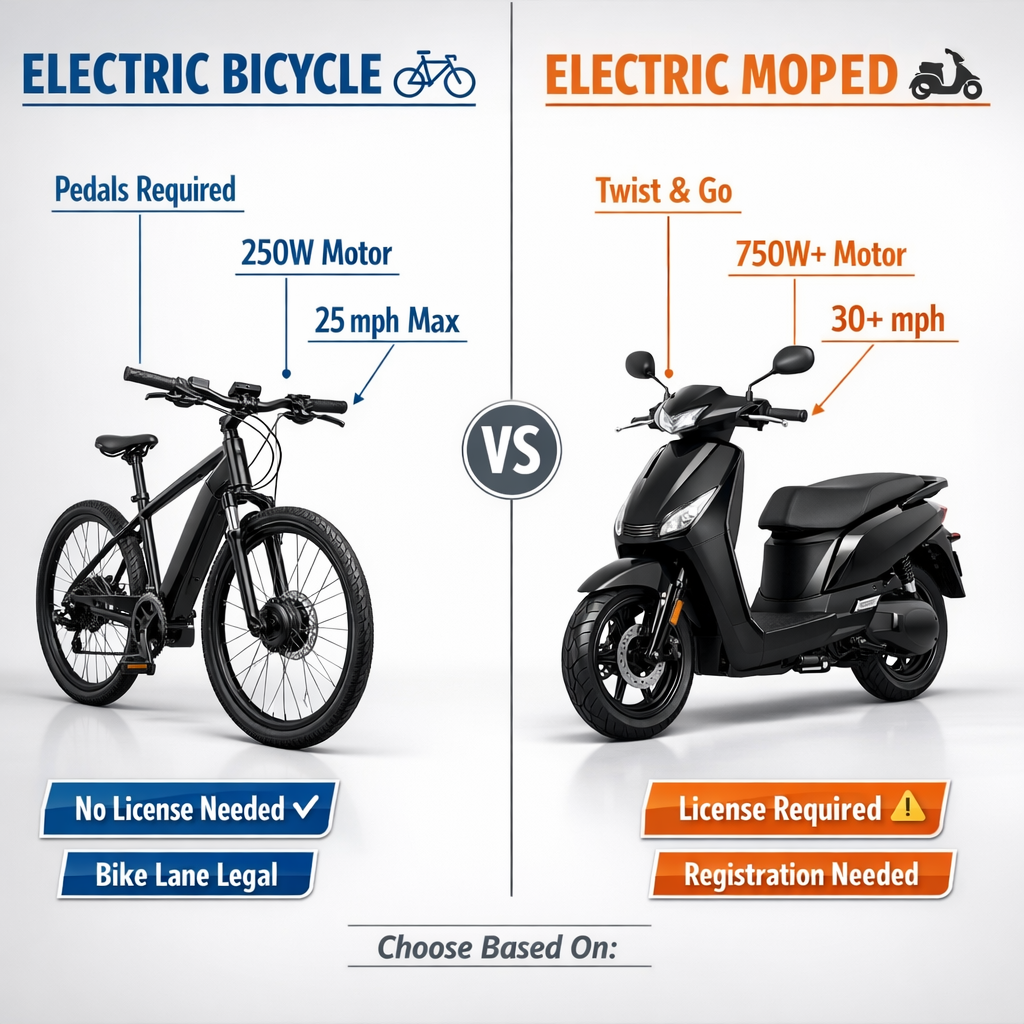
Motorized bicycle laws in Illinois e-bike versus moped comparison
Illinois draws a bright line between a low-speed electric bicycle and a moped, even when two machines can look similar at a glance.

Motorized Bicycle Laws in Illinois for mopeds and motor-driven cycles

This is the point where many riders overgeneralize. Illinois mopeds are not the same thing as low-speed electric bicycles, and not every moped is treated the same as a broader motor-driven cycle.

Illinois mopeds sit inside the motor-driven-cycle family, but get an important license break

The Illinois moped definition begins by calling a moped a motor-driven cycle. But Illinois then gives mopeds a licensing exception that does not apply to every motor-driven cycle. Under 625 ILCS 5/6-104, any person may operate a moped if that person has a valid current Illinois driver’s license, regardless of classification.

Broader motor-driven cycles need the proper motorcycle classification

Illinois Secretary of State guidance says operation of a motorcycle or motor-driven cycle requires a valid license with the proper classification. The Secretary of State explains that Class L covers a motor-driven cycle with less than 150cc displacement, while Class M covers a motorcycle with 150cc or greater displacement.

Illinois registration statutes treat mopeds as plated vehicles

Illinois registration law specifically provides for registration plates to be issued for a moped, and the display statute says that plate is attached at the rear. That is a practical clue that mopeds are not in the same paperwork category as low-speed electric bicycles.

Secretary of State guidance adds practical scooter and moped equipment notes

Illinois Secretary of State safety guidance says scooter or moped drivers must obey signs, signals, and traffic laws and are subject to most bicycle-use laws. It also says a scooter may be titled and registered in Illinois if it displays a federal safety certification label and VIN, and it highlights passenger-seat/footrest and nighttime lighting requirements for scooters and mopeds.

What is different in Illinois?

  • Illinois expressly says a low-speed electric bicycle is not a moped or motor-driven cycle.
  • Illinois allows low-speed electric bicycles on bicycle-authorized roadways and bike lanes.
  • Illinois allows low-speed electric bicycles on bicycle paths by default, but local authorities can prohibit a class on a particular path.
  • Illinois has a clear no-sidewalk rule for low-speed electric bicycles.
  • Illinois imposes a minimum age of 16 for class 3 operators and requires a speedometer on class 3 e-bikes.
  • Illinois lets a qualifying moped rider use any valid current Illinois driver’s license, even without a separate motorcycle classification.
  • Illinois distinguishes Class L and Class M licensing for broader motor-driven-cycle and motorcycle operation.
  • Illinois registration statutes specifically provide for moped registration plates.

Common rider situations under Motorized Bicycle Laws in Illinois

If you ride a normal class 1 or class 2 e-bike to work

You are usually in Illinois’ low-speed electric bicycle lane, not the moped lane, as long as the bike truly fits the statutory definition. That means bicycle-style operating rules apply, including the sidewalk prohibition and the path-access rule with local exceptions.

If you want to ride a class 3 e-bike on a local path

Do not assume the statewide answer is enough. Illinois allows low-speed electric bicycles on bicycle paths unless the municipality, county, or local authority prohibits that class on the path. So check the local path operator before relying on the statewide default.

If your gas or electric machine tops out between 20 and 30 mph

You may be in moped territory, but Illinois still cares about the rest of the definition. Speed, brake horsepower, displacement if gas-powered, and whether the operator must shift gears all matter. If the machine falls outside that definition, the moped exception may disappear.

If your scooter or motorized build is under 150cc but not a true moped

You may be in Illinois’ broader motor-driven-cycle category instead. In that case, Illinois Secretary of State guidance points you to the proper motorcycle classification system, with Class L for less than 150cc displacement.
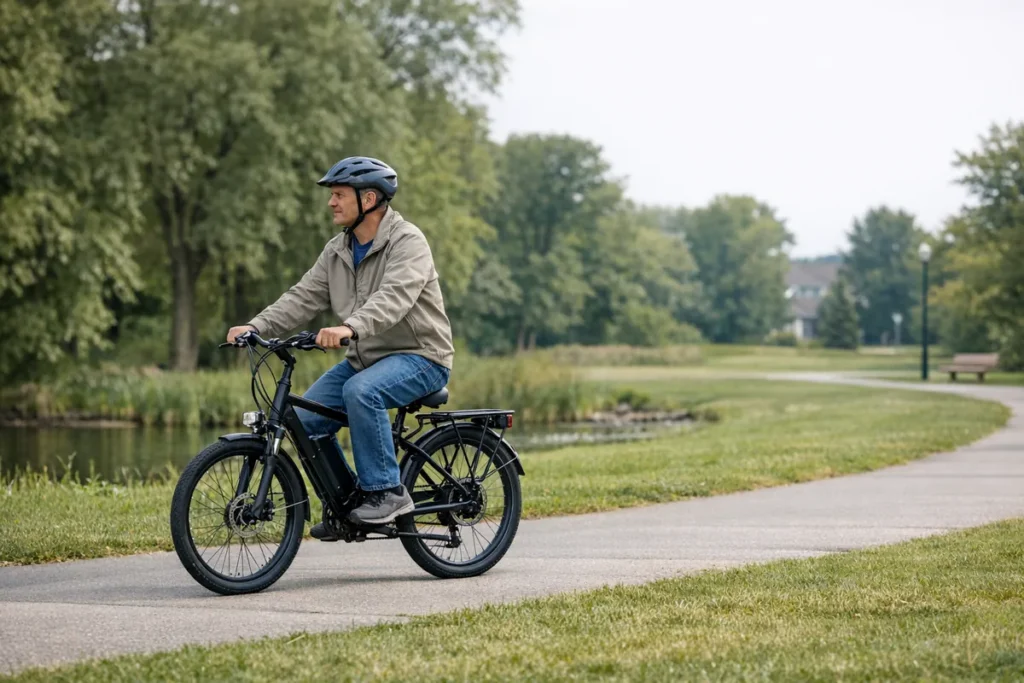
Adult riding an electric bicycle on a shared-use path in West Virginia
Illinois starts with broad e-bike path access, but local trail operators and municipalities can still post narrower rules for a specific path or class.

License, registration, and equipment in Illinois

Low-speed electric bicycles

  • License: Illinois places qualifying low-speed electric bicycles in the bicycle lane rather than the moped or motor-driven-cycle lane.
  • Registration plate: Illinois registration statutes specifically discuss moped and motorcycle plates, not low-speed electric bicycle plates.
  • Equipment: Class 3 speedometer, permanent class label, and normal bicycle equipment rules matter.

Mopeds

  • License: Any valid current Illinois driver’s license is enough for a qualifying moped, regardless of classification.
  • Registration plate: Illinois registration statutes specifically provide for moped plates.
  • Equipment / use notes: Illinois Secretary of State guidance highlights lights for night use, passenger-seat/footrest requirements for two-up riding, and compliance with signs, signals, and traffic laws.

Motor-driven cycles

  • License: Proper motorcycle classification required under Illinois Secretary of State guidance.
  • Classification split: Class L for less than 150cc displacement; Class M for 150cc or greater.

The Illinois source set is strongest on licensing, definitions, and registration-plate treatment. Riders should still verify exact title, insurance, and dealer/manufacturer paperwork requirements for the specific machine they own if it falls outside the low-speed electric bicycle lane.

Local ordinance and path-access caveat

Illinois’ e-bike path rule is statewide, but it is not absolute. A municipality, county, or local authority with jurisdiction can prohibit low-speed electric bicycles or a specific class on a bicycle path. If you are planning to ride on a park trail, local greenway, rail-trail, or municipal shared-use path, check the local operator’s posted rules before assuming the statewide default applies.

Official Illinois sources

Related reading

Disclaimer

This page is for general informational purposes only and is not legal advice. Illinois statutes, local ordinances, and agency interpretations can change. Verify current rules before riding on public roads, paths, or trails.

Warranty Protection

Have a problem? Bike repairs and replacement parts are covered through our manufacturer warranty for up to two years after purchase.

Verified Secure Checkout

Your information is kept 100% protected and private. Payments are handled through trusted third-party providers and never stored on our servers.
Copyright © 2026 Motorized Bicycle HQ. All rights reserved.
linkedin facebook pinterest youtube rss twitter instagram facebook-blank rss-blank linkedin-blank pinterest youtube twitter instagram