How far can an eBike go on one charge? Most eBikes can travel roughly 20 to 60 miles in normal mixed riding, while some long-range models may go farther with larger batteries, efficient tires, lower assist, and easier terrain. The real answer depends less on the headline range claim and more on battery size, motor efficiency, rider weight, hills, wind, temperature, tire pressure, cargo, and how much assist you use.
Quick answer: A typical eBike often goes about 20 to 60 miles on one charge, but real-world range can be much lower or higher depending on the battery, terrain, assist level, speed, rider weight, cargo, weather, and tire pressure. For commuting or errands, plan around your real route and keep a range buffer instead of trusting the maximum advertised number.
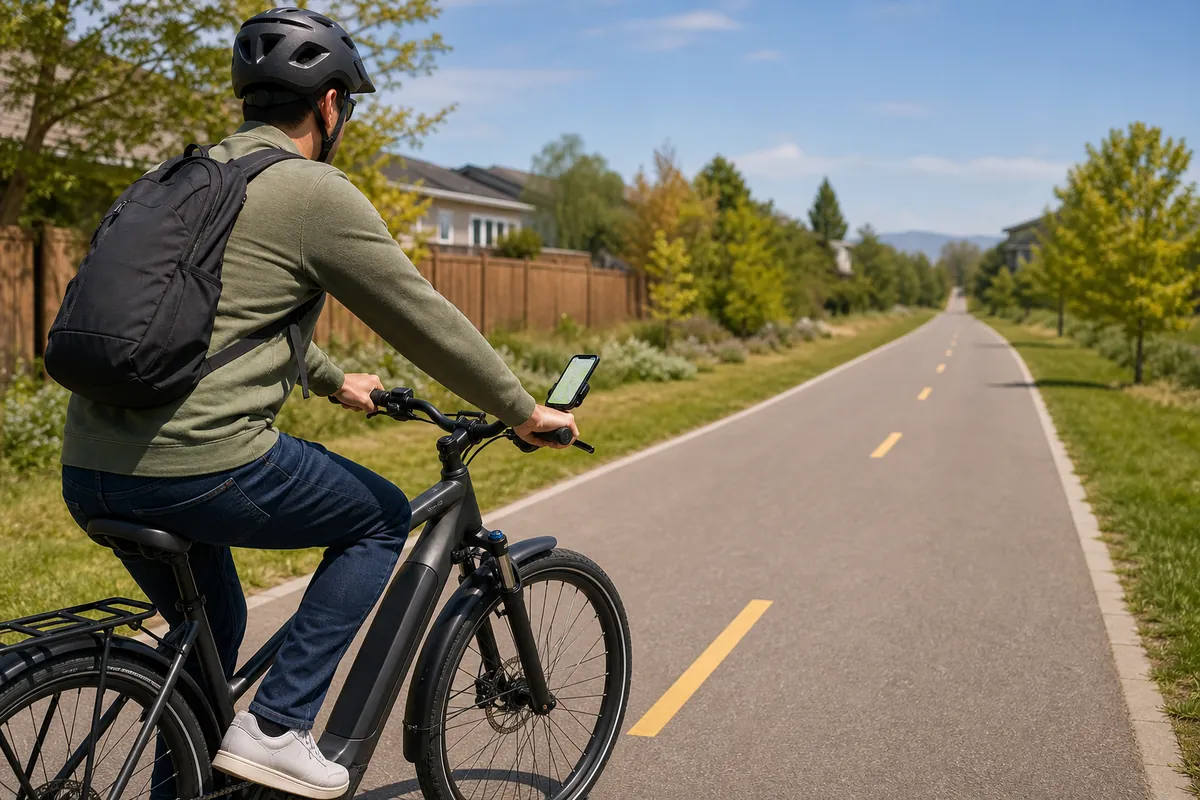
Advertised range is a comparison tool, not a promise. The same eBike can feel like a long-range machine on flat paths in low assist and a short-range bike on hills, in cold weather, with cargo, or at high assist.
In everyday riding, many eBikes land somewhere around 20 to 60 miles per charge. That is a practical planning range, not a guarantee. A small-battery commuter ridden fast in high assist may come in below that. A larger-battery eBike ridden gently on flat terrain may exceed it.
The gap between advertised range and real range is normal because range estimates depend on test conditions. If a brand quotes a high number, that may assume a lighter rider, low assist, smooth pavement, moderate speed, mild weather, and little cargo. Your route may not look like that.
If range is one of your main buying filters, MBHQ’s guide to the best electric bikes can help you compare broad eBike categories before narrowing down by battery size and use case.
| Riding situation | Range expectation | Why it changes |
|---|---|---|
| Flat path, low assist | Often near the higher end of a bike’s practical range | The motor is doing less work and speed is easier to maintain |
| City commuting | Usually mid-range | Stops, starts, traffic, and mixed assist levels use more energy |
| Hilly routes | Often noticeably lower | Climbing demands much more from the motor and battery |
| Cold weather | Can be lower than warm-weather riding | Battery performance and rider effort can change in low temperatures |
| Heavy cargo or larger rider load | Usually lower | More total weight requires more power to move and climb |
| High assist or throttle-heavy riding | Often much lower | The motor supplies more of the work, draining the battery faster |
Battery capacity is usually measured in watt-hours, often written as Wh. In simple terms, more watt-hours usually means more stored energy. A 672Wh battery has more energy available than a 360Wh battery, assuming similar bike efficiency and riding conditions.
That does not mean watt-hours tell the whole story. Two eBikes with the same battery size can have different real-world range because of motor tuning, tire choice, weight, drivetrain efficiency, riding position, and controller behavior.
Still, battery size is the first number to check when comparing range. If the manufacturer only lists voltage and amp-hours, watt-hours are commonly estimated by multiplying volts by amp-hours. For example, a 48V 14Ah battery is about 672Wh.
Assist level may be the biggest day-to-day range lever. Low assist lets the motor help without doing most of the work. High assist feels easier, especially on hills or into wind, but it pulls energy out of the battery faster.
Throttle use can reduce range even more on bikes that have one, because the motor may be moving the bike with little rider input. That can be useful in the right situation, but it is not the best strategy when you are trying to stretch miles.
If you need predictable range, ride one assist level lower than your comfort instinct suggests. You can always use more assist for hills, traffic starts, or the last few miles home.
Flat pavement is range-friendly. Hills are not. Climbing demands much more power than cruising, and repeated climbs can drain a battery quickly. Even gentle rolling terrain can reduce range if the ride constantly asks the motor to help you accelerate and climb.
Speed also matters. Riding faster increases aerodynamic drag, especially above casual bike-path speeds. An eBike that feels efficient at a relaxed pace may drain faster when you push toward the top of its assist range.
Wind is the hidden range tax. A strong headwind can feel like a long hill, and the battery sees it the same way: more resistance, more motor work, less range.
Cold temperatures can make range less predictable. The battery may deliver less usable energy, tire pressure can drop, clothing and winter gear can add drag or weight, and riders often lean on higher assist when conditions feel harder.
If you ride through winter mornings or store the bike somewhere cold, plan extra buffer. MBHQ’s guide to e-bike range in cold weather goes deeper on why range changes and how to manage expectations when temperatures drop.
Practical range buffer: for commuting, try not to plan your daily route around the bike’s maximum claimed range. A round trip that uses 60 to 70 percent of your real-world battery is much less stressful than one that depends on arriving nearly empty.
The bike is only part of the total load. Rider weight, backpack weight, child seats, panniers, trailers, and cargo all affect range. More weight takes more energy to accelerate and climb, especially on stop-and-go routes.
Cargo is not a problem by itself; eBikes are often excellent utility vehicles. It just needs to be part of your range planning. If you regularly carry groceries, work gear, tools, or a child seat, your real range may be different from a lightweight test ride.
Tire pressure deserves attention too. Underinflated tires can add rolling resistance, make the bike feel sluggish, and reduce range. Stay within the tire’s printed pressure range and adjust for comfort, load, and surface conditions.
An older battery may not deliver the same range it did when new. Capacity can decline gradually with age, charge cycles, storage conditions, heat exposure, and general use. That does not mean the bike is failing; it means the battery is a wear item.
Good habits help. Store the battery away from extreme heat when possible, avoid leaving it empty for long periods, use the correct charger, and follow the manufacturer’s guidance for charging and storage. MBHQ’s e-bike battery maintenance guide covers those habits in more detail.
The best range estimate comes from your route, not the spec sheet. Start with the manufacturer’s range claim, then adjust down if your ride includes hills, high assist, throttle use, heavy cargo, cold weather, rough surfaces, or higher speeds.
For a new bike, do a controlled range test on a familiar route. Start with a full charge, ride the way you normally would, and note the distance, battery percentage, assist level, terrain, temperature, and cargo. Repeat it a few times. Patterns matter more than one ride.
You can usually stretch range without making the ride miserable. Use lower assist on flats, save higher assist for climbs, keep tires properly inflated, reduce unnecessary cargo, and ride smoothly instead of sprinting between stops.
Clean drivetrain maintenance also helps. A dry, dirty, or poorly adjusted drivetrain wastes energy and makes the bike feel rough. It may not transform range by itself, but it is part of keeping the whole system efficient.
If you are choosing a bike and know range will matter, consider whether a removable battery fits your routine. MBHQ’s guide on whether you should buy an eBike with a removable battery explains when removable packs make charging, storage, and long-distance ownership easier.
Not every rider needs the biggest battery. If your trips are short and you can charge easily, comfort, fit, brakes, weight, and storage may matter more than chasing the longest possible range number.
Range becomes more important if you commute far, ride in cold weather, carry cargo, live around hills, cannot charge at work, or want one bike for errands and recreation. In those cases, buy more range than the bare minimum. The best range is the range you do not have to worry about.
An eBike can often go about 20 to 60 miles on one charge, but the useful answer depends on how and where you ride. Battery size sets the foundation, then assist level, hills, wind, speed, rider load, tire pressure, temperature, and battery age shape the result.
For everyday planning, treat advertised range as a starting point. Test your own route, keep a buffer, and choose a bike that fits your real riding pattern. That is how you avoid range anxiety and get a bike that feels dependable instead of optimistic on paper.