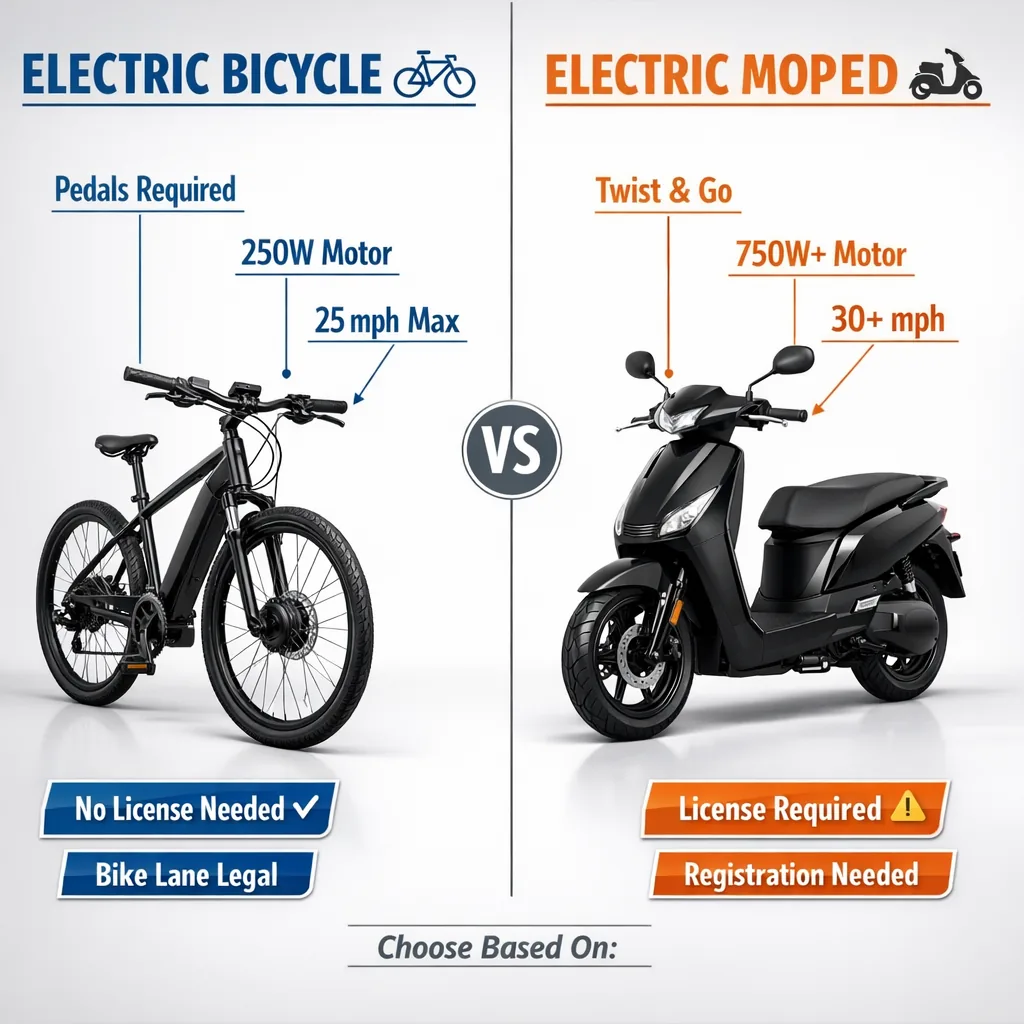
Motorized Bicycle Laws in Wisconsin only make sense once you split three categories that older summaries often blend together: electric bicycles, mopeds, and motor bicycles. Wisconsin gives electric bicycles their own 750-watt class 1, class 2, and class 3 definitions and exempts them from licensing, registration, title, and financial-responsibility rules. Mopeds and motor bicycles stay in a different lane, with lower speed caps, different path restrictions, and Wisconsin DMV title and registration requirements for mopeds.
Note: This Wisconsin guide is based on current Wisconsin statutes and Wisconsin Department of Transportation guidance. It is informational only and not legal advice.
Last reviewed / source-checked: 2026-03-16
Wisconsin-specific caution: A bike with added power is not automatically a moped in Wisconsin. The state separately defines electric bicycles, mopeds, and motor bicycles, and those labels change the paperwork and path rules.
Quick answer: are motorized bicycles legal in Wisconsin?
Electric bicycles: Yes. Wisconsin recognizes class 1, class 2, and class 3 electric bicycles as their own category.
E-bike definition: A Wisconsin electric bicycle must have fully operative pedals, an electric motor of 750 watts or less, and fit the state's class 1, 2, or 3 speed rules.
E-bike paperwork: Wisconsin says an electric-bicycle operator is not subject to chapters on operator's licenses, registration, title, or financial responsibility.
Mopeds: Yes, but Wisconsin treats them as motor vehicles. A moped can be either a bicycle-type vehicle with fully operative pedals and an engine of not more than 130cc, or an automatic-transmission motorcycle with an engine of not more than 50cc, so long as it stays at 30 mph or less with a 150-pound rider.
Motor bicycles: Yes, but Wisconsin defines a motor bicycle separately as a bicycle with an added power unit that is not an integral part of the vehicle and that stays at 30 mph or less.
License rule for mopeds: Wisconsin DOT says most riders need a valid Class D license, and a person without a Class D license may apply for a moped permit if eligible.
Registration and title: Wisconsin DOT says you must register a moped and obtain a certificate of title. Wisconsin's electric-bicycle statute exempts e-bikes from title and registration chapters.
Bike path rule: Wisconsin lets electric bicycles use bikeways subject to DNR, municipal, county, or department restrictions. Wisconsin statutes separately say no person may ride a moped or motor bicycle with the power unit in operation upon a bicycle way.
Roadway rule: Wisconsin statutes allow mopeds on ordinary roadways unless signs prohibit them, but DOT says mopeds may not use freeways.
Class 3 age rule: No person under 16 may operate a class 3 electric bicycle in Wisconsin.
In Wisconsin, the first legal question is not just gas versus electric. It is whether the machine is an electric bicycle, a moped, or a motor bicycle.
Motorized Bicycle Laws in Wisconsin: how Wisconsin classifies your ride
Wisconsin is more specific than many state summaries suggest.
Electric bicycle: Wisconsin defines an electric bicycle as a bicycle with fully operative pedals, an electric motor of 750 watts or less, and one of the state class definitions.
Class 1 electric bicycle: Pedal-assist only, with assistance stopping at 20 mph.
Class 2 electric bicycle: May be powered solely by the motor and cannot provide assistance above 20 mph.
Class 3 electric bicycle: Pedal-assist only, with assistance stopping at 28 mph.
Moped: Wisconsin defines a moped as certain motor vehicles capable of not more than 30 mph with a 150-pound rider, including either a bicycle-type vehicle with fully operative pedals and an engine of not more than 130cc, or a motorcycle with automatic transmission and an engine of not more than 50cc.
Motor bicycle: Wisconsin defines a motor bicycle as a bicycle with an added power unit that is not an integral part of the vehicle, limited to 30 mph with a 150-pound rider.
That classification split drives most of Motorized Bicycle Laws in Wisconsin. Wisconsin even says a moped does not include a motor bicycle or electric bicycle, and a motor bicycle does not include an electric bicycle.
Motorized Bicycle Laws in Wisconsin for electric bicycles
Wisconsin gives e-bikes bicycle-style treatment
Wisconsin statute section 346.806 says an electric bicycle and its operator generally get the same rights and duties as a bicycle rider unless another statute expressly says otherwise. That is a major difference from the moped lane.
E-bikes are exempt from license, title, registration, and financial-responsibility rules
Wisconsin expressly says a person operating an electric bicycle is not subject to chapters 341, 342, 343, or 344 for financial responsibility, operator's licenses, registration, or certificates of title. That means a compliant Wisconsin e-bike does not use the same paperwork lane as a moped.
Wisconsin allows e-bikes on bikeways, but local and agency restrictions still matter
Wisconsin allows a person to ride an electric bicycle with the power unit in operation on a bikeway under DNR, municipal, county, or department jurisdiction, but that right remains subject to restrictions created by rule or ordinance. So the state is friendly to e-bikes on bikeways, but not in a blanket, no-exceptions way.
Class 3 riders under 16 are not allowed to operate the bike
Wisconsin says no person under 16 years of age may operate a class 3 electric bicycle. A person under 16 may still ride as a passenger on a class 3 electric bicycle designed to carry passengers.
Wisconsin gives electric bicycles a lighter compliance lane than mopeds. Once the machine leaves the electric-bicycle definition, the legal treatment changes fast.
Motorized Bicycle Laws in Wisconsin for mopeds and motor bicycles
Wisconsin still keeps real moped and motor-bicycle categories
Unlike states that merge almost every small powered bike into one label, Wisconsin separates mopeds from motor bicycles. The difference turns on whether the power source is integral to the vehicle and whether the machine fits the state's moped definition.
Mopeds need title and registration in Wisconsin
Wisconsin DOT says you must register your moped and obtain a certificate of title. Wisconsin's registration page also lists mopeds in the biennial registration cycle, with moped registrations expiring at the end of April in even years.
Most riders need a Class D license or a moped permit
Wisconsin DOT says anyone with a valid Class D regular or probationary driver license may generally operate a moped. DOT also says it is not legal to operate a moped with only an instruction permit, and a person without a Class D license may apply for a moped permit if the person is at least 16 and has completed an approved driver education course.
Mopeds and motor bicycles are restricted on bicycle ways
Wisconsin statute section 346.79(5) says no person may ride a moped or motor bicycle with the power unit in operation upon a bicycle way. That is one of the clearest places where Wisconsin separates mopeds and motor bicycles from electric bicycles.
Mopeds can use ordinary roadways, but not where signs or freeway rules say no
Wisconsin statute section 346.80(4) says no person may operate a moped on a roadway where a sign is erected indicating that moped riding is prohibited. Wisconsin DOT also says you may ride a moped on any roadway except freeways or roads where mopeds are specifically prohibited.
Passengers and roadway position still matter
Wisconsin DOT says mopeds are designed for only one person and it is illegal to carry a passenger. DOT also says mopeds are entitled to a full traffic lane, may not impede traffic, and on roads with more than 25 mph limits must ride single file. On roads with two or more lanes in each direction, DOT says mopeds must operate in the right lane except when turning left.
Wisconsin is usually more welcoming to electric bicycles on bikeways than it is to mopeds or motor bicycles with the power unit operating.
What is different in Wisconsin?
Wisconsin keeps three meaningful categories in play: electric bicycles, mopeds, and motor bicycles.
Wisconsin defines an electric bicycle at 750 watts or less and then uses class 1, 2, and 3 speed definitions.
Wisconsin's moped definition is broader than many riders expect because it can cover a pedal-equipped bicycle-type vehicle up to 130cc or an automatic-transmission motorcycle up to 50cc, so long as it stays within the 30 mph cap.
Wisconsin says a moped does not include a motor bicycle or electric bicycle, which stops some common label-mixing.
Wisconsin expressly exempts electric bicycles from licensing, title, registration, and financial-responsibility chapters.
Wisconsin expressly bars mopeds and motor bicycles with the power unit operating on bicycle ways, while allowing e-bikes on bikeways subject to restrictions.
Wisconsin DOT requires a title and registration for mopeds and says most operators need either a Class D license or a moped permit.
Common rider situations under Motorized Bicycle Laws in Wisconsin
If you bought a 750-watt pedal-assist commuter e-bike
You are usually in Wisconsin's electric-bicycle lane, not the moped lane. That means no operator-license, title, or registration requirement under the electric-bicycle statute, though ordinary bicycle-style traffic rules still apply.
If you bought a throttle e-bike that tops out at 20 mph
That can still fit Wisconsin's class 2 electric-bicycle definition if it otherwise qualifies. A throttle alone does not automatically turn the machine into a moped.
If you ride a small 49cc step-through scooter
You are likely in Wisconsin's moped lane. That means you should think about title, registration, Class D license or moped permit eligibility, one-person use, and the bicycle-way restriction.
If you added a bolt-on motor kit to a bicycle
That setup may fit Wisconsin's motor-bicycle definition rather than the moped or electric-bicycle definition, because Wisconsin specifically uses a separate category for a bicycle with a power unit added that is not integral to the vehicle.
If you want to use a bike path or bikeway
Wisconsin is more favorable to electric bicycles than to mopeds or motor bicycles. E-bikes may use bikeways subject to restrictions, while mopeds and motor bicycles may not be ridden with the power unit operating on a bicycle way.
This page is for general informational purposes only and is not legal advice. Wisconsin statutes, DOT procedures, local ordinances, and bikeway restrictions can change. Verify the current rules before riding on public roads, bikeways, bike paths, or trails.
Warranty Protection
Have a problem? Bike repairs and replacement parts are covered through our manufacturer warranty for up to two years after purchase.
Verified Secure Checkout
Your information is kept 100% protected and private. Payments are handled through trusted third-party providers and never stored on our servers.
To provide the best experiences, we use technologies like cookies to store and/or access device information. Consenting to these technologies will allow us to process data such as browsing behavior or unique IDs on this site. Not consenting or withdrawing consent, may adversely affect certain features and functions.
Functional
Always active
The technical storage or access is strictly necessary for the legitimate purpose of enabling the use of a specific service explicitly requested by the subscriber or user, or for the sole purpose of carrying out the transmission of a communication over an electronic communications network.
Preferences
The technical storage or access is necessary for the legitimate purpose of storing preferences that are not requested by the subscriber or user.
Statistics
The technical storage or access that is used exclusively for statistical purposes.The technical storage or access that is used exclusively for anonymous statistical purposes. Without a subpoena, voluntary compliance on the part of your Internet Service Provider, or additional records from a third party, information stored or retrieved for this purpose alone cannot usually be used to identify you.
Marketing
The technical storage or access is required to create user profiles to send advertising, or to track the user on a website or across several websites for similar marketing purposes.