Motorized Bicycle Laws in South Carolina are easiest to understand when you split the state into two legal lanes: electric-assist bicycles and mopeds. South Carolina now defines electric-assist bicycles separately and says riders of bicycles with helper motors follow the bicyclist rule set, while mopeds stay in a different lane with their own license, registration, helmet, speed, lane-position, and roadway-limit rules.
Note: This South Carolina guide is based on current South Carolina Code sections and current SCDMV guidance linked below. It is informational only and not legal advice.
Last reviewed / source-checked: 2026-03-16
South Carolina caution: Older summaries often treat e-bikes and mopeds as the same thing. Current South Carolina law does not. South Carolina expressly says electric-assist bicycles and bicycles with helper motors are not mopeds, which changes the paperwork and operating rules.
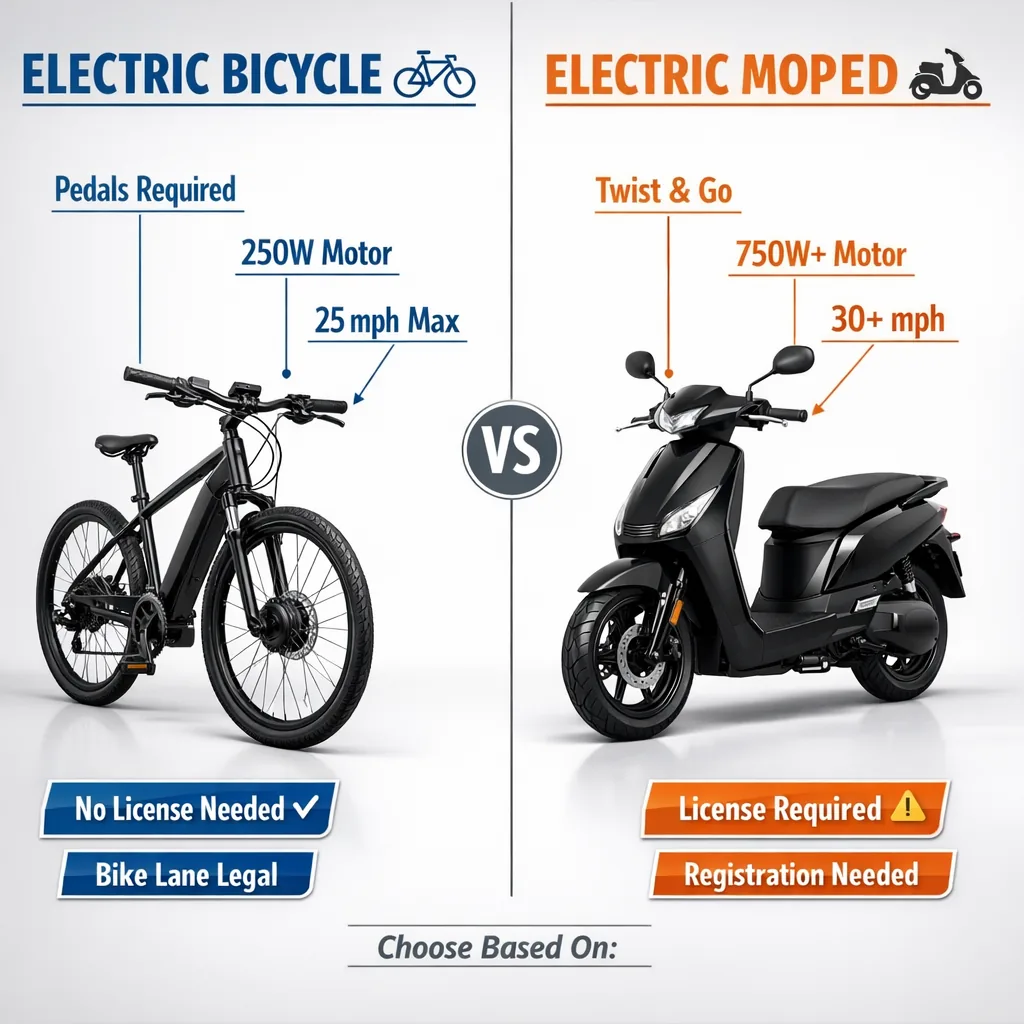
South Carolina's first split happens in the definitions section.
That split is the center of Motorized Bicycle Laws in South Carolina. A compliant helper-motor bicycle is not a moped, so the state does not treat every small powered two-wheeler the same way.
South Carolina's current e-bike definition is narrower than the moped definition. To stay in the electric-assist bicycle lane, the machine needs fully operable pedals, must remain under the statute's 750-watt / one-horsepower ceiling, and must stay below 20 mph on motor power alone. If a machine goes beyond that lane, the moped or motorcycle analysis becomes much more important.
South Carolina Code section 56-5-3520 says bicyclists operating bicycles with helper motors are subject to the statutory provisions applicable to bicyclists. That means compliant helper-motor bicycles are pushed into the bicycle rule set rather than the moped registration-and-license lane.
South Carolina's bicycle rules require riders on a roadway to ride as near to the right side of the roadway as practicable, allow up to two abreast, and require use of a bicycle lane when one is provided and the statute says it must be used. The bicycle statutes also require nighttime equipment: a front white lamp visible at least 500 feet and a rear red reflector, with an optional rear red lamp.
For a practical rider, that means a lawful helper-motor bicycle in South Carolina looks more like a bicycle with extra power than a mini-motorcycle with a plate.
Because South Carolina says helper-motor bicycles are not mopeds and then sends them into the bicyclist rule set, the moped registration and moped-license statutes are not the main legal lane for a compliant electric-assist bicycle. That is a major difference from small electric machines that are powerful enough to land in the moped definition instead.
South Carolina's statewide bicycle provisions are the baseline, but local authorities can adopt additional traffic regulations that are not in conflict with state law. If you plan to ride on a local greenway, beach path, park trail, or city-managed bicycle facility, check the posted local rules before assuming every helper-motor bicycle is automatically welcome everywhere.
A lot of older pages reduce South Carolina mopeds to a simple 50cc rule. The current statute is more specific. South Carolina allows gasoline, electricity, alternative fuel, or hybrid power in the moped lane. The code also recognizes an electric-power lane that can reach above ordinary 750-watt e-bike territory, which is one reason riders should not assume every electric two-wheeler is automatically an e-bike.
South Carolina Code section 56-2-3000 says a person operating a moped on a public highway must have a valid moped operator's license or valid driver's license and moped registration. Section 56-2-3010 then says a moped operated on a public highway must be registered and licensed with the department in the same fashion as passenger vehicles. The SCDMV also says mopeds must have a license plate and the registration card must be carried while driving.
South Carolina Code section 56-2-3010 says mopeds are not required to be titled or insured in the state. The SCDMV echoes that point by saying insurance is not required for registration and titling is optional. The code also allows the department to issue a title on request when the owner has the right supporting documents, which explains why you may see some titled mopeds even though titling is not mandatory.
Section 56-2-3070 sets the main on-road limits. A moped may not be operated faster than 35 mph. It also may not be operated on a public highway with a speed limit greater than 55 mph, though it may cross an intersection at one of those highways. On multilane highways, the moped must be operated in the farthest right lane except when making a left turn or when the far-right lane is unsafe.
South Carolina says a person under 21 may not operate or ride upon a moped unless he wears a protective helmet tied to the underage motorcycle helmet standard in section 56-5-3660. That is a concrete statewide rule, not just a best-practice suggestion.
South Carolina says a moped may not carry more people than the number for which it is designed and equipped by the manufacturer. The operator also must have the operational lights and headlight turned on whenever the moped is being operated. For sellers and rental operators, South Carolina requires at least one rearview mirror, operable headlights and running lights, and brake lights that work when either brake is deployed.
If it keeps fully operable pedals, stays under the statutory wattage ceiling, and remains below the state's motor-powered speed threshold, you are likely in South Carolina's helper-motor bicycle lane rather than the moped lane. That means the bicyclist rules matter more than moped registration rules.
This is where many riders get tripped up. South Carolina's moped definition can reach certain stronger electric machines, so a bike that no longer fits the helper-motor definition may move into the moped lane and trigger registration, plate, and license questions.
The SCDMV says a 15-year-old may apply for a Class G moped license by taking the vision and knowledge test. The SCDMV also says that anyone younger than 16 with a moped license may operate a moped alone only during daylight hours and, at night, only with a qualifying licensed driver nearby under the DMV's stated rules.
You do not need to keep the special Class G path forever if you already hold a valid driver's license. South Carolina's statute allows a valid driver's license in place of a separate moped operator's license, but the moped still needs registration for public-highway use.
Check the machine's design and equipment first. South Carolina allows only the number of riders for which the moped was designed and equipped by the manufacturer.
A moped should not be treated like a full motorcycle in South Carolina. Once the posted speed limit exceeds 55 mph, the statute blocks ordinary moped operation there, other than crossing the intersection.
South Carolina statutes provide the statewide baseline, but city trail systems, beach towns, park authorities, and other local jurisdictions may post narrower operating rules for paths, boardwalks, and bicycle facilities. Before riding any helper-motor bicycle or low-power scooter outside an ordinary road setting, check the local facility rules instead of assuming the statewide baseline is the last word.
This page is for general informational purposes only and is not legal advice. South Carolina statutes, DMV procedures, local path rules, and local enforcement practices can change. Verify the current rules before riding any helper-motor bicycle, moped, scooter, or motorcycle on public roads, bicycle lanes, paths, parks, or other public property.