Motorized bicycle laws in Montana are unusual because Montana separates true mopeds from motor vehicles in the reviewed statutes and uses a narrow 20 mph definition for electrically assisted bicycles. If your bike meets Montana’s moped definition—pedals, two or three wheels, no more than 2 brake horsepower, no more than 30 mph on level ground, and a direct or automatic drive system—the traffic code gives you a usable statewide rule set for roadway operation. But if your machine falls outside that narrow definition, or if it looks more like a scooter than a pedal-equipped moped, you should verify the next vehicle category before riding on public roads.
Note: This page is for general informational purposes only, not legal advice. Montana rules can change, and local access rules can be narrower than the statewide default. Verify current requirements with the Montana Legislature, Montana Department of Justice, and the local authority where you plan to ride. Last reviewed: 2026-03-15.
| Topic | Quick answer |
|---|---|
| Electric bike definition | Montana defines an electrically assisted bicycle as a two-tandem-wheel vehicle with an electric motor that can propel a 170-pound rider no faster than 20 mph on a paved, level surface. |
| Moped definition | A Montana moped needs 2 or 3 wheels, foot pedals, an independent power source of no more than 2 brake horsepower, a 30 mph max speed on level ground, and a drive system that works directly or automatically without operator clutching or shifting after engagement. |
| License | The reviewed statewide moped statutes do not clearly create a separate moped driver-license rule. The general driver-license statute reviewed applies to motor vehicles, and the reviewed motor-vehicle definition excludes mopeds. Verify current MVD guidance before riding on public roads. |
| Registration / title | The reviewed registration statute applies to motor vehicles, and the reviewed motor-vehicle definition excludes mopeds. A true moped is therefore not clearly covered by the reviewed motor-vehicle registration rule, but riders should verify current state guidance before assuming no plate is required. |
| Insurance | The reviewed mandatory-insurance statute applies to motor vehicles, and the reviewed motor-vehicle definition excludes mopeds. The reviewed statewide statutes do not clearly state a separate moped insurance requirement. |
| Helmet / age | Operators and passengers under 18 must wear protective headgear on a moped or motorized scooter operated on streets or highways. The reviewed statutes did not show a separate statewide e-bike helmet rule. |
| Where you can ride | Mopeds may operate on highways, in designated bicycle lanes on highways, and on highway shoulders. Under power, they may not operate on sidewalks or bicycle paths. E-bikes follow bicycle rules in the reviewed traffic code. |
| Local caveat | Local authorities can add narrower traffic controls, and Montana DNRC treats e-bikes as motorized vehicles for trust-land recreation access. |
For many riders, the biggest Montana takeaway is that compliant e-bikes and pedal-equipped mopeds are not analyzed the same way. The more your build departs from Montana’s narrow definitions, the more likely you are dealing with a different vehicle category.
Montana’s traffic code draws a bright line between an electrically assisted bicycle and a moped. An electrically assisted bicycle is folded into the state’s bicycle definition, but only if it has two tandem wheels and the motor can propel a 170-pound rider no faster than 20 mph on a paved, level surface.
A moped is different. It must have two or three wheels, foot pedals to permit muscular propulsion, an independent power source providing a maximum of 2 brake horsepower, a top speed of no more than 30 mph on level ground, and a drive system that functions directly or automatically without requiring the operator to clutch or shift after it is engaged.
That means Montana’s moped rule is narrower than the common “small scooter” assumption. If your machine does not have pedals, exceeds the speed or power cap, or requires manual shifting after engagement, it may fall outside Montana’s moped bucket even if riders casually call it a moped.
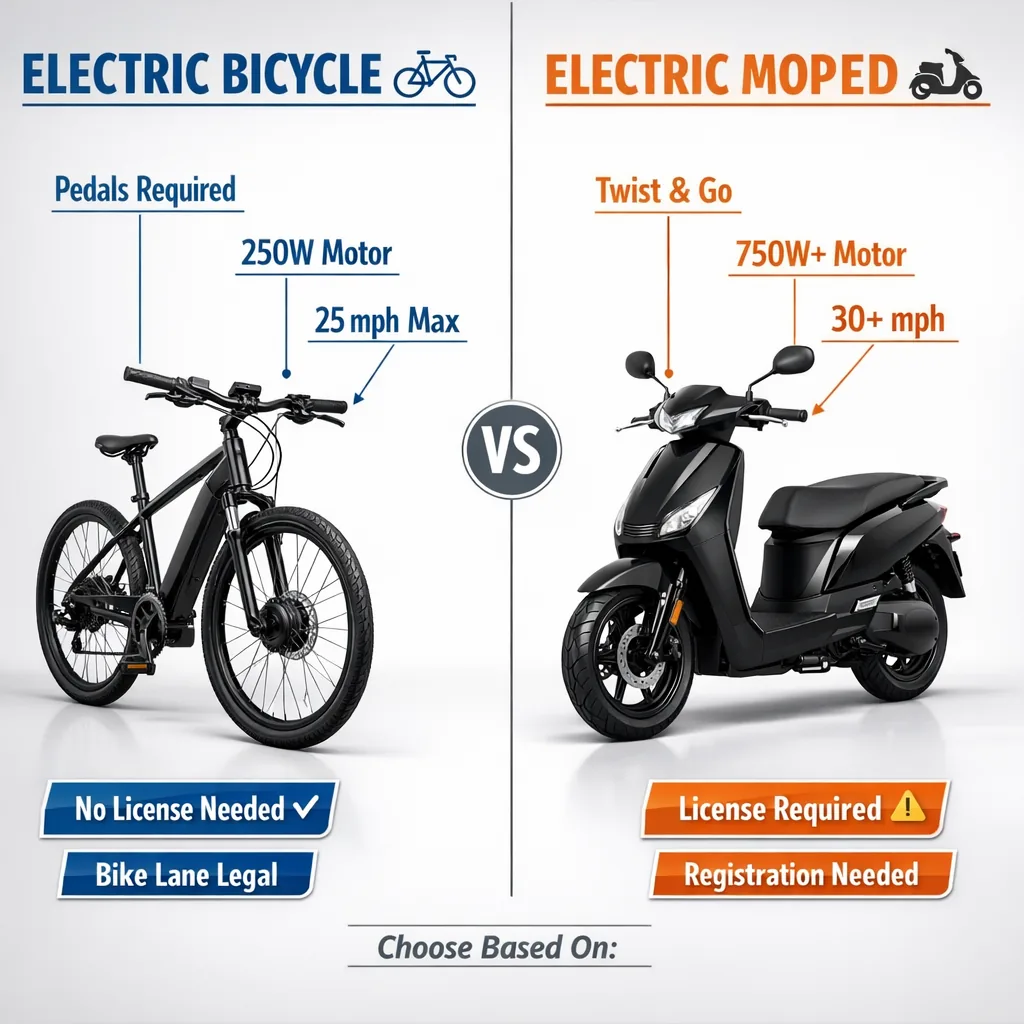
This is the part where motorized bicycle laws in Montana need careful wording. In the statutes reviewed for this draft, the general driver-license, registration, and mandatory liability-insurance sections apply to motor vehicles. In the reviewed definition section, Montana says the term motor vehicle does not include a bicycle, a motorized scooter, or a moped as defined in 61-8-102.
Because of that statutory structure, the reviewed statewide code does not clearly state that a true Montana moped must be licensed, registered, or insured the same way as a motor vehicle. That is very different from states that say the answer directly. Riders should treat this as a verification point rather than a blanket exemption, especially if the machine lacks pedals, is modified, or could be classified as something other than a moped.
For compliant electric bikes, the reviewed traffic code treats them as bicycles rather than motor vehicles. That is important because Montana’s e-bike definition is narrow and older-style: if a machine goes beyond the reviewed 20 mph electrically assisted bicycle definition, it may need to be analyzed under a different rule set.
Montana gives people operating bicycles, mopeds, and motorized scooters the rights and duties that apply to drivers of other vehicles unless a special rule changes the answer. That makes the access details especially important.
This is one of the most practical Montana differentiators. Even when a moped can use a highway shoulder or designated bike lane, it does not get blanket permission to ride a sidewalk or bicycle path under power.
If it has pedals, stays within the 2 brake horsepower and 30 mph limits, and uses a direct or automatic drive system, it is much closer to Montana’s reviewed moped definition than to a motorcycle category. You still need to verify current state guidance before assuming there is no separate licensing, registration, or insurance requirement.
Montana’s reviewed electrically assisted bicycle definition tops out at 20 mph for a 170-pound rider and requires two tandem wheels. If your bike exceeds that reviewed definition, do not assume Montana treats it like a standard bicycle just because another state would.
A bicycle may use a sidewalk or crosswalk subject to pedestrian-yield rules and any official local prohibition. A moped may be on a sidewalk or bicycle path only under human propulsion, not under motor power.
Montana DNRC says e-bikes are treated as motorized vehicles for trust-land recreational access. DNRC guidance allows them on public roads and roads signed as open, not as a blanket green light for every trail or off-road area.
Montana defines local authorities broadly enough that cities, counties, and other local bodies can set traffic controls within their authority. That means the statewide rules are the floor, not always the full answer. A city can post sidewalk restrictions, and a land manager can narrow access on certain routes.
That local-control issue matters even more for recreation access. DNRC’s trust-land guidance treats e-bikes as motorized vehicles, so a route that feels bicycle-adjacent may still be managed more like a motorized-access question than a normal bike-path question.