Motorized bicycle laws in Maine make more sense once you separate three different buckets: electric bicycles, motorized bicycles or tricycles, and mopeds. Maine gives compliant e-bikes bicycle-style treatment, but older motorized bicycles and mopeds still follow their own license, speed, and registration rules.
Note: This Maine guide is based on current Maine statutes and Maine Bureau of Motor Vehicles guidance. It is informational only and not legal advice.
Last reviewed / source-checked: 2026-03-15
Local rule note: Municipalities and public agencies in Maine can restrict where some electric bicycles may ride, especially on bicycle paths and natural-surface nonmotorized routes.
In Maine, the first legal question is whether your machine is an e-bike, a motorized bicycle, or a moped.
Motorized bicycle laws in Maine: quick answer
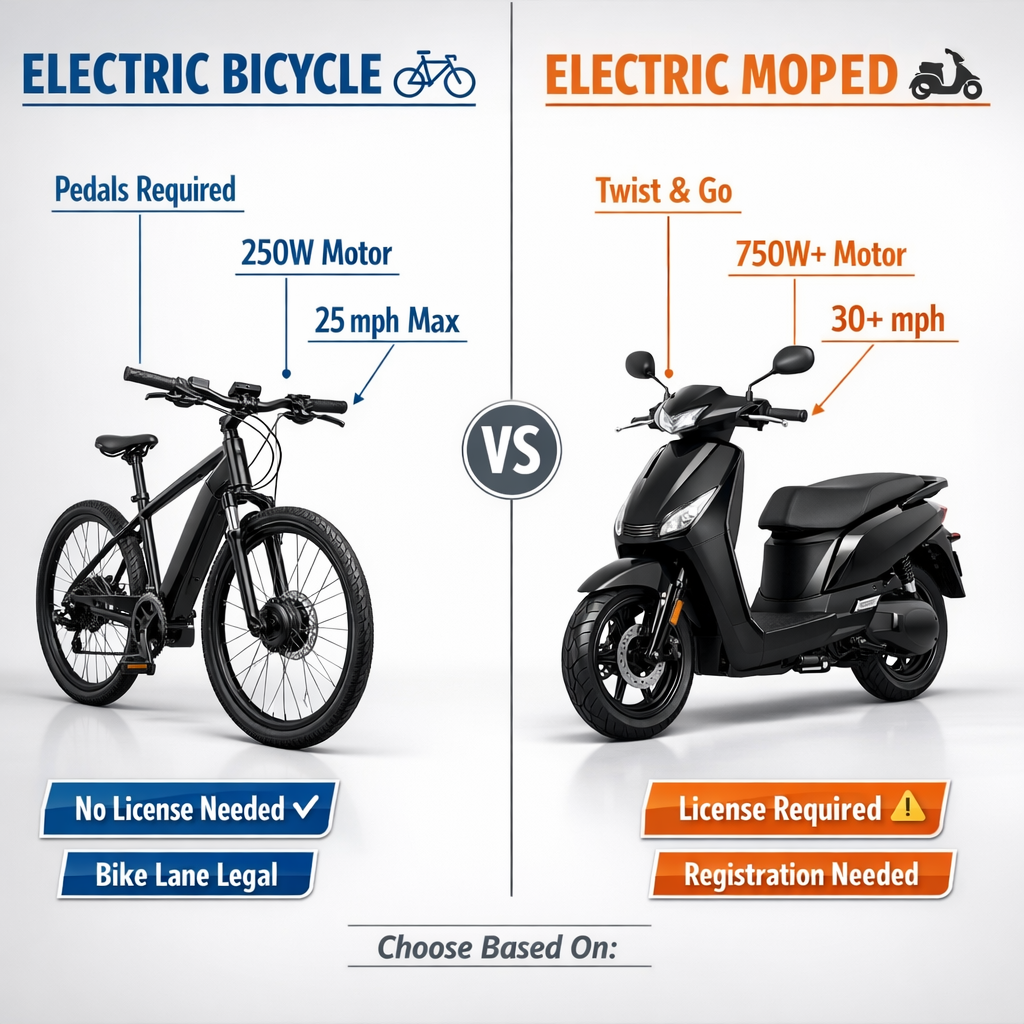
Electric bicycle: Maine defines an electric bicycle as a 2-wheel or 3-wheel bicycle with fully operable pedals, an electric motor under 750 watts, and class 1, 2, or 3 performance.
E-bike paperwork: Maine says electric bicycles are not subject to financial responsibility, driver's license, registration, or license plate rules under Title 29-A.
E-bike path rule: Class 1 and class 2 e-bikes may generally ride where bicycles are allowed unless a local authority says otherwise. Class 3 e-bikes may not use a bicycle path unless that path is specifically authorized for class 3 use.
Motorized bicycle: Maine defines a motorized bicycle or tricycle separately from an e-bike. It may have pedals, must stay within the state's low-power definition, and may not be operated above 20 mph on the road.
Motorized bicycle license rule: A Maine motorized bicycle or motorized scooter rider may use any class of valid license, a learner's permit, or a motorcycle or moped endorsement. Maine does not require a special motorcycle-only endorsement for this category.
Motorized bicycle registration rule: Maine BMV says a motorized bicycle or motorized scooter cannot be registered.
Moped rule: Maine treats mopeds differently. Mopeds can be registered, and Maine also offers a separate moped license starting at age 16.
Helmet rule: Riders under 16 on electric bicycles must wear a bicycle helmet. For mopeds, riders under 18 and certain newly licensed or permit holders must wear protective headgear.
How Maine classifies e-bikes, motorized bicycles, and mopeds
Maine is clearer than many states because it does not try to cram every powered bike into one label.
Electric bicycle: fully operable pedals, electric motor under 750 watts, and class 1, 2, or 3 design under 29-A M.R.S. §101.
Motorized bicycle or tricycle: a bicycle or tricycle that may have pedals and has a qualifying low-power motor setup that fits Maine's separate definition, excluding electric bicycles.
Moped: a separate category for a 2-wheel or 3-wheel motorized device with 10-inch or larger wheels, a small gas or electric motor, and an automatic or direct power drive system that does not require shifting after engagement.
That distinction drives almost every practical answer under motorized bicycle laws in Maine. E-bikes get bicycle-style treatment. Motorized bicycles sit in a limited low-speed category. Mopeds carry their own registration, lane-use, and helmet implications.
Maine separates bicycle-style e-bikes from slower motorized bicycles and from registerable mopeds.
Motorized Bicycle Laws in Maine for electric bicycles
Maine modernized its electric bicycle rules in 2019, and that statute matters more than older generic internet summaries.
Maine uses a true class 1, 2, and 3 e-bike system
Class 1: pedal-assist only, with assistance ending at 20 mph.
Class 2: motor can propel the bike, but not above 20 mph.
Class 3: pedal-assist only, with assistance ending at 28 mph.
Maine also requires a permanent label showing the e-bike's classification, top assisted speed, and motor wattage.
Maine does not require a license, registration, or plate for an electric bicycle
29-A M.R.S. §2063 says a person operating an electric bicycle is not subject to Maine's financial responsibility, driver's license, registration, or license plate provisions. That is one of the biggest Maine-specific advantages for a compliant e-bike.
Class 1 and class 2 e-bikes have broader path access than class 3
Maine allows class 1 and class 2 e-bikes anywhere bicycles are permitted, including bicycle paths, unless a municipality, local authority, or public agency with jurisdiction prohibits them. Class 3 e-bikes may not operate on a bicycle path unless that path has been specifically authorized for class 3 use.
Natural-surface nonmotorized routes are a separate caution zone
Maine also says an electric bicycle may not be used on a bicycle path designated for nonmotorized traffic if significant portions of that path have a natural surface, including gravel, stones, or wooden bridging, unless the local authority or public agency authorizes it. That matters for rail trails, mixed-surface greenways, and similar routes.
Riders under 16 face special e-bike restrictions
Maine adds age-based safety rules for electric bicycles:
a person under 16 may not operate a class 2 or class 3 e-bike;
a person under 16 may ride as a passenger on a class 2 or class 3 e-bike only if the bike is designed to carry passengers;
a person under 16 who is an operator or passenger on an electric bicycle must wear a properly fitted and fastened bicycle helmet.
Motorized Bicycle Laws in Maine for motorized bicycles and mopeds
Maine still keeps a separate legal lane for low-power motorized bicycles and another one for mopeds. Those rules matter if your ride is not a true classed e-bike.
Maine's motorized-bicycle category is slower than many riders expect
Maine defines a motorized bicycle or tricycle as a bicycle or tricycle that may have pedals and has a qualifying low-power motor. But 29-A M.R.S. §2063 separately says a motorized bicycle or motorized scooter may not be operated above 20 mph. That means the real-road use rule is more restrictive than many generic “25 mph” summaries floating around online.
Maine does not require a motorcycle endorsement for a motorized bicycle
29-A M.R.S. §1254 says a motorized bicycle, tricycle, or motorized scooter may be operated by someone who has a valid license of any class, a learner's permit, or a motorcycle or moped license. Maine specifically says the Secretary of State may not require a motorcycle or moped endorsement for this category.
Maine BMV says motorized bicycles cannot be registered
Maine BMV's registration guidance places motorized scooters and motorized bicycles in a category that cannot be registered. The same BMV chart also says inspection is not required for that category.
Mopeds are a different legal bucket in Maine
Maine defines a moped separately. The vehicle can have 2 or 3 wheels that are at least 10 inches in diameter, a small gas motor up to 50cc or an electric motor under 1,500 watts, and a power drive system that works directly or automatically without shifting after engagement.
Unlike motorized bicycles, Maine BMV says a moped can be registered as a moped. Maine also offers a separate moped license for applicants who are at least 16 and pass the required examination.
Moped helmet rules are stricter than ordinary bicycle helmet rules
Under 29-A M.R.S. §2083, protective headgear is required for:
operators and passengers on a moped who are under 18;
an operator of a motorcycle or moped riding on a learner's permit;
an operator of a motorcycle or moped within one year of successfully completing a driving test;
passengers riding with an operator who is required to wear headgear.
Maine also applies practical roadway rules to these machines
For bicycles under 29-A M.R.S. §2063, Maine requires slower riders to travel on the right portion of the way as far as practicable, while still allowing turns, passing, hazard avoidance, and paved-shoulder use. Maine also says a bicycle may not carry more persons than it was designed to carry. For mopeds, 29-A M.R.S. §2062 requires single-file operation and riding as far right as practicable except when making a left turn.
Maine is friendlier to compliant e-bikes than to older motorized categories, but path access can still change by surface type and local rule.
What makes Maine different from many other states
Maine recognizes both a modern three-class e-bike system and older motorized bicycle and moped categories at the same time.
Maine gives compliant e-bikes a clean exemption from driver's license, registration, plate, and financial responsibility rules.
Maine caps real-world operation of a motorized bicycle or motorized scooter at 20 mph even though many readers only notice the low-power definition.
Maine lets a motorized bicycle rider use any class of valid license or a learner's permit instead of forcing a motorcycle endorsement.
Maine says a motorized bicycle cannot be registered, while a moped can be registered.
Maine uses a more restrictive class 3 bicycle-path rule and adds a special rule for natural-surface nonmotorized bicycle paths.
Common rider situations under motorized bicycle laws in Maine
If you commute on a class 1 or class 2 e-bike
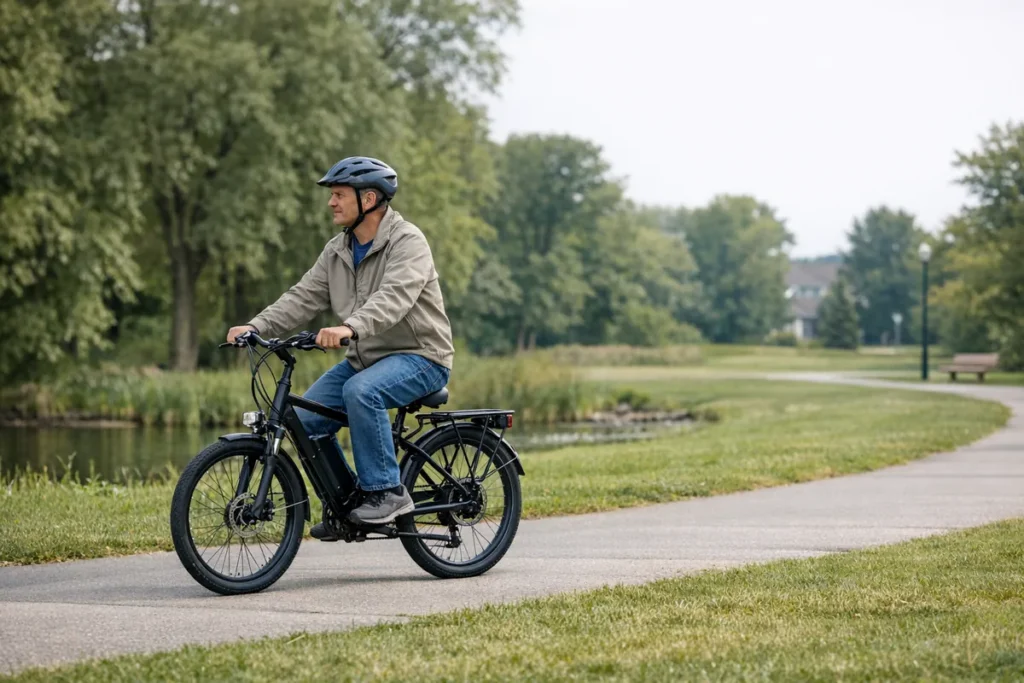
You are usually in Maine's simplest legal bucket. The e-bike is treated much more like a bicycle, and Maine does not require the registration, plate, or driver's license steps that apply to motor vehicles. You still need to obey traffic rules and any local path restrictions.
If you want a class 3 e-bike for faster paved commuting
Maine allows class 3 e-bikes, but they are more limited on bicycle paths. They also require a speedometer, and riders under 16 may not operate them. If the route includes a bike path instead of a roadway shoulder or lane, check local authorization first.
If your bike has a small gas motor or older helper-motor setup
Do not assume Maine treats it like an e-bike. It may fall into the separate motorized-bicycle category, where the operation cap is 20 mph and the license rule is different from the no-license e-bike lane.
If your machine fits Maine's moped definition
Plan around moped-specific rules, not electric-bicycle rules. Registration becomes relevant, helmet rules get stricter for younger and newly licensed riders, and Maine's separate moped-license option can matter if you do not hold a regular driver's license.
Official Maine sources
29-A M.R.S. §101 — definitions for electric bicycle, moped, motorized bicycle or tricycle, and motorized scooter
29-A M.R.S. §2063 — rights and duties for bicycles and electric bicycles, motorized bicycle speed limit, path access, and age rules
29-A M.R.S. §1254 — operator licensing for motorized bicycles, scooters, and mopeds
29-A M.R.S. §2084 — night equipment and brake rules for bicycles, scooters, and motorized bicycles
29-A M.R.S. §2083 — protective headgear rules for motorcycles and mopeds
To provide the best experiences, we use technologies like cookies to store and/or access device information. Consenting to these technologies will allow us to process data such as browsing behavior or unique IDs on this site. Not consenting or withdrawing consent, may adversely affect certain features and functions.
Functional
Always active
The technical storage or access is strictly necessary for the legitimate purpose of enabling the use of a specific service explicitly requested by the subscriber or user, or for the sole purpose of carrying out the transmission of a communication over an electronic communications network.
Preferences
The technical storage or access is necessary for the legitimate purpose of storing preferences that are not requested by the subscriber or user.
Statistics
The technical storage or access that is used exclusively for statistical purposes.The technical storage or access that is used exclusively for anonymous statistical purposes. Without a subpoena, voluntary compliance on the part of your Internet Service Provider, or additional records from a third party, information stored or retrieved for this purpose alone cannot usually be used to identify you.
Marketing
The technical storage or access is required to create user profiles to send advertising, or to track the user on a website or across several websites for similar marketing purposes.