Motorized Bicycle Laws in Virginia split into two very different lanes: mopeds and electric power-assisted bicycles. Virginia still uses a real moped category for certain gas, electric, or hybrid bikes up to 35 mph, and those vehicles have title, registration, age, helmet, and roadway rules that do not apply to a normal 750-watt class 1, 2, or 3 e-bike. That classification gap is the key to Motorized Bicycle Laws in Virginia, because the right answer depends on whether your machine fits Virginia's moped definition or Virginia's electric bicycle definition.
Note: This Virginia guide is based on current Virginia Code sections and Virginia DMV moped guidance. It is informational only and not legal advice.
Last reviewed / source-checked: 2026-03-16
Virginia-specific caution: A 750-watt pedal e-bike is usually not a moped in Virginia, but a faster or heavier-powered bike-shaped machine can move into the moped or motorcycle lane instead.
Quick answer: are motorized bicycles legal in Virginia?
Mopeds: Yes. Virginia allows mopeds on public roads, but riders must follow Virginia's moped-specific rules.
Moped definition: A Virginia moped can have up to three wheels, a seat at least 24 inches high, a motor of 50cc or less or 1,500 watts or less, and a top speed no higher than 35 mph.
Moped title / registration: Virginia DMV says a moped operated on Virginia roadways must be titled and registered.
Moped license rule: Virginia law requires the rider to be at least 16 and carry government-issued photo ID, but Virginia DMV does not require a driver's license just to operate a moped.
Moped safety gear: Virginia requires helmets for riders and passengers, plus a face shield, safety glasses, or goggles unless the moped has a windshield.
Moped roadway rule: Mopeds cannot be ridden faster than 35 mph and cannot be operated on the Interstate Highway System.
Electric bicycles: Yes. Virginia treats electric power-assisted bicycles much more like bicycles than mopeds.
E-bike paperwork: Virginia exempts electric power-assisted bicycles from driver's-license, registration, title, financial-responsibility, and license-plate requirements.
E-bike path rule: Virginia generally allows e-bikes where bicycles are allowed, including streets, shoulders, bike lanes, and shared-use paths, but local or agency rules can still restrict some paths, trails, sidewalks, or crosswalks.
E-bike helmet rule: Virginia requires a bicycle helmet for class 3 e-bike operators and passengers statewide, and local governments may require helmets for riders age 14 or younger on bicycles and e-bikes.
In Virginia, the first question is whether your machine is legally a moped or an electric power-assisted bicycle. That one split controls most of the rules that follow.
Motorized Bicycle Laws in Virginia: the categories that matter first
Virginia does not dump every powered bike into one bucket.
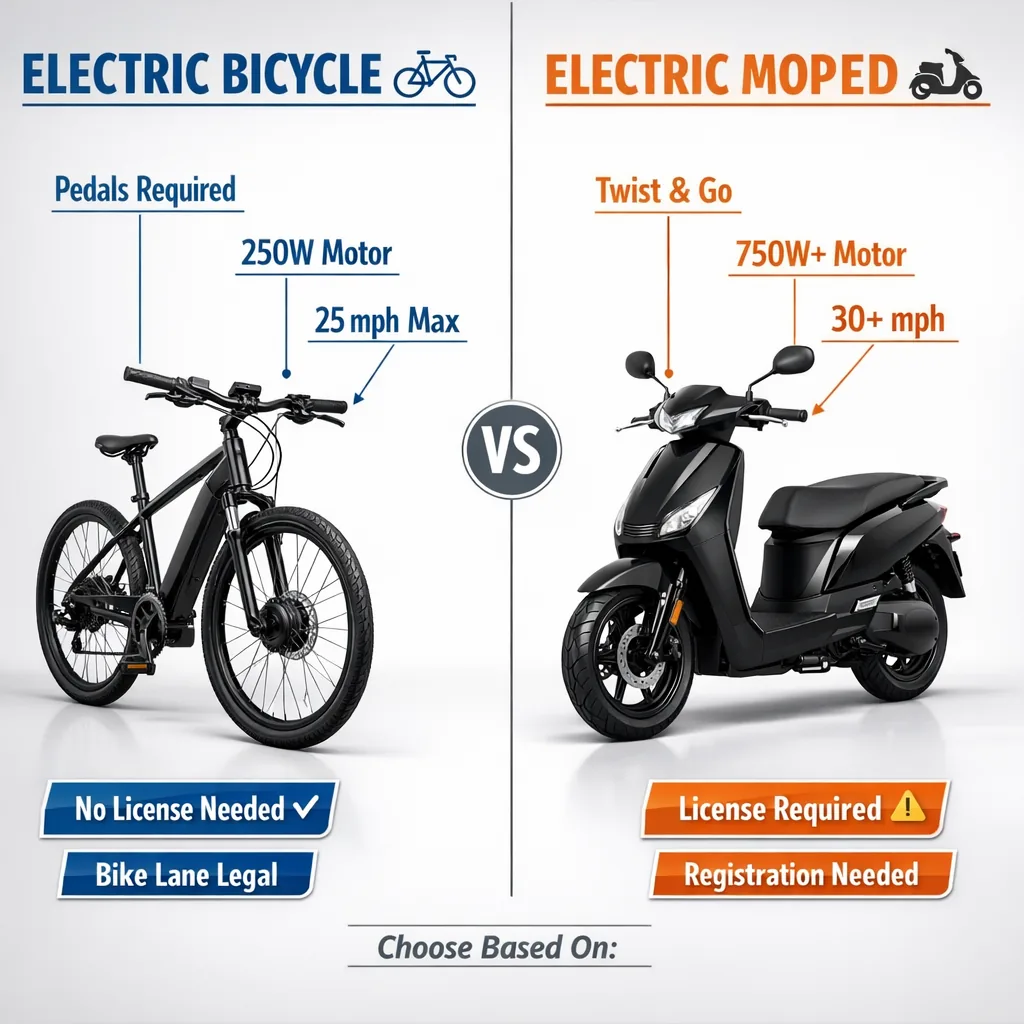
Moped: Virginia defines a moped as a vehicle with no more than three wheels touching the ground, a seat at least 24 inches high, a gasoline, electric, or hybrid motor of 50cc or less or 1,500 watts or less, and a top speed no greater than 35 mph.
Electric power-assisted bicycle: Virginia defines an e-bike as a pedal bike with a seat and an electric motor of no more than 750 watts, then splits it into class 1, class 2, and class 3.
Motor-driven cycle: Virginia separately defines a motor-driven cycle as a small motorcycle with a gasoline engine under 150cc, a seat lower than 24 inches, and no manufacturer-issued VIN. That matters because some minibike-style builds fall outside the normal moped lane.
That is the most important reader-facing takeaway in Motorized Bicycle Laws in Virginia. A modern 750-watt pedal e-bike is not handled the same way as a titled Virginia moped, and a low-seat minibike may not qualify as a moped at all.
Motorized Bicycle Laws in Virginia for mopeds
Virginia's moped lane is broader than just tiny gas scooters
Virginia's moped definition covers more than the classic 49cc scooter. The category can also include an electric or hybrid machine, with or without pedals, so long as it stays within the seat-height, wattage / displacement, and 35 mph limits in Virginia Code § 46.2-100.
Virginia title and registration matter for mopeds
Virginia DMV says a moped that will be operated on Virginia roadways must be titled and registered to receive a title. DMV lists ownership documents, a completed moped certification, and the title and annual registration fees as part of that process. DMV also says you do not need insurance, an odometer reading, an electric vehicle fee, or a safety inspection just to title and register a Virginia moped.
You must be at least 16 and carry photo identification
Virginia Code § 46.2-914 says no moped may be driven on a highway by a person under 16, and every person driving a moped must carry a government-issued photo ID that includes name, address, and date of birth. Virginia DMV's current moped page matches that posture by requiring photo ID, not a driver's license, for normal moped operation.
Virginia requires helmets and eye protection for mopeds
Virginia Code § 46.2-915.2 requires every person operating a moped on a public street or highway to wear a face shield, safety glasses, or goggles unless the moped has safety glass or a windshield. The same section requires protective helmets for the operator and any passenger.
Mopeds stay out of the interstate and out of the motorcycle lane
Virginia Code § 46.2-914 caps moped operation at 35 mph and bars mopeds from the Interstate Highway System. If a vehicle is operated faster than 35 mph, Virginia treats it as a motorcycle for purposes of the title.
Virginia's real-world split is simple: if the machine fits the 750-watt pedal e-bike definition, it gets the bicycle-style rule set. If it fits the broader 35 mph moped definition instead, it gets the moped rule set.
Motorized Bicycle Laws in Virginia for electric power-assisted bicycles
Virginia uses class 1, class 2, and class 3 e-bike definitions
Virginia defines a class 1 e-bike as pedal-assist only up to 20 mph, a class 2 as throttle-capable up to 20 mph, and a class 3 as pedal-assist up to 28 mph. To stay in Virginia's electric-bicycle lane, the bike must have pedals, a seat, and an electric motor of no more than 750 watts.
Virginia gives e-bikes bicycle treatment and broad paperwork exemptions
Virginia Code § 46.2-904.1 says an electric power-assisted bicycle and its operator generally get the same rights and duties as a bicycle rider. The same section also says e-bikes are not subject to Virginia's driver-license, registration, title, financial-responsibility, off-highway motorcycle, or license-plate requirements.
Virginia generally allows e-bikes where bicycles are allowed
Virginia says an electric power-assisted bicycle may be ridden where bicycles are allowed, including streets, highways, roads, shoulders, bicycle lanes, and bicycle or shared-use paths. But Virginia also gives localities or state agencies room to prohibit class 1 or class 2 e-bikes on a bicycle or shared-use path after notice and hearing, prohibit class 3 e-bikes on such a path, and regulate e-bike use on certain natural-surface nonmotorized trails.
Sidewalk and crosswalk use can still be narrowed locally
Virginia Code § 46.2-904 allows local governments to prohibit riding bicycles, motor-driven cycles, and electric power-assisted bicycles on designated sidewalks or crosswalks. Where sidewalk or shared-use-path riding is allowed, the rider must yield to pedestrians and give an audible signal before passing.
Virginia's helmet rules differ by e-bike situation
Virginia requires each operator and passenger of a class 3 electric power-assisted bicycle to wear a properly fitted and fastened bicycle helmet. Separately, Virginia lets counties, cities, and towns require helmets by ordinance for riders age 14 or younger on bicycles and electric power-assisted bicycles on highways, sidewalks, or public bicycle paths.
Virginia generally allows e-bikes where bicycles are allowed, but local or agency rules can still narrow access on some shared-use paths, trails, sidewalks, and crosswalks.
What is different in Virginia?
Virginia's moped definition is broader than many riders expect, because it can include certain gas, electric, or hybrid machines up to 1,500 watts or 50cc and 35 mph.
Virginia's e-bike definition is much narrower, capped at 750 watts and tied to class 1, 2, and 3 pedal-bike rules.
A Virginia moped must be titled and registered, but DMV says it does not need insurance or a safety inspection just for that title / registration lane.
Virginia does not require a driver's license for normal moped use, but it does require age 16+ and a government-issued photo ID.
Virginia requires helmets and eye protection for mopeds, while e-bike helmet rules are narrower and mostly tied to class 3 or local youth ordinances.
Virginia generally lets e-bikes use bicycle infrastructure, but local or agency rules can still restrict some shared-use paths, trails, sidewalks, or crosswalks.
Virginia separately defines a motor-driven cycle, so some minibike-style machines do not fit the moped box even if riders casually call them “motorized bikes.”
Common rider situations under Motorized Bicycle Laws in Virginia
If you bought a 49cc scooter with a tall seat and a 35 mph top end
You are probably in Virginia's moped lane. That means title, registration, photo ID, age 16+, helmet, eye protection, and no-interstate rules matter first.
If you bought a 750-watt class 2 pedal e-bike
You are usually in Virginia's electric power-assisted bicycle lane, not the moped lane. That means no title, registration, or driver's license requirement, but bicycle-style traffic rules and local path restrictions still apply.
If your bike-shaped machine has no pedals or pushes past the e-bike limits
Once you move outside Virginia's e-bike definition, you need to re-check whether the machine fits the moped definition or moves up into motorcycle or motor-driven-cycle territory. Do not assume that every electric machine is automatically treated like a bicycle.
If you want to use a shared-use path, trail, sidewalk, or crosswalk
Virginia is generally friendly to e-bikes where bicycles are allowed, but path and trail rules are not universal. Local governments and agencies can restrict some facilities, and sidewalk or crosswalk use can also be prohibited by local rule.
Official Virginia sources
Virginia Code § 46.2-100 — definitions for mopeds, electric power-assisted bicycles, and motor-driven cycles
This page is for general informational purposes only and is not legal advice. Virginia statutes, DMV procedures, local ordinances, and trail rules can change. Verify the current rules before riding on roads, bike lanes, shared-use paths, sidewalks, or trails.
Warranty Protection
Have a problem? Bike repairs and replacement parts are covered through our manufacturer warranty for up to two years after purchase.
Verified Secure Checkout
Your information is kept 100% protected and private. Payments are handled through trusted third-party providers and never stored on our servers.
To provide the best experiences, we use technologies like cookies to store and/or access device information. Consenting to these technologies will allow us to process data such as browsing behavior or unique IDs on this site. Not consenting or withdrawing consent, may adversely affect certain features and functions.
Functional
Always active
The technical storage or access is strictly necessary for the legitimate purpose of enabling the use of a specific service explicitly requested by the subscriber or user, or for the sole purpose of carrying out the transmission of a communication over an electronic communications network.
Preferences
The technical storage or access is necessary for the legitimate purpose of storing preferences that are not requested by the subscriber or user.
Statistics
The technical storage or access that is used exclusively for statistical purposes.The technical storage or access that is used exclusively for anonymous statistical purposes. Without a subpoena, voluntary compliance on the part of your Internet Service Provider, or additional records from a third party, information stored or retrieved for this purpose alone cannot usually be used to identify you.
Marketing
The technical storage or access is required to create user profiles to send advertising, or to track the user on a website or across several websites for similar marketing purposes.